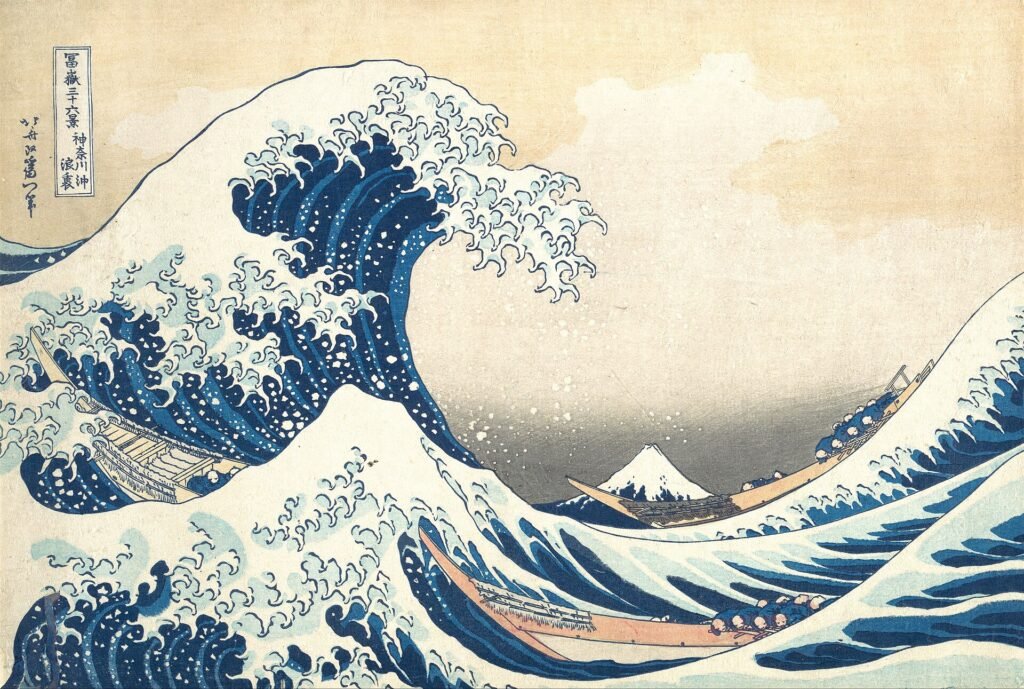
The Great Wave off Kanagawa is a Japanese woodblock print by Katsushika Hokusai, made around 1830 to 1833 as part of the series Thirty-Six Views of Mount Fuji. Its Japanese title is Kanagawa oki nami ura, which means Under the Wave off Kanagawa, and The Great Wave is an English nickname. It shows a towering wave above three boats, with a small Mount Fuji in the distance.
Background and creation of The Great Wave off Kanagawa
Hokusai (1760 to 1849) began the Fuji series in 1830, when he was 70 years old. The Art Institute of Chicago reports that his late 60s had been difficult, with a stroke, the death of his wife and a grandson whose gambling debts threatened the family. The publisher Nishimuraya Yohachi then commissioned a new series, and the success of the Fuji prints led Hokusai to write that nothing he had done before 70 was worth bothering with.
Dates vary slightly by institution. The Art Institute gives 1830 to 1833, the Nelson-Atkins Museum of Art gives about 1831, and the Metropolitan Museum of Art gives about 1830 to 1832. A print from the period measures roughly 25 by 37 centimeters, and the Great Wave is an oban, the standard large print format.
The subject had precedents and a personal side. Mount Fuji was a sacred site, and the Art Institute notes that Hokusai belonged to a religion centered on the mountain, which flourished in the Edo period (1615 to 1868). The museum also points to the painter Soga Shohaku’s screens of about 1761 to 1762 as a direct antecedent of Hokusai’s images of the mountain.
Description of The Great Wave off Kanagawa
A huge wave curls over the left and center of the image, its crest breaking into fingers of foam. Beneath it, three narrow boats crowded with rowers ride the swell. Mount Fuji appears small and snow-capped in the gap beneath the crest, framed by the wave and the sky.
The Art Institute stresses how much blue the print contains. Hokusai used both traditional indigo and Berlin blue, popularly known as Prussian blue, a newly affordable pigment imported from Europe. The many shades of sea and sky would have looked novel to its first viewers, and the color is part of the print’s appeal.
The title and series name appear in a rectangular cartouche at the upper left, with the artist’s signature beside it. On the Chicago impression the signature reads Hokusai aratame Iitsu fude, and the publisher is recorded as Nishimura-ya Yohachi.
Themes and interpretation of The Great Wave off Kanagawa
Mount Fuji is the subject of the whole series, which shows the peak from many angles, in different seasons and in all kinds of weather. In some prints it fills the scene. In the Great Wave it is small and far away, so a viewer has to look for it. The contrast between a vast wave and a distant, calm mountain is the main idea of the composition.
The Art Institute also suggests that the first Japanese viewers may have found the image even more threatening than modern ones do. Because Japanese is read from right to left, they would probably have met the boatmen first and then the great claw of water about to swallow them. A viewer reading in the opposite direction instead seems to ride along with the wave.
Hokusai’s work is sometimes read as a record of human fragility set against natural power. That is a modern interpretation, and the museum sources describe the print more simply as a view of the mountain from the sea.
Printing, editions and survival of The Great Wave off Kanagawa
The Great Wave is a print and not a painting. A curator at the Art Institute explains that it was produced commercially for the mass market, with thousands of copies and different editions made over many years, even after the artist’s death. Only about 100 original prints are thought to survive. The Art Institute owns three, and all are later impressions than the first state of the design.
Because color and paper fade in light, the museum shows its prints only for three to four months every five years. Other museums, including the Nelson-Atkins Museum of Art and the Metropolitan Museum of Art, also hold impressions, which is why the image is so widely reproduced.
Reception and legacy of The Great Wave off Kanagawa
The Art Institute says the Fuji series made landscape prints popular, a popularity that continues today. The series sold so well that ten more prints were added a few years after the first 36, and Hokusai later published a three-volume book, One Hundred Views of Mount Fuji. The Great Wave is the most famous image from the set.
Its influence has been wide. The composer Claude Debussy owned a copy of the print, and the first edition of his 1905 score for La Mer used a detail of it on the cover. The poet Rainer Maria Rilke’s 1908 poem The Mountain is thought to have been inspired by it. The sculptor Camille Claudel replaced the boats with three women holding hands in her onyx piece The Wave or the Bathers.
The Art Institute adds that Vincent van Gogh admired Japanese prints, writing to his brother Theo in September 1888 that the waves in one of them were claws. It has been suggested that the print influenced Van Gogh‘s own swirling blue night painting, The Starry Night. The image has also become an emoji and was due to appear on a new Japanese banknote in 2024, according to the museum.
The print’s setting ties it to Japan and to the tradition of printmaking in the Edo period.
More in Visual Arts
Key facts
- The Great Wave is a woodblock print by Katsushika Hokusai, made about 1830 to 1833 as part of Thirty-Six Views of Mount Fuji.12
- Its Japanese title, Kanagawa oki nami ura, means Under the Wave off Kanagawa; The Great Wave is an English nickname.2
- Hokusai began the series at age 70, and the publisher was Nishimura-ya Yohachi.12
- The print uses both indigo and imported Berlin blue, also called Prussian blue.2
- The Art Institute of Chicago owns three original-edition prints, all later impressions than the first state.12
Related concepts
Quick checkIs The Great Wave off Kanagawa a painting?Show answer
No. It is a woodblock print made commercially for the mass market, and thousands of copies were printed over many years.
Sources
- Art Institute of Chicago, Under the Wave off Kanagawa (Kanagawa oki nami ura), also known as The Great Wave (collection record), https://www.artic.edu/artworks/24645/under-the-wave-off-kanagawa-kanagawa-oki-nami-ura-also-known-as-the-great-wave-from-the-series-thirty-six-views-of-mount-fuji-fugaku-sanjurokkei
- Art Institute of Chicago, 10+ Things to Know about The Great Wave, 27 August 2024, https://www.artic.edu/articles/1139/10-things-to-know-about-the-great-wave
- Nelson-Atkins Museum of Art, Under the Wave off Kanagawa (collection record), https://art.nelson-atkins.org/objects/5975/under-the-wave-off-kanagawa
- Metropolitan Museum of Art, Under the Wave off Kanagawa (object record, accession details via Google Arts & Culture), https://artsandculture.google.com/asset/WwGO0e-2fXG1dg
Editorially reviewed by Specialty Digest Editorial TeamLast reviewed November 5, 2026Researched and drafted with AI assistanceReport an issue