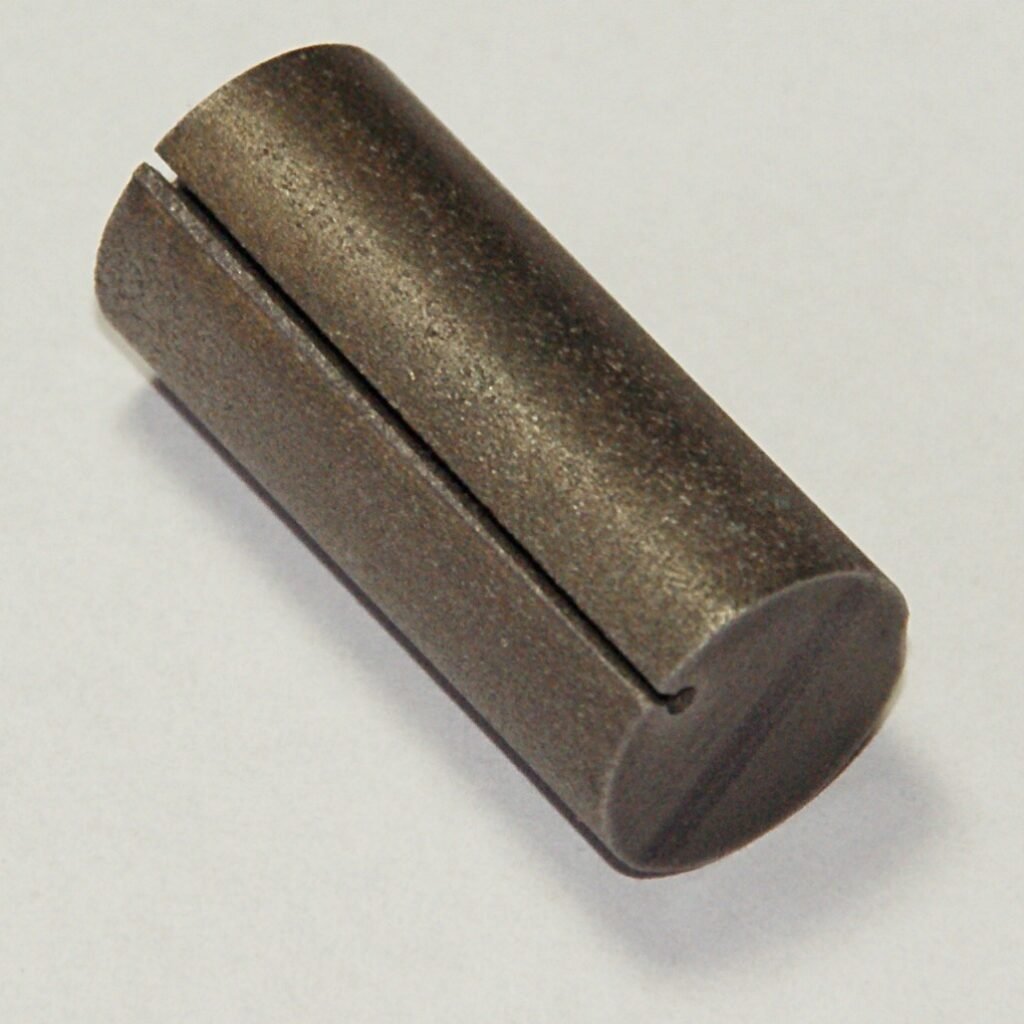
Tungsten is the chemical element with atomic number 74 and the symbol W. It is a shiny, silvery-white metal with the highest melting point of all metals, at about 3422 degrees Celsius. Tungsten and its alloys are used in high-temperature equipment, and tungsten carbide is a leading material for cutting and drilling tools.
History of tungsten
More than 350 years ago, porcelain makers in China gave their designs a unique peach color by using a tungsten pigment that was not known in the West. European chemists did not become aware of the element until about a century later.
In 1779 Peter Woulfe examined a mineral from Sweden and concluded that it contained a new metal, although he did not separate it. In 1781 Wilhelm Scheele investigated the same mineral and succeeded in isolating an acidic white oxide, which he correctly deduced was the oxide of a new metal.
Credit for the discovery goes to the brothers Juan and Fausto Elhuyar, who were interested in mineralogy and were based at the Seminary at Vergara in Spain. In 1783 they produced the same acidic metal oxide and reduced it to tungsten metal by heating it with carbon. PubChem lists 1783 as the year of discovery.
The discovery therefore involved several people over four years, from Woulfe in 1779 to the Elhuyar brothers in 1783, and each contributed a step toward separating the metal.
Properties of tungsten
PubChem, drawing on IUPAC data, gives tungsten a standard atomic weight of 183.84. Its electron configuration is [Xe] 6s2 4f14 5d4. Tungsten sits in group 6 and period 6 of the periodic table and is classed as a transition metal, one of the elements in the central block of the table. These elements can often form compounds in several oxidation states, and the Royal Society of Chemistry lists oxidation states of 6, 5, 4, 3, 2 and 0 for tungsten, with 6 the most common.
Tungsten is a solid with a density of 19.3 grams per cubic centimeter, more than 19 times the density of water. It melts at 3695 kelvin, about 3422 degrees Celsius, and boils at 5828 kelvin, about 5555 degrees Celsius. The Royal Society of Chemistry states that tungsten has the highest melting point of all metals, and this single property accounts for most of its industrial importance. The two sources differ on the electronegativity of tungsten, giving 2.36 and 1.7 on the Pauling scale, so no single value is quoted here.
The first ionization energy of tungsten, the energy needed to remove one electron from a neutral atom, is 7.98 electronvolts, or about 759 kilojoules per mole. The covalent radius, half the distance between two atoms joined by a single bond, is 150 picometers. The Royal Society of Chemistry gives an electron affinity of 78.757 kilojoules per mole, which is the energy released when a neutral atom picks up an electron.
Occurrence and production of tungsten
An ore is a rock or mineral from which a metal can be extracted. The principal tungsten-containing ores are scheelite and wolframite. Tungsten does not occur as a free metal in these ores but is combined with oxygen in its compounds.
The metal is obtained commercially by reducing tungsten oxide with hydrogen or carbon. Reduction means removing oxygen from a compound, so that the hydrogen or carbon combines with the oxygen and leaves metallic tungsten behind. The use of carbon echoes the method that the Elhuyar brothers applied in 1783.
Uses of tungsten
Tungsten was used extensively for the filaments of old-style incandescent light bulbs, but these bulbs have been phased out in many countries. They are not very energy efficient, because they produce much more heat than light. The high melting point of tungsten allowed the filament to glow white-hot without melting.
A filament needs a metal that stays solid at the temperature at which it glows, which explains the choice. Tungsten is also alloyed with other metals to strengthen them. An alloy is a metal mixed with one or more other elements to improve its properties. Tungsten and its alloys are used in many high-temperature applications, such as arc-welding electrodes and heating elements in high-temperature furnaces.
Tungsten carbide is immensely hard and is very important to the metal-working, mining and petroleum industries. It is made by mixing tungsten powder and carbon powder and heating the mixture to 2200 degrees Celsius. It makes excellent cutting and drilling tools, including a new type of painless dental drill that spins at ultra-high speeds. Calcium and magnesium tungstates are widely used in fluorescent lighting.
Isotopes of tungsten
Tungsten has five naturally occurring isotopes: tungsten-184 at 30.64 percent, tungsten-186 at 28.43 percent, tungsten-182 at 26.5 percent, tungsten-183 at 14.31 percent and tungsten-180 at 0.12 percent. An isotope is a form of an element whose atoms have the same number of protons but different numbers of neutrons.
The Royal Society of Chemistry lists all five as undergoing alpha decay, a form of radioactive change in which an atom emits a helium nucleus. The half-lives are extremely long. Tungsten-180 has a half-life of about 1.8 times 10 to the 18th years, and the other four are listed as greater than 4.1 times 10 to the 21st years. In practice, natural tungsten behaves as a stable element.
Tungsten in life and the environment
The Royal Society of Chemistry notes that tungsten is the heaviest metal known to have a biological role. Some bacteria use tungsten in an enzyme, a protein that speeds up a chemical reaction, to reduce carboxylic acids to aldehydes. These are two families of organic compounds, and the reaction converts one into the other.
The Royal Society of Chemistry does not list tungsten as a hazard in the way that it does for mercury or lead. This entry gives general background drawn from reference sources and is not advice.
Key facts
- Tungsten has atomic number 74, symbol W, and sits in group 6 and period 6 of the periodic table.2
- Tungsten has the highest melting point of all metals, 3695 kelvin or about 3422 degrees Celsius.1
- Juan and Fausto Elhuyar produced tungsten metal in 1783 at Vergara, Spain.1
- The principal ores of tungsten are scheelite and wolframite.1
- Tungsten has five naturally occurring isotopes, the most abundant being tungsten-184 at about 30.6 percent.1
In the news
Quick checkWhich metal has the highest melting point?Show answer
Tungsten has the highest melting point of all metals, at about 3422 degrees Celsius, which is why it was used for incandescent bulb filaments and is alloyed for high-temperature equipment.
Sources
- Royal Society of Chemistry, Periodic Table: Tungsten, https://periodic-table.rsc.org/element/74/tungsten
- National Center for Biotechnology Information, PubChem Periodic Table: Tungsten (element 74, including IUPAC-sourced atomic weight data), https://pubchem.ncbi.nlm.nih.gov/element/74
Editorially reviewed by Specialty Digest Editorial TeamLast reviewed November 4, 2026Researched and drafted with AI assistanceReport an issue