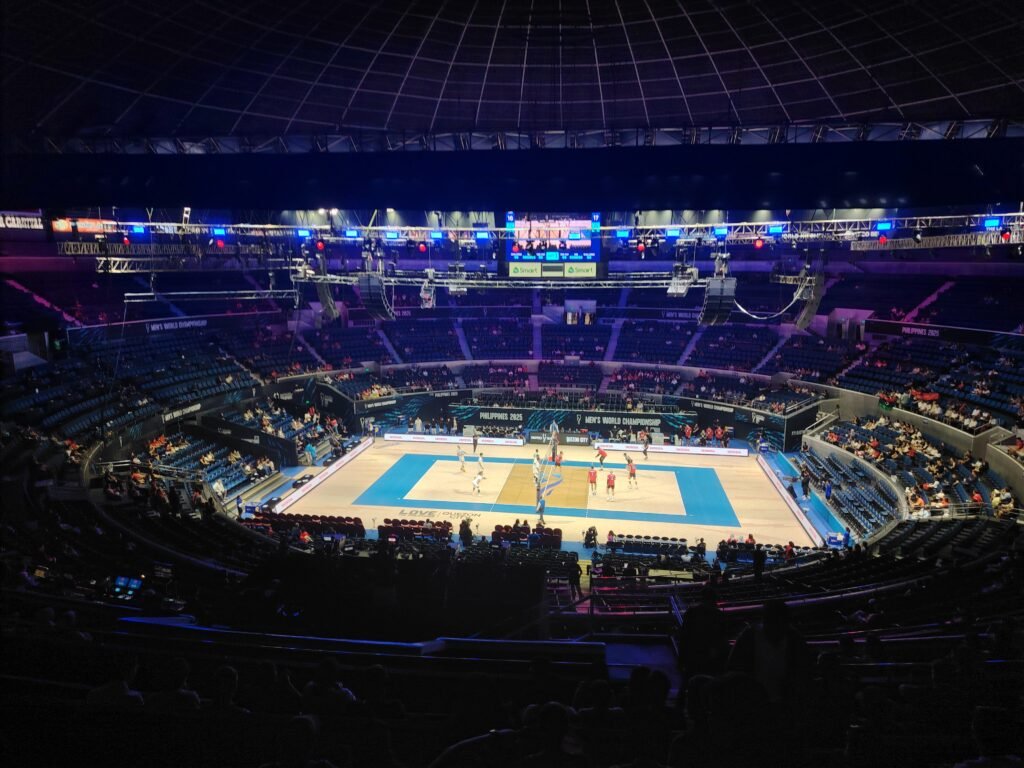
Volleyball is a team sport in which two teams of six players, separated by a high net, try to ground the ball on the opponent’s side of the court. It was invented in 1895 by William G. Morgan, a YMCA physical director in Holyoke, Massachusetts, as a less strenuous alternative to basketball. It is governed internationally by the Federation Internationale de Volleyball (FIVB), and it has been an Olympic sport since 1964.
History of volleyball
William G. Morgan was a physical education director at the Holyoke YMCA in Massachusetts. He created a gentler game for older men, and the first game of what he called Mintonette was played in December 1895. The original game had no limit on the number of players, and each side could hit the ball as many times as it liked before it crossed the net.
The game was introduced at a YMCA conference at Springfield College in 1896. The International Volleyball Hall of Fame describes the first Springfield showing as about eight months after the first game. Alfred T. Halstead proposed the name Volley Ball because the object was to volley the ball back and forth, and it was accepted. The name became one word in 1952.
Rules were published in the July 1896 issue of Physical Education, and they appeared in the first official handbook of the North American YMCA Athletic League in 1897. In 1916 the YMCA persuaded the NCAA to publish the rules. A Spalding guide that year estimated 200,000 players in the United States.
The rules took modern form in stages. The points needed to win a set fell from 21 to 15 in 1917. Teams were limited to six players in 1918, and each side was limited to three ball contacts in 1922.
Rules and how volleyball is played
Each team has six players in competition, three in the front row near the net and three in the back. When a team wins the right to serve, its players rotate clockwise one position, so every player other than the libero eventually plays in both the front row and the back row. The libero is a defensive specialist who wears a different color and does not rotate to the front line. Under FIVB rules the libero does not serve and cannot complete an attack hit if the ball is above the net at contact.
Britannica describes rally scoring, in which either team can score on any rally and a successful play earns one point. A set is won by the first team to 25 points with a lead of at least two points, so a set can run past 25 when the teams are level at 24. A match is best of five sets, and the fifth set goes to 15 points, also with a lead of at least two.
Teams are limited to three ball contacts before the ball must cross the net. That limit dates to 1922, and it is one reason volleyball relies on a sequence of receive, set and attack.
Equipment and venues
The court measures 9 meters by 18 meters (30 by 60 feet) and is divided into two equal halves by a center line. The net stands about 2.4 meters (8 feet) high for men and 2.2 meters (7.4 feet) for women, measured in the middle of the court.
Because the game was designed for older men at a YMCA, its first rules were relaxed, with no cap on the number of players or on how many times a side could hit the ball.
Indoor volleyball needs little more than a ball, a net and posts. Beach volleyball moves the game outdoors to sand. The sources opened for this entry do not state the number of players per beach team, so it is not given here. The beach game joined the Olympic program at Atlanta in 1996. The first FIVB Beach Volleyball World Championships followed in 1997.
Governing bodies and major competitions
Olympics.com places the founding of the FIVB in Paris in 1947 by 14 nations, although the FIVB’s own history page, as read for this entry, gives no founding date. The FIVB says it has 220 affiliated national federations and calls itself the largest international sporting federation in the world.
The first men’s World Championships were held in Prague in 1949, and the women’s event followed in Moscow in 1952. The FIVB also runs the World League, the World Grand Prix, the World Cup and the Grand Champions Cup. The IOC granted indoor volleyball Olympic status in 1957, and the sport made its Olympic debut at the Tokyo Games in 1964.
Volleyball vs. basketball
The two games share a birthplace region and a purpose. Basketball was invented in Springfield, Massachusetts, in 1891, and Morgan designed volleyball in 1895 as a less strenuous alternative to it. Basketball reached the Olympic Games in 1936, and volleyball followed in 1964.
Their international federations differ as well. FIBA, founded in 1932, governs basketball, and the FIVB, founded in 1947 according to Olympics.com, governs volleyball.
Notable moments in volleyball history
Canada became the first foreign country to adopt volleyball in 1900. Franklin H. Brown introduced the game to Japan in 1908, and Elwood S. Brown took it to the Philippines in 1910. Volleyball was included in the first Far-Eastern Games, held in Manila in 1913.
William Morgan was born on January 23, 1870, in Lockport, New York, and died on December 27, 1942. He was inducted as the first member of the International Volleyball Hall of Fame in 1985.
Volleyball around the world
The YMCA network carried volleyball abroad, much as it had carried basketball a few years earlier. The first foreign adoptions were in Canada and then in Asia.
Today the FIVB’s 220 federations span every region, and its competitions include indoor and beach events for men and women.
Key facts
- William G. Morgan invented volleyball in 1895 at the Holyoke YMCA in Massachusetts.13
- The FIVB was founded in Paris in 1947 by 14 nations, and volleyball made its Olympic debut in 1964.1
- The number of players per team was set at six in 1918, and each side was limited to three contacts in 1922.2
- A volleyball court is 9 meters by 18 meters, and a set is won at 25 points with a two-point lead.4
- Beach volleyball joined the Olympic program at Atlanta in 1996.12
Related concepts
Quick checkWho invented volleyball?Show answer
William G. Morgan, a YMCA physical director, invented it in Holyoke, Massachusetts in 1895 as a gentler alternative to basketball, and called it Mintonette.
Sources
- Olympics.com, History of volleyball: From origins to the Olympics, https://www.olympics.com/en/news/what-history-volleyball-game-origin-mintonette-ymca-fivb-olympics
- FIVB, History of volleyball, https://www.fivb.com/volleyball/the-game/history/
- International Volleyball Hall of Fame, William G. Morgan, https://www.volleyhall.org/william-g-morgan.html
- Britannica, Volleyball: The game, https://www.britannica.com/sports/volleyball/The-game
Editorially reviewed by Specialty Digest Editorial TeamLast reviewed November 4, 2026Researched and drafted with AI assistanceReport an issue