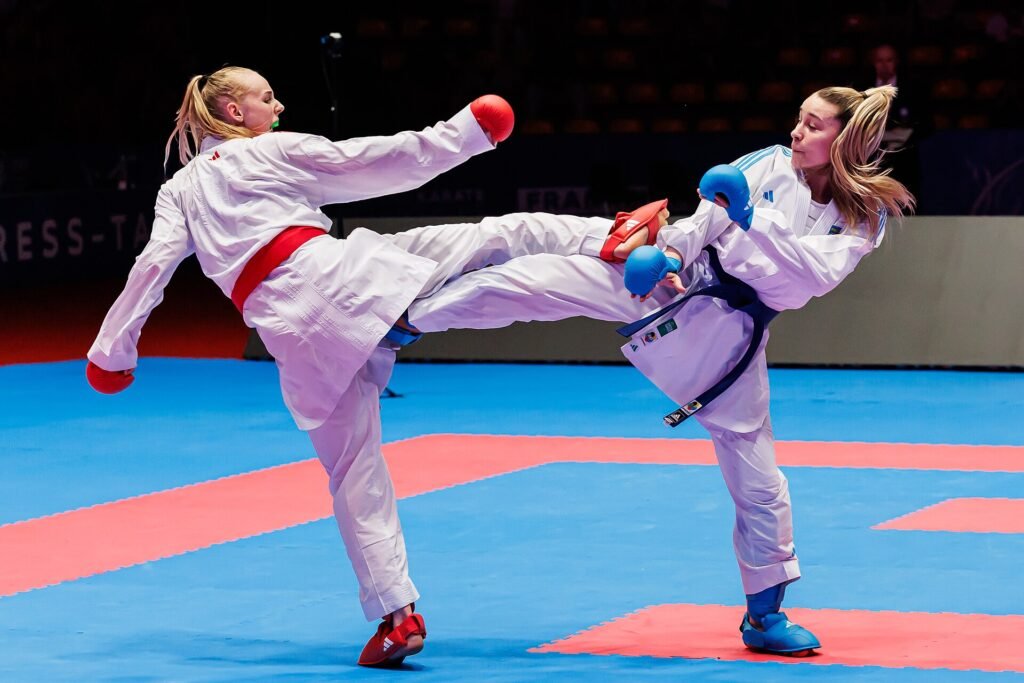
Karate is a martial art and combat sport, developed on the island of Okinawa, in which practitioners strike with the hands and feet. Competitive karate has two main events, kumite, which is sparring, and kata, which is a performance of prescribed movements, and it is governed worldwide by the World Karate Federation.
History of karate
Karate emerged in the 14th century on Okinawa, then the Ryukyu Kingdom. During the reign of Shō Shin, which ended in 1527, and later under the rule of the Satsuma domain, which began in 1609, residents were barred from bearing arms. A weaponless fighting system developed from local martial arts that had been influenced by Chinese fighting styles.
In the first decade of the 20th century, karate began to be taught in Okinawan schools as physical education. In 1922 the Okinawan instructor Funakoshi Gichin demonstrated karate in Tokyo at the First Physical Education Exhibition, hosted by the Ministry of Education, which was its first presentation on mainland Japan.
The art then spread through universities, and in 2016 karate was selected for the Tokyo 2020 Olympics. Keio University opened a karate club in 1924, and the University of Tokyo, then Tokyo Imperial University, followed in 1926. The first All Japan University Karate Tournament was held in Tokyo in 1957, and the Japan Karatedo Federation was formed in 1964.
Rules and scoring in karate
Competitive karate is mostly held in the kata and kumite formats. In kumite, two athletes spar under rules that award points for controlled techniques to scoring areas.
Under the World Karate Federation rules for 2026, a senior bout lasts three minutes. Cadet and junior bouts last two minutes and bouts for athletes under 14 last one and a half minutes. In tournaments without limits on entries, elimination bouts may be shortened, from three minutes to two or from two to one and a half, if this is announced before the event.
A yuko is worth one point and is scored with a straight punch or a strike to a scoring area. A waza-ari is worth two points and is scored with a kick to the body. An ippon is worth three points and is scored with a kick to the head, or with any legal technique that lands while the opponent has a body part other than the feet touching the mat.
The rules forbid many actions. They include excessive contact, any contact to the throat, attacks to the arms, legs, groin, joints or instep, open-hand attacks to the face, and strikes with the head, knees or elbows. Kicks against an opponent lying flat on the floor, dangerous throws and grabbing below the waist to lift or pull an opponent’s legs are also prohibited.
Equipment and venues for karate
Kumite takes place on a matted square with sides of 8 meters, measured from the outside. The outer 1-meter band is a different color and marks the boundary, and a 2-meter safety area surrounds the competition area, with at least 2 meters between areas.
Protective equipment is compulsory. Athletes wear WKF-approved mitts, in red for one athlete and blue for the other, a gum shield, a body protector for men, a chest and body protector for women, shin pads and foot protection in the same colors, and a groin guard for men. The red and blue colors let officials and spectators tell the two competitors apart at a glance.
Athletes under 14 also wear a WKF-approved helmet and an external body protector. Women under 14 need a WKF-approved chest protector as well.
Governing bodies and major competitions
Nippon.com dates the establishment of the World Karate Federation in Japan to 1970, the year the first Karate World Championships were held at the Budokan in Tokyo. Olympedia adds that the body was known as the World Union of Karate-do Organizations until 1990. It had 201 member federations in January 2026.
Karate was contested at the World Games from its inaugural edition in 1981, with kata and kumite events continuously held since. It appeared at the Youth Summer Olympics at Buenos Aires in 2018.
Karate made its Olympic debut at the Tokyo Games of 2020, with eight events: a kata event for men and for women, and three kumite weight classes for each gender. It was an optional sport for those Games, and as of 2024 the Games in Japan remain its only Olympic appearance.
Records and notable moments in karate
Each of the eight Olympic karate titles went to a different nation: Bulgaria, Egypt, France, Iran, Italy, Japan, Serbia and Spain. Olympedia lists the Olympic gold medalists as including Ivet Goranova of Bulgaria, Feryal Ashraf of Egypt and Sandra Sánchez of Spain.
In the all-time Olympic medal table, Japan has three medals, one of each color. Spain, Egypt and Italy have two each, and Türkiye leads in total medals with four, though without a gold.
Before its Olympic debut, karate had been contested at the World Games since 1981. Women competed in only a single kata event at the first edition, but all later editions have included kata and kumite for both genders.
At the 2018 Youth Olympics in Buenos Aires, Japan and Iran each won four karate medals, and gold medals went to six different nations: Japan, Iran, Belgium, Egypt, Saudi Arabia and Norway.
Global participation in karate
The WKF reported 201 member federations in January 2026, and Olympic karate medals have gone to 20 national teams. Medalists include Egypt, Azerbaijan, China, Ukraine, Saudi Arabia, Kazakhstan and the United States.
Olympedia notes that there are multiple styles and schools of karate, so the Olympic format of kata and kumite covers only part of how the art is practiced worldwide.
More in Sports Coaching and Performance
Key facts
- Karate emerged on Okinawa in the 14th century, and Funakoshi Gichin first demonstrated it in Tokyo in 1922.2
- Nippon.com dates the World Karate Federation to 1970, when the first Karate World Championships were held.21
- Karate made its only Olympic appearance to date at Tokyo 2020, with eight events.1
- In WKF kumite, a yuko scores 1 point, a waza-ari 2 points and an ippon 3 points.3
- The kumite competition area is a matted square 8 meters on each side.3
Related concepts
Quick checkWhat are the two main events in competitive karate?Show answer
The two main events are kumite, which is sparring scored by points, and kata, which is a performance of prescribed movements. Both were contested at the Tokyo 2020 Olympics.
Sources
- Olympedia, Karate (discipline overview, with WKF history and Olympic medal data), olympedia.org, https://www.olympedia.org/sports/KTE
- Nippon.com, Karate history, nippon.com, https://www.nippon.com/en/articles/-/12662
- World Karate Federation, WKF Kumite Competition Rules 2026, wkf.net, https://www.wkf.net/files/pdf/documents/WKF_2026_Kumite_Competition_Rules_MASTER_COPY_V12.pdf
Editorially reviewed by Specialty Digest Editorial TeamLast reviewed November 4, 2026Researched and drafted with AI assistanceReport an issue