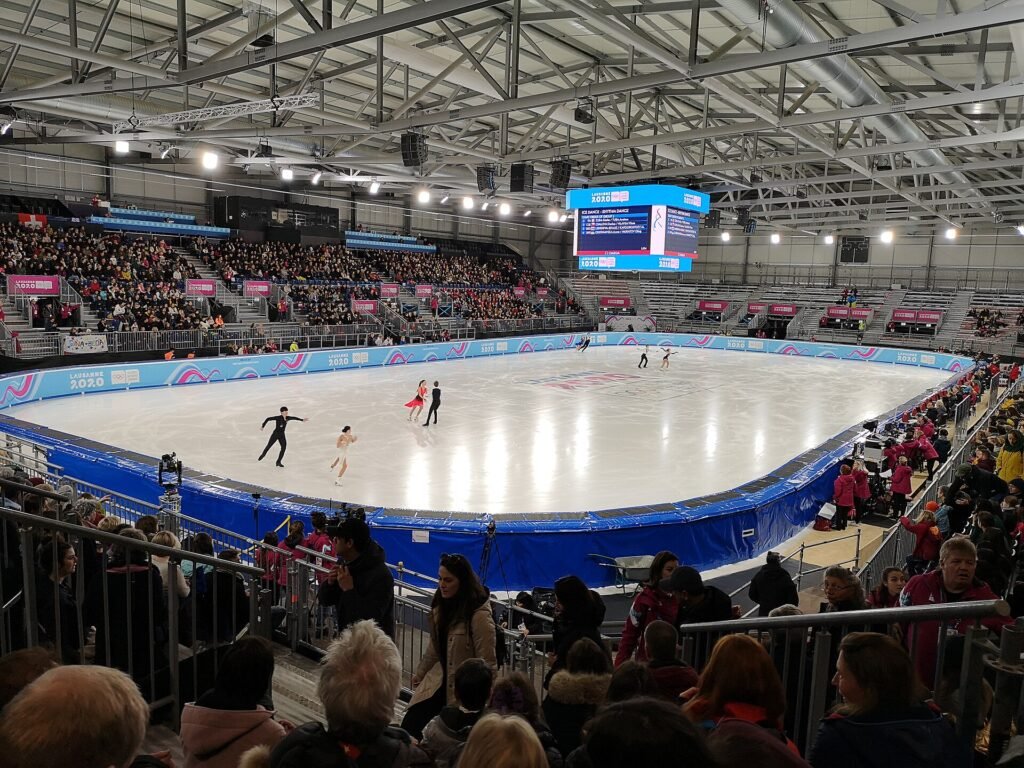
Figure skating is a winter sport in which skaters perform jumps, spins, footwork and lifts on ice, and are scored by a panel for technical difficulty and overall performance. It is contested in four main disciplines: men’s singles, women’s singles, pairs and ice dance. The International Skating Union was established on 23 July 1892 and is the sport’s governing body.
History of figure skating
Figure skating has a long place in the Olympic movement. It was first contested at the 1908 Games in London, which were summer Games, and again at the 1920 Games in Antwerp, before moving to the Winter Olympics. Compulsory figures, which required skaters to trace set patterns on the ice, were last part of the Olympic program in 1988 at Calgary. Their removal marked the move of the sport from tracing patterns toward athletic performance.
The International Skating Union, or ISU, is described by Olympedia as the first true international governing body of any winter sport. The first World Championship was held in 1896 in what is now Saint Petersburg, and the first women’s championship followed in 1906.
Through the 1972 Winter Games in Sapporo, the Olympic program had three events: men’s singles, women’s singles and pairs. Ice dance became a fourth event at Innsbruck in 1976, after it was a demonstration event at Grenoble in 1968. A mixed team event, the fifth, was added at Sochi in 2014.
Rules and how figure skating is played
Skaters compete in two segments. The first is the short program, called the rhythm dance in ice dance, and the second is the free skating, called the free dance in ice dance. The highest combined score from both segments wins.
A senior singles short program lasts no more than 2 minutes and 40 seconds, and the free skating is longer, with more elements and room for the skater’s own choreography. The technical panel assigns levels to elements in real time, so scoring happens as the program is skated.
The program’s elements include jumps, spins, step sequences, and lifts in pairs and ice dance. Jumps range from single and double jumps to triple jumps and quadruple jumps, which elite men often include once or twice in a program. Skaters can also combine jumps, for example in double-double or triple-triple combinations, and pairs perform throw jumps. In a long program, skaters must show four different types of spin.
Scoring and judging
Each program’s total score combines two parts, the Technical Element Score and the Program Component Score. A technical panel assesses each element, and each element has a base value and can earn up to four levels, with Level 4 the highest. Judges also give each element a grade of execution from plus 5 to minus 5, based on how well it was performed.
The program component score reflects the overall quality of the program, including skating skills, composition and performance. Deductions are subtracted for falls and time violations.
Under the older 6.0 system, judges gave each performance marks out of six. The International Judging System, introduced by the ISU in 2004, replaced it with a points total in which each element and component has a recorded value. The change followed a controversial pairs judging decision at the Salt Lake City Games in 2002.
Equipment and venues
Skating takes place on ice rinks, and skaters wear boots fitted with blades. Because figure skating was first held at the summer Games of 1908 and 1920, it was among the first sports to move indoors for the Olympic Games.
At the Olympic competition, a technical panel assigns levels to elements while a separate group of judges gives grades of execution and component scores. The same rink is used for singles, pairs, dance and the team event, in which results from several disciplines are combined into one competition.
Governing bodies and major competitions
The ISU, founded in 1892, governs figure skating and speed skating. As of January 2026 it had 102 member federations and two club members, and because some nations have both figure and speed skating members, 80 nations are represented. Its major events include the World Championships, the Grand Prix series, the European and Four Continents Championships, and the Olympic Games.
The Olympic Games remain the sport’s largest stage. The mixed team event added in 2014 combines results from several disciplines into a single team score.
Records and notable moments
Two skaters share the record for most Olympic medals in figure skating: Scott Moir and Tessa Virtue, both of Canada, have five each, including three golds each. Gillis Grafström of Sweden, Sonja Henie of Norway and Irina Rodnina of the Soviet Union each won three Olympic golds.
Henie won Olympic gold in 1928, 1932 and 1936, and Katarina Witt of East Germany won in 1984 and 1988, the first woman to win consecutive titles since Henie. Scott Hamilton of the United States, a four-time world champion, won the men’s Olympic gold medal in 1984, the same Games at which Jayne Torvill and Christopher Dean skated ice dance.
The United States leads the all-time figure skating medal table with 57 medals and 19 golds, and Russia has 27 medals and 15 golds. When results from the Soviet Union are added, Russia has 51 medals and 25 golds.
Global reach
The ISU’s 102 member federations come from 80 nations, and the Olympic medal table is led by the United States, Russia and the former Soviet Union. The first World Championship in 1896 and the first women’s championship in 1906 show that the sport had an organized international circuit well before the Winter Olympics began.
Figure skating is among the most visible winter sports, with competitions from junior events through the world championships and the Olympics. The sport moved from sedate competitions to a dynamic athletic contest marked by political intrigue and judging scandals, according to Britannica’s summary.
More in Sports Coaching and Performance
Key facts
- The International Skating Union was established on 23 July 1892 and is the first true international governing body of any winter sport.1
- Figure skating was first contested at the 1908 Olympics in London, and ice dance joined the program at Innsbruck in 1976.1
- The International Judging System was introduced in 2004 after a controversial pairs decision at the 2002 Winter Games.1
- Each element earns a base value and a grade of execution from plus 5 to minus 5, and scores combine technical elements and program components.3
- The ISU had 102 member federations from 80 nations as of January 2026.1
Related concepts
Quick checkWhen did ice dance become an Olympic event?Show answer
Ice dance became an Olympic event at the 1976 Winter Games in Innsbruck, after being a demonstration event at Grenoble in 1968.
Sources
- Olympedia, Figure skating, https://www.olympedia.org/sports/FSK
- Encyclopaedia Britannica, Figure skating: Programs and scoring, https://www.britannica.com/sports/figure-skating/Programs-and-scoring
- International Skating Union, How do you score points in figure skating, https://isu-skating.com/figure-skating/news/how-do-you-score-points-in-figure-skating/
Editorially reviewed by Specialty Digest Editorial TeamLast reviewed November 4, 2026Researched and drafted with AI assistanceReport an issue