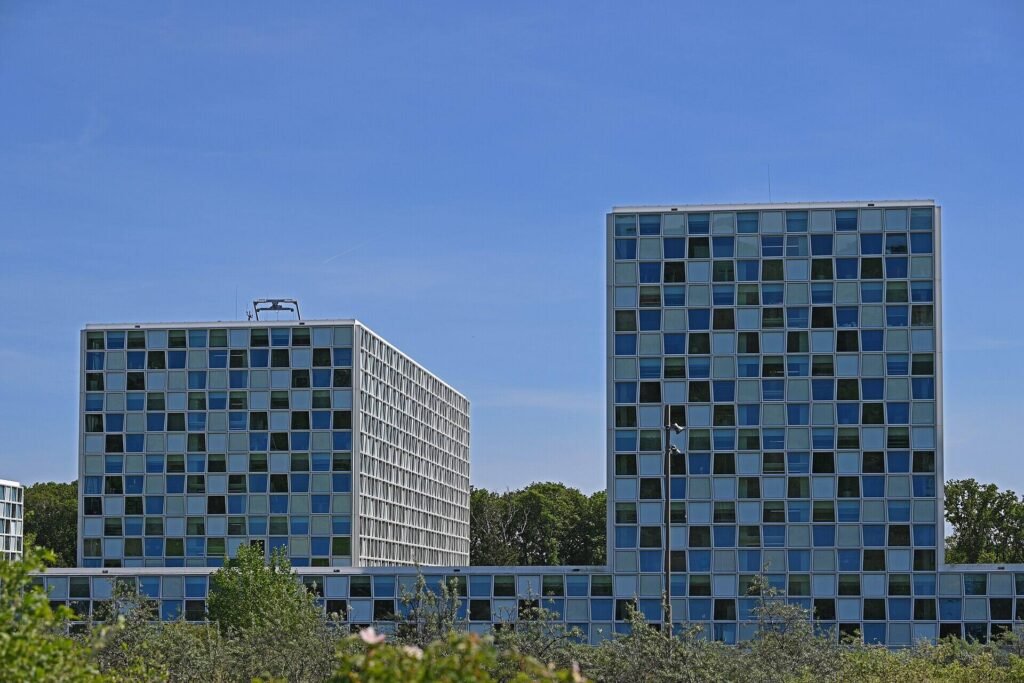
The International Criminal Court (ICC) is a permanent international tribunal in The Hague that investigates and tries individuals accused of genocide, crimes against humanity, war crimes and the crime of aggression. It is governed by a treaty called the Rome Statute, and it acts as a court of last resort that complements national courts instead of replacing them.
History of the ICC
The Nuremberg Trials after the Second World War were the first international war crimes tribunal. Many governments only came together around the idea of a permanent court in the 1990s. The United Nations had by then set up temporary tribunals for the former Yugoslavia and Rwanda, but many experts in international law considered them inefficient as deterrents.
Trinidad and Tobago asked a UN commission to look into a permanent court in 1989. The Rome Statute was adopted at a conference in Rome in July 1998 and entered into force on 1 July 2002, after more than sixty countries had ratified it.
The definition of the crime of aggression was added to the Statute at a review conference in Kampala, Uganda, in 2010. On 15 December 2017 the Assembly of States Parties agreed by consensus to activate the court’s jurisdiction over aggression from 17 July 2018.
Structure and membership of the ICC
The Rome Statute created three separate bodies: the Assembly of States Parties, the court itself and the Trust Fund for Victims. The court has four organs. The Presidency handles external relations and assigns judges and cases. The Judicial Divisions consist of 18 judges in three divisions: Pre-Trial, Trial and Appeals. The Office of the Prosecutor conducts preliminary examinations, investigations and prosecutions. The Registry handles non-judicial work such as security, interpretation, outreach and support to defense and victims’ lawyers.
Judges are elected by the member states, each from a different country, and serve nonrenewable nine-year terms. The bench must be gender-balanced and include judges from each of the UN’s five regional groups. The court has six official languages, English, French, Arabic, Chinese, Russian and Spanish, and two working languages, English and French.
The ICC’s Assembly of States Parties lists 125 states parties, including the State of Palestine. Of these, 33 are African states, 19 are Asia-Pacific states, 20 are Eastern European, 28 are Latin American and Caribbean, and 25 are Western European and other states. The court has over 900 staff members drawn from about 100 states, with field offices in Kinshasa, Bunia, Kampala, Bangui, Abidjan, Bamako and Kyiv.
What does the ICC do?
The Rome Statute gives the court jurisdiction over four main crimes. Genocide requires a specific intent to destroy a national, ethnic, racial or religious group in whole or in part. Crimes against humanity are serious violations committed as part of a large-scale attack on a civilian population, and the Statute lists 15 forms of them. War crimes are grave breaches of the Geneva Conventions in armed conflict, such as using child soldiers. Aggression is the use of armed force by a state against the sovereignty, integrity or independence of another.
The court follows the principle of complementarity: it prosecutes only when states are unwilling or unable to do so genuinely. A situation can reach it through a referral by a state party, a referral by the UN Security Council, or an investigation opened by the Prosecutor with authorization from the Pre-Trial Division. The Security Council has referred the situations in Darfur and Libya.
The process begins with a preliminary examination. If an investigation follows, the Prosecutor asks the judges for an arrest warrant or a summons to appear. At a confirmation of charges hearing, judges usually decide within 60 days whether there is enough evidence for trial. At trial, three judges require the Prosecutor to prove guilt beyond reasonable doubt. The defendant is presumed innocent, and victims have the right to participate in proceedings. The court does not prosecute anyone who was under 18 when a crime was committed.
The ICC has no police force. It depends on countries to make arrests, transfer suspects to its detention center in The Hague, freeze assets and enforce sentences. According to its own figures in November 2026, the court had handled 34 cases and its judges had issued 68 arrest warrants. Twenty-three people had been detained and had appeared before the court, while 34 remained at large.
Funding and governance of the ICC
The Assembly of States Parties provides management oversight. It meets at least once a year, approves the budget and elects the judges and the Prosecutor. The court’s 2026 budget was 196,852,900 euros. Expenses are funded mainly by states parties, and the court can also accept voluntary contributions from governments, international organizations, individuals and corporations.
The Trust Fund for Victims was created in 2004 under Article 79 of the Rome Statute. It has two mandates: to implement court-ordered reparations and to provide physical, psychological and material support to victims and their families.
The ICC is not a United Nations organization, but it has a cooperation agreement with the UN. Its permanent premises on the edge of The Hague, funded by the states parties, consist of six buildings, including a central tower that houses the courtrooms.
Criticism and challenges
Membership is the court’s most visible limit. According to the Council on Foreign Relations, dozens of governments are not parties, including China, India, Israel, Russia and the United States. Nearly thirty countries signed the Statute but never ratified it. The aggression jurisdiction also does not apply to nationals or territory of a state party that has not accepted the amendments.
Withdrawals have added pressure. Burundi left in 2017 and the Philippines in 2019. In July 2026 the court confirmed that Burkina Faso, Mali and Niger had begun the yearlong withdrawal process, and the Council on Foreign Relations reported that two more states announced they were starting it later that month. Some African governments argue that the court’s prosecutions have disproportionately targeted the continent.
The court also faces political opposition from major powers. The Council on Foreign Relations reports that the United States announced financial sanctions on the court in October 2026, after a diplomatic campaign against it earlier that year. Supporters answer that the court deters atrocities and gives victims a route to justice.
Key facts
- The Rome Statute was adopted in July 1998 and entered into force on 1 July 2002.4
- The ICC has jurisdiction over genocide, crimes against humanity, war crimes and the crime of aggression, and its aggression jurisdiction was activated on 17 July 2018.2
- The Assembly of States Parties lists 125 states parties, including the State of Palestine.3
- The court has 18 judges in three divisions and its 2026 budget was 196,852,900 euros.12
- As of November 2026 the court reported 34 cases, 68 arrest warrants and 34 people at large.1
Related concepts
Quick checkWhy does the ICC depend on other countries?Show answer
It has no police force of its own, so it relies on countries to make arrests, transfer suspects, freeze assets and enforce sentences. [2]
Sources
- 1. International Criminal Court, About the Court, https://www.icc-cpi.int/about
- 2. International Criminal Court, How the Court works, https://www.icc-cpi.int/about/how-the-court-works
- 3. Assembly of States Parties, The States Parties to the Rome Statute, https://asp.icc-cpi.int/states-parties
- 4. Council on Foreign Relations, The Role of the International Criminal Court (ICC), https://www.cfr.org/backgrounders/role-icc
Editorially reviewed by Specialty Digest Editorial TeamLast reviewed November 4, 2026Researched and drafted with AI assistanceReport an issue