Xenon is the chemical element with atomic number 54 and the symbol Xe. It is a colorless, odorless noble gas that makes up only about 0.086 parts per million of the atmosphere by volume. Xenon is best known for the bright light it gives off in flash lamps and for its role as a propellant in spacecraft.
History of xenon
Xenon was discovered in July 1898 by William Ramsay and Morris Travers at University College London. The two chemists had already separated neon, argon and krypton from liquid air, which is air cooled until it condenses, and they wondered whether it held further gases. The industrialist Ludwig Mond gave them a new liquid-air machine, and they used it to prepare more of the rare gas krypton.
By repeatedly distilling that krypton, Ramsay and Travers isolated a heavier gas. When they examined it in a vacuum tube, it gave a beautiful blue glow. They recognized it as yet another member of the group of gases then called inert, because they showed no chemical reactivity, and they named the new gas xenon.
The label inert did not last. In 1962 Neil Bartlett showed that xenon could form a compound when he made a fluorine derivative of it. The Royal Society of Chemistry reports that more than 100 xenon compounds have been made since then, which is why chemists now speak of noble gases rather than inert gases.
Properties of xenon
PubChem, which draws on IUPAC data, gives xenon a standard atomic weight of 131.29. Its electron configuration is [Kr] 5s2 4d10 5p6, a shorthand showing that the outermost shell of electrons is completely full. A full outer shell explains why xenon is so unreactive: its atoms have little tendency to gain, lose or share electrons. Xenon sits in group 18 and period 5 of the periodic table.
At room temperature xenon is a gas with a density of about 0.0059 grams per cubic centimeter. It melts at 161.36 kelvin, or about minus 111.8 degrees Celsius, and boils at 165.03 kelvin, or about minus 108.1 degrees Celsius. On these figures the liquid exists across a range of less than 4 degrees, so xenon changes from solid to gas within a very narrow temperature band.
Xenon has an electronegativity of 2.6 on the Pauling scale, a relative measure of how strongly an atom attracts electrons toward itself. Its first ionization energy, the energy needed to remove one electron from a neutral atom, is 12.130 electronvolts, or about 1170 kilojoules per mole. The Royal Society of Chemistry lists a non-bonded atomic radius of 216 picometers and a covalent radius of 136 picometers. In the free element the oxidation state is 0, while xenon compounds commonly show oxidation states of 6, 4 and 2.
Occurrence and production of xenon
Xenon is present in the atmosphere at 0.086 parts per million by volume. It can also be found in the gases that evolve from certain mineral springs. Because it is so scarce in air, xenon is produced in small quantities compared with the main gases of the atmosphere.
Commercially, xenon is obtained by extraction from liquid air. The process uses the same principle that Ramsay and Travers relied on in 1898: the components of liquid air boil off at different temperatures, so distillation can separate them. The heavy noble gases krypton and xenon collect in the least volatile fractions.
Uses of xenon
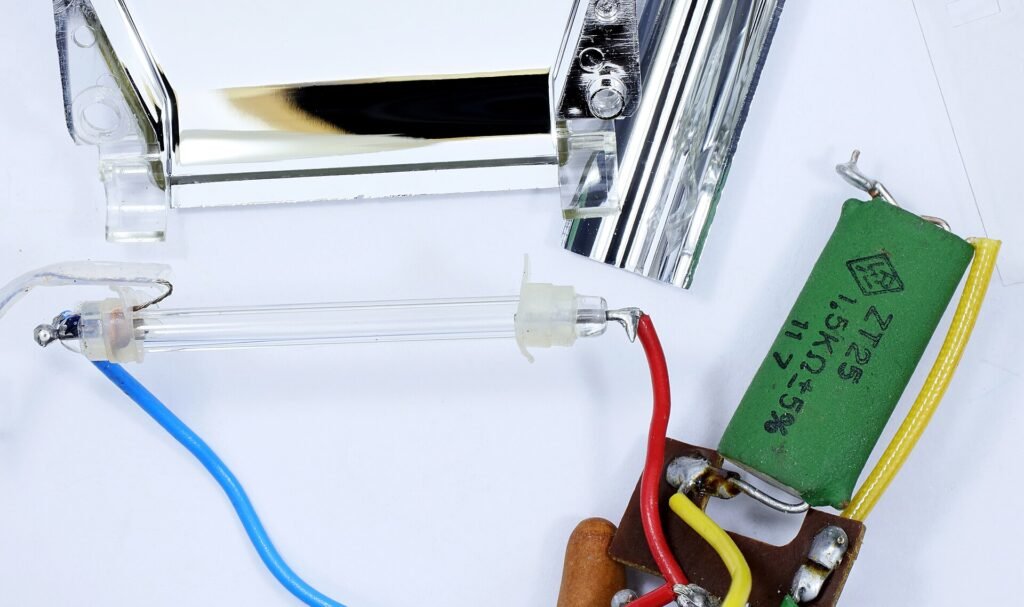
Most uses of xenon depend on the blue-white light it produces when an electric current passes through it. A xenon flash tube is a glass tube filled with the gas, with an electrode at each end and a metal trigger plate near the middle. When triggered, it releases a brief, intense flash, which is why xenon lamps serve as high-speed electronic flash bulbs for photographers. The Royal Society of Chemistry also lists sunbed lamps and bactericidal lamps used in food preparation and processing. Xenon lamps are also used with ruby lasers.
Xenon ion propulsion systems are used by several satellites to keep them in orbit, and by some other spacecraft. In such a system the gas is ionized, meaning its atoms are given an electric charge, and the charged atoms are pushed out of the engine to create thrust.
Xenon difluoride is used to etch silicon microprocessors, which means it removes selected material from the silicon surface during chip manufacture. The same compound is used in making 5-fluorouracil, a drug used to treat certain types of cancer.
Isotopes of xenon
Nine isotopes of xenon occur in nature. An isotope is a version of an element whose atoms have the same number of protons but a different number of neutrons. The most abundant are xenon-132 at 26.9086 percent, xenon-129 at 26.4006 percent and xenon-131 at 21.2324 percent. The others are xenon-134 (10.4357 percent), xenon-136 (8.8573 percent), xenon-130 (4.071 percent), xenon-128 (1.9102 percent), xenon-124 (0.0952 percent) and xenon-126 (0.089 percent).
Three of these isotopes, xenon-124, xenon-134 and xenon-136, are listed by the Royal Society of Chemistry as undergoing double beta decay, a rare form of radioactive change. Their half-lives are enormous: more than 10 to the 17th power years for xenon-124, more than 1.1 times 10 to the 16th years for xenon-134 and more than 8.5 times 10 to the 21st years for xenon-136. For practical purposes, natural xenon behaves as a stable element.
Health and environmental effects of xenon
The Royal Society of Chemistry states that xenon has no known biological role. Xenon itself is not toxic, but its compounds are highly toxic because they are strong oxidizing agents, substances that readily take electrons from other materials.
Xenon is a natural, trace component of the air, and because it is so unreactive it does not react with other substances in the atmosphere. This entry gives general background drawn from reference sources and is not advice.
Key facts
- Xenon has atomic number 54, symbol Xe, and sits in group 18 and period 5 of the periodic table.2
- Xenon is a noble gas present in the atmosphere at 0.086 parts per million by volume.1
- Ramsay and Travers discovered xenon in July 1898 at University College London.1
- Neil Bartlett made the first xenon fluorine compound in 1962, and more than 100 xenon compounds are now known.1
- Xenon has nine naturally occurring isotopes, the most abundant being xenon-132 at about 26.9 percent.1
Related concepts
Quick checkWho discovered xenon?Show answer
William Ramsay and Morris Travers discovered xenon in July 1898 at University College London, after repeatedly distilling the rare gas krypton obtained from liquid air.
Sources
- Royal Society of Chemistry, Periodic Table: Xenon, https://periodic-table.rsc.org/element/54/xenon
- National Center for Biotechnology Information, PubChem Periodic Table: Xenon (element 54, including IUPAC-sourced atomic weight data), https://pubchem.ncbi.nlm.nih.gov/element/54
Editorially reviewed by Specialty Digest Editorial TeamLast reviewed November 4, 2026Researched and drafted with AI assistanceReport an issue