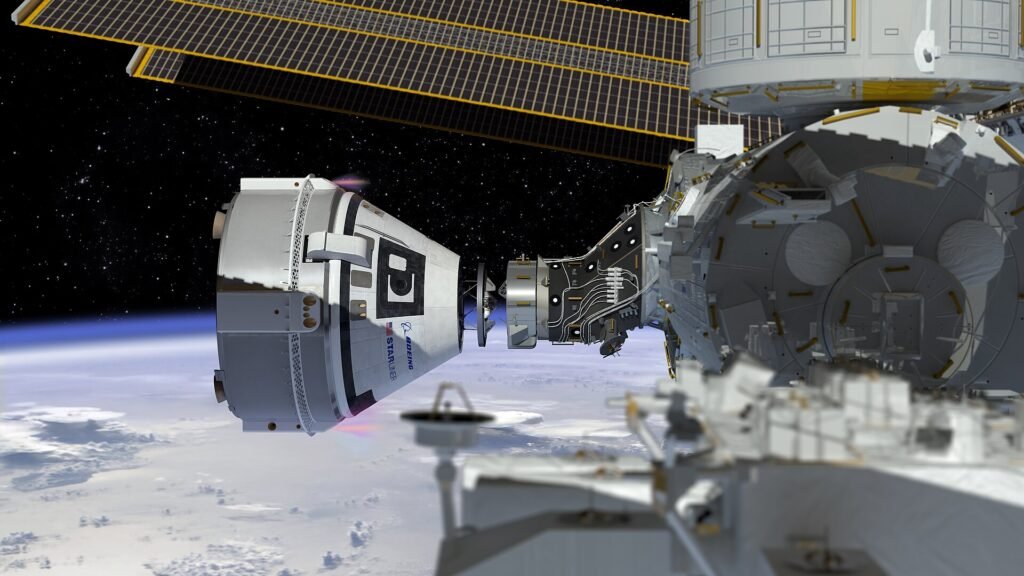
NASA and Boeing have updated the plan for the Starliner spacecraft: an uncrewed test flight could launch in December 2026 or January 2027, NASA intends to add a fifth and sixth crew flight option, and astronauts are due to fly on Starliner-2 by 2028. The update was released on September 28, 2026. This article on Starliner update summarizes what NASA says about the schedule, the investigation findings and the fixes planned, and it keeps to the engineering record.
What did NASA announce?
NASA said it intends to exercise options for a fifth and sixth Starliner flight to and from the International Space Station. NASA, Boeing and United Launch Alliance will also work to certify the Vulcan rocket for crew transportation after the final flight of the Atlas V rocket. Certification means a rocket meets the safety requirements to carry people. The update is a plan, so each step depends on testing and approval.
What is Starliner-1?
NASA describes Starliner-1 as an uncrewed engineering evaluation mission that could fly in December 2026 or January 2027. Its purpose is to verify thermal environments and gather performance data. Thermal environments means the heating and cooling the spacecraft experiences in flight. NASA says Boeing made thermal modifications to the service module, and NASA will evaluate them on this flight.
What about crewed flights?
For Starliner-2, NASA says: “Our current plan is to return astronauts on Starliner-2 by 2028.” The wording is careful. It describes a current plan, and it sets a latest date and not a fixed one. NASA does not say how many astronauts will fly.
What did the investigation find?
NASA released the Program Investigation Team’s report in February 2026, with 61 recommendations. It traced the problems of the 2024 Crew Flight Test to service module reaction control thrusters operating outside their engineering qualification, which caused a loss of control. A reaction control thruster is a small engine used to point and steer a spacecraft. Qualification means the range of conditions a part has been tested for.
What fixes are planned?
NASA lists these steps:
- Thermal modifications to the service module, to be evaluated on Starliner-1
- A thruster valve redesign, after that flight, to address poppet seal extrusion
- New crew module thrusters
- New batteries
- Minor changes to the parachute system
A poppet is a valve part, and seal extrusion is the squeezing of a seal out of its seat. Both definitions are general and are not drawn from NASA’s text.
How to read the schedule
The sequence matters. The uncrewed flight comes first, the valve redesign comes after it, and the crewed flight comes after that. By our own arithmetic, a December 2026 launch would leave about 12 to 13 months before the start of 2028 and up to about 25 months before the end of 2028, which is the window for the by-2028 crewed plan. Any slip in the first flight would squeeze that window. These calculations are ours and not NASA statements.
What do the recommendation and flight counts mean?
The number 61 shows how broad the investigation was, but the count alone does not say how serious each item was. Likewise, exercising options for a fifth and sixth flight indicates that the contract allows more flights, not that those flights are scheduled. NASA’s update reports intent, which is weaker than a firm commitment. Readers should avoid reading the update as a guarantee of the pace of flights.
Why separate the fixes into two stages?
NASA says the thermal changes will be tested on Starliner-1, and the thruster valve redesign will follow that flight. Testing one change at a time makes it easier to tell which change fixed which problem. A staged approach also means the spacecraft that carries astronauts will have both sets of changes, because the redesign comes before Starliner-2. That sequencing is our reading of NASA’s list and not a statement of strategy by the agency.
What does the investigation tell readers about the process?
A report with 61 recommendations suggests that NASA reviewed the program broadly, not only the failed component. The finding that thrusters operated outside their engineering qualification points to a mismatch between how parts were tested and how they were used in flight. NASA’s update does not discuss how that mismatch arose, and we do not speculate.
What should readers watch for next?
The key event is the Starliner-1 launch and what the thermal data show. After that, NASA and Boeing complete the valve redesign. Readers should also watch for Vulcan certification news, because the plan depends on a different rocket after the Atlas V retires. The update does not give dates for the certification, so timing is unknown.
How does it connect to other coverage?
Starliner is one of the vehicles that carries people to the space station, whose research we summarized in ISS science in 2025. Our article on Artemis III covers another test of spacecraft docking, and our report on the NASA ISAM State of Play covers technology for working in orbit. Our summary of NASA’s AWE experiment covers an instrument that used the station as a platform. Reliable transport underpins all of it.
Glossary
- Service module: the part of a spacecraft holding propulsion and supplies
- Crew Flight Test: the first flight of Starliner with astronauts, in 2024
- Certification: formal approval that hardware meets safety requirements
- Uncrewed flight: a flight with no people on board
- Engineering evaluation: a flight meant to test hardware rather than do science
These definitions are general explanations and are not quoted from NASA.
What is not covered here?
NASA’s update does not give costs, the names of crew members for Starliner-2, or the date of the Atlas V final flight. We have not added those. We also do not describe the 2024 flight beyond NASA’s own finding.
Key facts at a glance
- Update date: September 28, 2026
- Starliner-1: uncrewed, December 2026 or January 2027
- Starliner-2: crewed, by 2028 per the current plan
- Investigation: 61 recommendations, February 2026
- Rocket plan: certify Vulcan for crew after Atlas V
Frequently asked questions
Is the next Starliner flight crewed?
No. Starliner-1 is uncrewed.
What went wrong in 2024?
NASA traced it to thrusters operating outside their qualification, which caused a loss of control.
When will astronauts fly?
NASA’s current plan is by 2028 on Starliner-2.
More in Technology