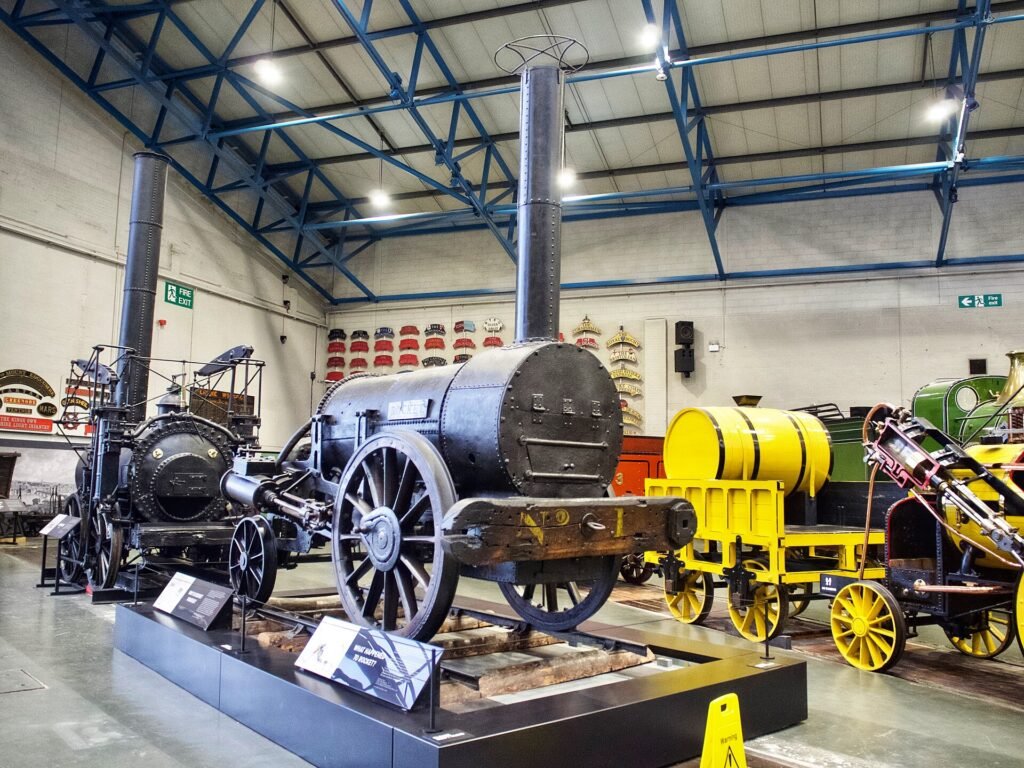
A steam locomotive is a railway engine that makes its own power by burning fuel to boil water and using the steam to move pistons that turn the wheels. Richard Trevithick’s Penydarren locomotive made the first recorded railway trip on February 21, 1804, and Robert Stephenson’s Rocket won the Rainhill trials of 1829.
History of the steam locomotive
In 1802 the ironmaster Samuel Homfray commissioned the Cornish engineer Richard Trevithick to build one of his high-pressure steam engines to drive a hammer at the Penydarren Ironworks in south Wales. With help from the works engineer Rees Jones, Trevithick mounted the engine on wheels and turned it into a locomotive. He seems to have started the work in the autumn of 1803, and it was finished by February 1804.
On February 21, 1804, the locomotive ran 9 miles from the ironworks to the Merthyr to Cardiff canal. National Museum Wales calls this the world’s first railway trip. By Trevithick’s own account, it hauled ten tons of iron in five wagons with seventy men riding along, at nearly five miles an hour, and it used two hundredweight of coal. A heritage-railway history site records a tradition that two ironmasters each wagered 500 guineas on whether it could haul ten tons of iron to the canal and bring the empty wagons back.
The test had its problems. On the return trip a bolt sheared and the boiler leaked, and the engine was too heavy for the rails. It was later used as a stationary engine driving a forge hammer. National Museum Wales adds that it was several years before steam locomotion became commercially viable.
The decisive step came in 1829. The Liverpool and Manchester Railway, described by the Science and Industry Museum in Manchester as the world’s first inter-urban passenger railway, held the Rainhill Trials to decide the best way to move trains. Rocket, designed by Robert Stephenson (1803 to 1859) and built by Robert Stephenson and Company in Newcastle upon Tyne, was the clear winner, the Science Museum Group says.
Rocket combined a multi-tube boiler with a blast-pipe. The pace of progress was so quick that it was substantially rebuilt within 18 months and set aside within 10 years. It was preserved in 1862, incomplete and in poor condition, and the Science Museum Group still calls it the most significant of all early railway locomotives. It is on display at the National Railway Museum in York.
Inventor and origins of the steam locomotive
No single person invented the steam locomotive. Trevithick’s high-pressure engine came first, and the museum in Wales argues that he, not George Stephenson, was the real father of the railways. Stephenson’s Rocket, on the other hand, drew together separate developments in one machine and set the pattern for later designs.
These two views do not conflict if the question is split in two. Trevithick showed that a steam engine could pull a load on rails. Robert Stephenson’s firm built a locomotive that was fast and efficient enough to win a public trial and be adopted by a railway.
How a steam locomotive works
A fire of coal or other fuel burns in a firebox, and the heat boils water in a boiler. The steam passes to cylinders, where it pushes pistons back and forth. Rods connect the pistons to the driving wheels, which turn and move the locomotive along the track. Trevithick’s engine used high-pressure steam, as did the stationary engines he had developed.
Rocket’s two main advances were aimed at making steam faster. A multi-tube boiler passes hot gases through many small tubes surrounded by water, which heats the water more quickly than a single flue. A blast-pipe sends exhaust steam up the chimney, which draws air through the fire and keeps it hot. Together they let the locomotive make steam at a higher rate.
Water supply mattered. Trevithick recorded that no water was added to the boiler between the start and the end of the first trip.
Types and variants of the steam locomotive
Early locomotives differed by purpose and layout. The Penydarren engine was built for a tramroad that carried iron to a canal, while Rocket was designed for passenger and goods traffic on a main line. Locomotives are classified by their wheel arrangement. Rocket was a 0-2-2, a notation that counts the leading, driving and trailing wheels, and its weight is estimated at about 3,000 kilograms.
The Science Museum Group records that Rocket was made of iron, pine, steel and brass. A working replica of Penydarren, built from Trevithick’s original documents and plans, was inaugurated in 1981. It presented the same problem as the original and broke the rails it ran on. It has been displayed and run at the National Railway Museum in York and, since 2005, at the National Waterfront Museum in Swansea.
Impact of the steam locomotive
Rocket’s win, according to the Science and Industry Museum, proved once and for all that locomotives were better than the alternatives at pulling trains on the Liverpool and Manchester line. The technology used in its design was soon extended across the whole railway network.
Railways also reshaped other industries. The first locomotive ran on a line built to carry iron, and the ironworks and railways alike grew up in the setting described in the entry on the Industrial Revolution. The later systems described in the entries on railway transport and rail electrification grew out of the networks that steam locomotives made practical.
Uses today
Steam locomotives survive mainly as heritage machines and museum objects. Rocket is kept in York, a replica of the Penydarren locomotive is displayed in Swansea, and many other early engines are preserved by museums and societies. The modern railways covered in the entries on high-speed rail and rail electrification use very different traction systems, but they share the basic idea of a self-propelled vehicle on rails that Trevithick and Stephenson established.
More in Maritime and Rail Transport
Key facts
- Richard Trevithick's locomotive ran 9 miles at the Penydarren Ironworks in south Wales on February 21, 1804.1
- Trevithick's own account says it hauled ten tons of iron in five wagons at nearly five miles an hour.3
- Rocket, designed by Robert Stephenson, won the Rainhill Trials of 1829.2
- Rocket combined a multi-tube boiler with a blast-pipe.2
- Rocket was substantially rebuilt within 18 months and was preserved in 1862.2
Related concepts
In the news
- ScienceCRS-25 Launch: Northrop Grumman Cygnus XL Heads for the Space Station on November 29
- TechnologyStarliner Update: NASA and Boeing Plan an Uncrewed Flight and Crew Return by 2028
- TechnologyNASA Plume-Surface Tests: How Engine Exhaust Throws Lunar Dust, Soil and Rocks
- ScienceNASA Adds Three Moon Base Science Investigations: A Lava Tube Scan, Ice Imaging and a Hazard Station
- ScienceMMX Launches to Mars’s Moons: What NASA and ESA Report About the Phobos Sample-Return Mission
Quick checkWho invented the steam locomotive?Show answer
No single person did. Richard Trevithick ran the first railway locomotive in 1804, and Robert Stephenson's Rocket won the Rainhill Trials in 1829 and set the pattern for later designs.
Sources
- National Museum Wales, Birth of the Railway Locomotive: Trevithick and the Penydarren Locomotive, https://museum.wales/learn/activity/725/Birth-of-the-Railway-Locomotive--Trevithick-and-the-Penydarren-Locomotive
- Science Museum Group Collection, Rocket locomotive (object 1862-5), https://collection.sciencemuseumgroup.org.uk/objects/co26704
- Preserved British Steam Locomotives, Richard Trevithick 1804 Penydarren, https://preservedbritishsteamlocomotives.com/richard-trevithick-1804-penydarren/
- Science and Industry Museum, Rocket in our collection (August 29, 2018), https://blog.scienceandindustrymuseum.org.uk/rocket-in-our-collection
Editorially reviewed by Specialty Digest Editorial TeamLast reviewed November 4, 2026Researched and drafted with AI assistanceReport an issue