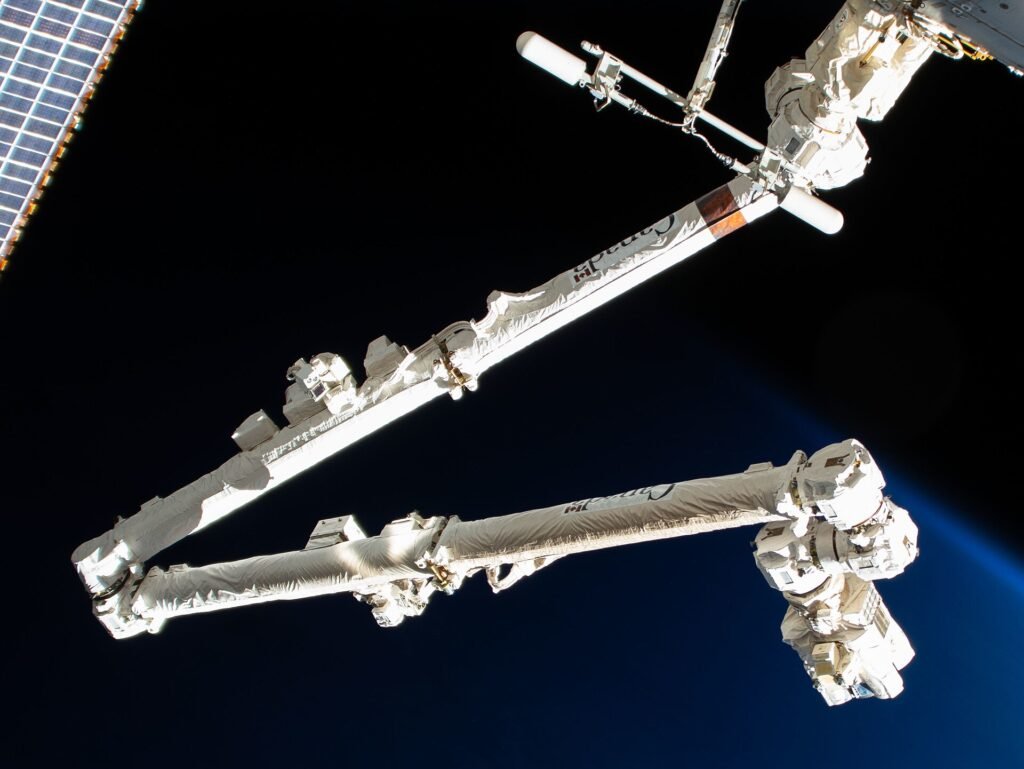
NASA has published the 2026 edition of its ISAM State of Play, a 368-page reference on in-space servicing, assembly and manufacturing. The document catalogs technologies that let spacecraft be repaired, built and made in orbit instead of launched as finished systems. This article summarizes NASA’s description of the report, its entry rules and why the agency says the field matters.
What is ISAM?
NASA says ISAM stands for In-Space Servicing, Assembly, and Manufacturing. It refers to technologies that let spacecraft be serviced, assembled and manufactured in orbit, instead of being launched as complete, integrated systems. Servicing might mean refueling or repair, assembly means joining parts in space, and manufacturing means making items there. Those three examples are a general reading and are not NASA’s wording.
What is the State of Play?
The State of Play is a NASA reference document that has been published since 2021. The 2026 edition runs 368 pages and covers current ISAM capabilities in 11 functional areas, including robotic manipulation, refueling and structural assembly. NASA says it works as both a catalog of existing capabilities and a roadmap for future ones. It began as a way for NASA centers to share a common reference point and has become a go-to resource for industry. The 2026 edition adds developer profiles and facility documentation, showing who is doing the work and where.
What counts as an entry?
NASA sets a clear bar. Hardware must physically exist, either as a ground prototype or as an in-flight demonstration. Concepts without hardware are not included. As team member Dale Arney describes it, some submissions are presentations with no evidence of technology work, and those wait until the following year’s review. NASA says the document contains no proprietary information from companies.
Who contributes?
Team member John Mulvaney calls the report a crowdsource document. Each year includes new interviews with industry partners. Contributors include NASA’s Ames, Glenn, Marshall, Kennedy and Johnson centers, plus international developers that meet the hardware criteria.
Why does NASA say it matters?
The article says ISAM will enable missions that single launches cannot. NASA gives these examples:
- Telescopes larger than any launch vehicle fairing
- Mobile and resilient national security assets
- Commercial systems upgraded on orbit
The first example is easy to picture. A rocket fairing limits the width of anything that launches inside it, so a larger mirror would have to be folded or assembled in space. Our article on the James Webb Space Telescope explains how that observatory used a folded design to fit inside its rocket. Assembly in orbit is a different approach to the same size limit. That comparison is our own framing and is not drawn from the NASA article.
How to read the numbers
By our own arithmetic, 368 pages across 11 functional areas averages about 33 pages per area. The areas are not equal in size, and some pages are introductory, so the average is only a rough scale. If one edition appeared each year from 2021 through 2026, that would make six editions, but NASA’s article says only that the report has been published since 2021, so we treat the count as our inference. The hardware requirement is the more important number: it means the catalog describes what exists, not what is proposed.
What does it say about current progress?
NASA’s article does not list the specific demonstrations in the report, so we do not describe them. Readers who want the capability tables should download the 2026 edition from NASA. The article does state that the document now documents who is doing the work and where, which suggests the field includes a growing number of developers, though the article does not give a count.
Why a hardware rule helps readers
A catalog built only on hardware that exists gives a more reliable picture than one built on proposals. A presentation can promise anything, while a ground prototype or an in-flight demonstration shows that something works at least once. The rule also helps companies and agencies compare like with like, since every entry has passed the same threshold. NASA does not claim the rule guarantees that every listed technology will be ready for use, and readers should not read it that way.
What to watch in future editions
NASA says submissions without evidence of technology work wait until the following year’s review. That suggests the next edition could add entries that have since built hardware. It also means the report is a snapshot of one year, and a capability missing from the 2026 edition may simply not have met the hardware rule yet. This reading is ours and follows from the entry rules NASA describes.
How does it connect to other missions?
Servicing and assembly ideas affect how future missions are designed. Our article on Artemis III covers a mission that tests docking between spacecraft, a basic skill for any in-orbit work. Our guide to NEO Surveyor shows a space telescope whose design is fixed before launch, which is the model ISAM aims to supplement. These comparisons are ours, and NASA does not draw them in the ISAM article.
Related reading: NASA Explores Commercial Servicing for Hubble as Its Orbit Slowly Decays.
Glossary
- ISAM: in-space servicing, assembly and manufacturing
- Launch fairing: the nose cover on a rocket that protects its payload
- Robotic manipulation: using robot arms to handle objects in space
- Refueling: adding propellant to a spacecraft already in orbit
- Ground prototype: hardware tested on Earth before flight
These definitions are general explanations and are not quoted from NASA.
What is not covered here?
The NASA article does not list the technologies in the report, the companies profiled or the cost of any program. We have not added them. For those details, the report itself is the source.
Key facts at a glance
- Report: ISAM State of Play, 2026 edition
- Length: 368 pages
- Coverage: 11 functional areas
- Published since: 2021
- Rule: only hardware that exists, as a ground prototype or flight demonstration
Frequently asked questions
Does the report include company secrets?
No. NASA says it contains no proprietary information.
Are concepts included?
No. Hardware must exist as a ground prototype or in-flight demonstration.
Where can I get it?
NASA says the 2026 edition is available for download from NASA.gov.
More in Technology