A rocket is a vehicle that moves by throwing a stream of hot gas out of its rear, and it carries its own propellant, so it can work where there is no air. Rockets power fireworks and weapons, lift satellites into orbit and send spacecraft to the Moon and planets.
History of the rocket
People used the principle of rocket flight long before they built real rockets. NASA’s Glenn Research Center retells a story from the Roman writer Aulus Gellius about a wooden pigeon that the Greek Archytas flew around 400 B.C., pushed along by escaping steam. About three hundred years later, Hero of Alexandria built the aeolipile, a sphere that spun as steam rushed out of two bent tubes.
The first true rockets probably used gunpowder. The Chinese reportedly had a simple form of gunpowder in the first century A.D., and at some point bamboo tubes filled with it were tied to arrows. The earliest date NASA gives for the use of true rockets is 1232, when Chinese defenders at Kai-Keng drove back Mongol invaders with fire arrows. The Mongols later made rockets of their own and may have helped carry the technology to Europe.
Over the following centuries rockets went in and out of fashion. In the 1500s a German fireworks maker, Johann Schmidlap, built a step rocket in which a large rocket carried a smaller one to a greater height. That idea is still basic to rockets that reach space. In the early 1800s the British artillery expert William Congreve designed military rockets after Indian forces used rocket barrages against the British in 1792 and 1799. British ships fired them at Fort McHenry in the War of 1812, which inspired the phrase “the rockets’ red glare” in the United States national anthem. Another Englishman, William Hale, introduced spin stabilization, in which exhaust gas striking small vanes made a rocket spin like a bullet and fly straighter.
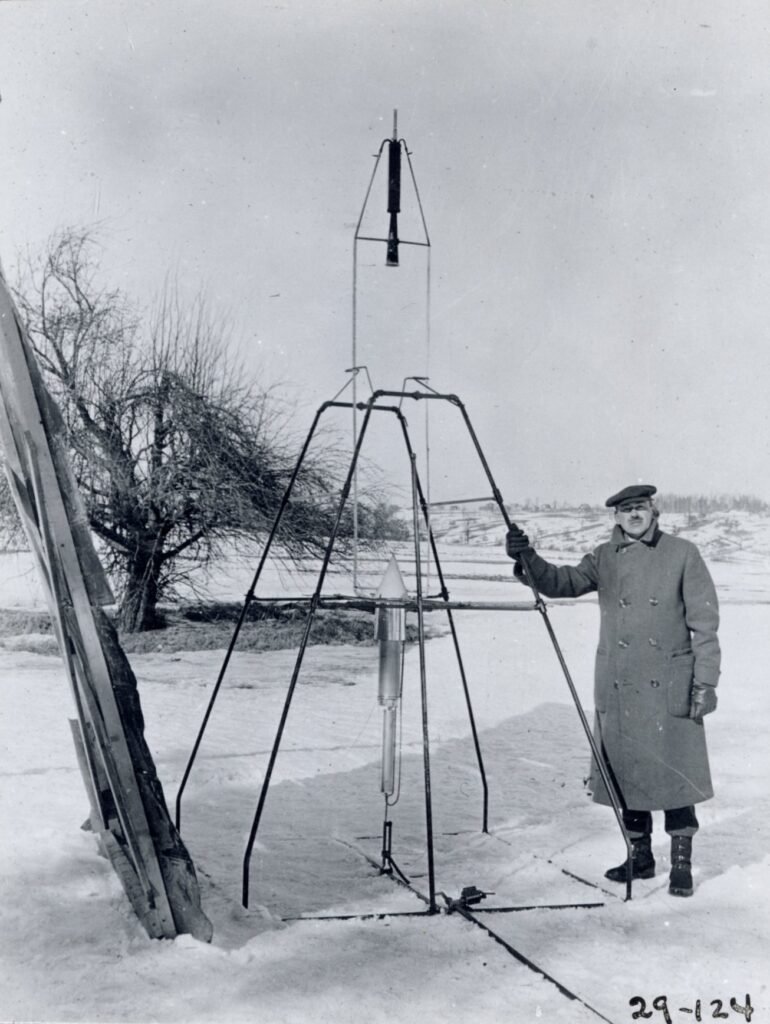
Modern rocketry began with a small group of pioneers. The Russian teacher Konstantin Tsiolkovsky proposed space exploration by rocket in 1898 and suggested liquid propellants in a report published in 1903. The American physicist Robert Goddard published A Method of Reaching Extreme Altitudes in 1919. On March 16, 1926, he launched the first liquid-propellant rocket, fueled by liquid oxygen and gasoline. It rose about 12.5 meters and landed 56 meters away, according to both NASA and the Smithsonian’s National Air and Space Museum. Hermann Oberth published a book on space travel in 1923.
German engineers working at Peenemunde from 1937 under Wernher von Braun built the V-2, which burned liquid oxygen and alcohol and was used against London in World War II. After the war, captured V-2 components and many German rocket scientists went to the United States.
Who invented the rocket?
No single person invented the rocket. NASA says it is unclear when the first true rockets appeared, and suggests that the earliest ones may have been accidents, gunpowder tubes that skittered out of a fire instead of exploding. Its account credits Chinese experimenters with turning those tubes into launched weapons, and treats the 1232 battle as the first reported use.
Credit for the liquid-propellant rocket is clearer, but it is not simple either. Goddard flew the first one, and the museum notes that no one can take that first away from him. He kept the 1926 launch secret for about ten years, however, and the museum argues that his lasting importance lay in inspiring others, because the German V-2 program made the breakthrough to large-scale rocketry. NASA calls Tsiolkovsky the father of modern astronautics and Goddard the father of modern rocketry.
How a rocket works
In its simplest form, a rocket is a chamber holding gas under pressure, with a small opening at one end. Gas escaping through the opening produces thrust that pushes the chamber the other way, just as air leaving a balloon pushes the balloon. In a space rocket the gas comes from burning propellant.
The science behind this was set out by Isaac Newton in his Principia of 1687. His third law says that every action has an equal and opposite reaction, which is why a rocket moves opposite to its exhaust. More detail is in Newton’s laws of motion. Tsiolkovsky added that a rocket’s speed and range are limited only by the speed of its exhaust gases.
A rocket carries both fuel and the oxygen needed to burn it, so it does not rely on the atmosphere. This separates it from a jet engine, which draws in air for combustion. The combustion chamber and nozzle that turn burning propellant into thrust are covered in rocket engine.
Types of rockets
Rockets are usually grouped by propellant. Solid-propellant rockets, the descendants of the Chinese fire arrow, hold a hardened propellant inside a casing, and they are comparatively simple. Liquid-propellant rockets keep fuel and oxidizer in separate tanks and feed them to a combustion chamber. NASA describes them as far harder to build than solid rockets, since they need tanks, turbines and combustion chambers. Some designs combine solid and liquid propellants.
Rockets are also grouped by staging. A multistage rocket drops empty sections as it climbs, so the remaining stages do not have to lift dead weight. This is Schmidlap’s step rocket grown to large scale. A sounding rocket, the kind Goddard analyzed in his 1919 paper, carries instruments into the upper atmosphere for weather and research.
Impact of the rocket
For most of its history the rocket was a weapon or a firework. Congreve’s rockets were effective less because they were accurate than because thousands could be fired in a single siege. The V-2 was a formidable weapon that could devastate whole city blocks, and its wartime development tied spaceflight closely to military research.
The same technology opened the way to space. NASA points to the Saturn V and the Space Shuttle as giant rockets made possible by an understanding of Newton’s laws, and missions such as the Apollo 11 moon landing depended on them.
Uses of rockets today
NASA describes today’s large rockets as vehicles that carry satellites into orbit and spacecraft to the Moon and planets. Those satellites in turn support services such as satellite communication. Smaller sounding rockets still lift instruments for atmospheric research, and fireworks and military missiles remain further common applications.
More in Mechanical Engineering
Key facts
- The first reported use of true rockets was in 1232, when Chinese defenders used fire arrows against Mongol invaders.1
- A rocket moves by expelling gas, and the thrust acts opposite to the exhaust, as Newton's third law of motion describes.2
- Robert Goddard launched the first liquid-propellant rocket on March 16, 1926, using liquid oxygen and gasoline.3
- Goddard's 1926 rocket rose about 12.5 meters and landed 56 meters away.3
- The V-2 burned liquid oxygen and alcohol and was used against London in World War II.1
Related concepts
In the news
- ScienceCRS-25 Launch: Northrop Grumman Cygnus XL Heads for the Space Station on November 29
- TechnologyStarliner Update: NASA and Boeing Plan an Uncrewed Flight and Crew Return by 2028
- TechnologyNASA Plume-Surface Tests: How Engine Exhaust Throws Lunar Dust, Soil and Rocks
- ScienceNASA Adds Three Moon Base Science Investigations: A Lava Tube Scan, Ice Imaging and a Hazard Station
- ScienceMMX Launches to Mars’s Moons: What NASA and ESA Report About the Phobos Sample-Return Mission
Quick checkWho invented the rocket?Show answer
No single person did. Chinese experimenters made the first gunpowder rockets, with 1232 the first reported use, and Robert Goddard launched the first liquid-propellant rocket on March 16, 1926.
Sources
- NASA Glenn Research Center, Brief History of Rockets, https://www.grc.nasa.gov/www/k-12/TRC/Rockets/history_of_rockets.html
- NASA Glenn Research Center, Rocket Principles, https://www.grc.nasa.gov/www/k-12/rocket/TRCRocket/rocket_principles.html
- National Air and Space Museum (Smithsonian), Robert Goddard and the First Liquid-Propellant Rocket, https://airandspace.si.edu/stories/editorial/robert-goddard-and-first-liquid-propellant-rocket
Editorially reviewed by Specialty Digest Editorial TeamLast reviewed November 4, 2026Researched and drafted with AI assistanceReport an issue