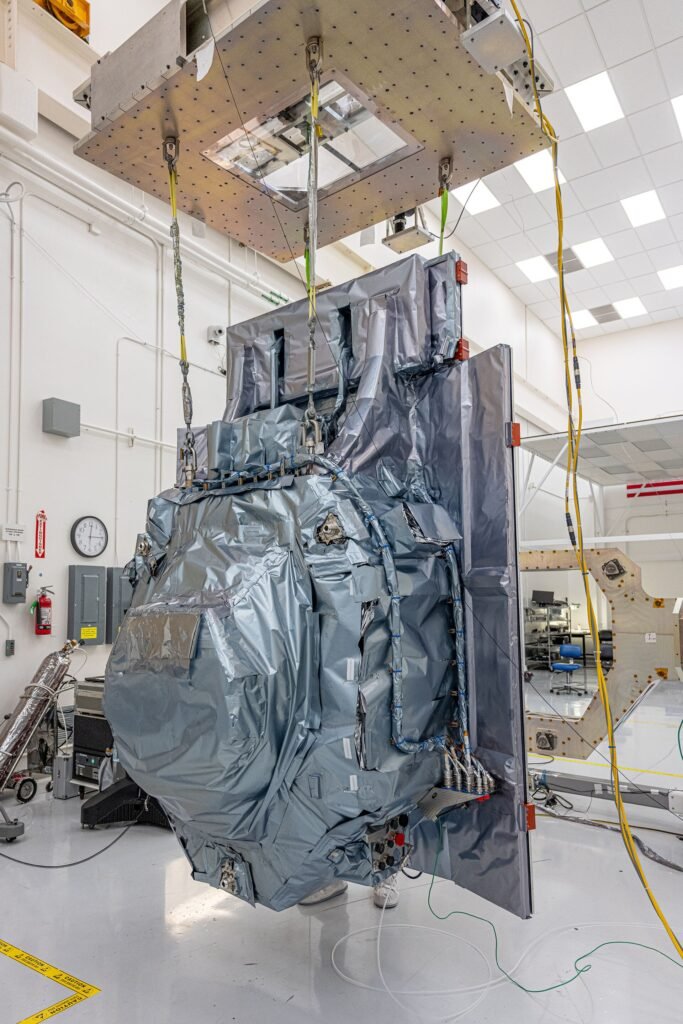
NASA says its Nancy Grace Roman Space Telescope has entered the science commissioning phase after a checkout of the observatory and its primary instrument. The agency’s mission blog, published on October 22, 2026 and updated the next day, says engineers have established that the observatory is fully functional. This article summarizes what NASA reported, what work remains before science operations begin and what the telescope is meant to study.
What did NASA announce?
According to NASA, Roman has completed a checkout and refinement of the observatory and the performance of its primary instrument. It has now moved into science commissioning. Julie McEnery, Roman’s senior project scientist, said: “We’ve established that the observatory is fully functional.” Commissioning is the stage between a spacecraft being switched on and it starting its real work. The blog does not give a date for the start of science operations, so we do not give one either.
What work remains?
NASA lists three kinds of work still to do before science operations begin:
- Test observations
- Instrument calibration
- Image-quality refinement
Calibration means measuring how the instrument responds to light so that later images can be corrected accurately. Image-quality refinement means adjusting the system so that stars look as sharp as the design allows. Those two definitions are general and are not quoted from NASA.
Which instruments are involved?
NASA’s blog names the Wide Field Instrument and the telescope’s fine guidance system. The fine guidance system holds steady on stars to point the observatory. The Wide Field Instrument is the primary camera. The blog excerpt we used does not give the telescope’s mirror size or its launch date, and we have not added them from memory.
What is Roman meant to study?
NASA says Roman’s deep surveys are meant to help astronomers study dark matter, dark energy, exoplanets, objects in our solar system and galaxies at the edge of the observable universe. Our entry on the exoplanet explains what astronomers mean by a planet around another star, and our article on Euclid’s first data release covers another survey mission that aims at dark matter and dark energy.
How sensitive is it?
NASA gives one number to show the telescope’s reach. In a typical Wide Field Instrument observation, Roman can detect objects about a hundred million times fainter than the human eye can see. By our own arithmetic, that is a factor of ten to the eighth power. In the astronomers’ magnitude system, where five magnitudes equal a factor of 100, a factor of 100 million corresponds to 20 magnitudes. The magnitude conversion is a general astronomy rule and is our calculation, not a NASA statement.
How to read the announcement
Three claims in the blog deserve different weights. First, the observatory is fully functional, which is a status statement from the project scientist. Second, the remaining work is a to-do list, and lists like this can change. Third, the sensitivity figure describes what a typical observation can do, not a result from a finished survey. None of this is a scientific finding yet. Roman has not started its deep surveys, so the dark matter, dark energy and exoplanet goals are plans.
Why does commissioning matter?
A space telescope cannot be repaired easily once it is far from Earth, so teams test every part in flight before they trust the data. A general lesson from earlier observatories is that commissioning can reveal small problems that are cheap to fix at the start and costly later. That is a general point and is not from NASA’s blog. It explains why NASA reports the milestone separately from the science.
What is the difference between a survey and a targeted telescope?
A survey telescope images large areas of sky to build statistics, such as how many galaxies of a given type exist and how they are distributed. A targeted telescope stares at one object for a long time to see detail. NASA describes Roman’s deep surveys as the tool for its science goals, which is consistent with a wide-field design. That is a general distinction, and the blog does not give the area Roman will cover. The practical point for readers is that Roman’s results will probably arrive as large catalogs and maps, not single dramatic pictures.
What should readers watch for next?
The next milestones in NASA’s own framing are the end of calibration, the refinement of image quality and the formal start of science operations. NASA has not said when those will happen in the text we used, so the timing is unknown. When NASA publishes first images or data, they will be the first real test of the sensitivity claim, and early images are often released to show what the instrument can do. Until then, the figure of a hundred million times fainter than the eye can see is a description of capability and not an observed result.
How does it relate to other telescopes?
Roman is designed for wide, deep surveys, while the James Webb Space Telescope is built for detailed views of individual targets. Our report on Hubble’s missing oxygen finding shows how an older observatory still produces new results. Together, wide surveys and targeted observations answer different questions, and astronomers often use both on the same objects.
Glossary
- Commissioning: the testing period after launch when a mission verifies its systems
- Calibration: measuring an instrument’s response so data can be corrected
- Dark matter: an unseen form of matter detected through its gravity
- Dark energy: the name for whatever drives the accelerating expansion of the universe
- Fine guidance system: a sensor that keeps a telescope pointed steadily
These definitions are general explanations and are not quoted from NASA.
What is not covered here?
NASA’s blog excerpt does not state the mirror diameter, the launch date, the orbit, the survey schedule or the date science operations begin. We have not filled these gaps. Readers should check NASA’s Roman pages for current plans.
Key facts at a glance
- Phase: science commissioning
- Blog published: October 22, 2026, updated October 23
- Instruments named: Wide Field Instrument and fine guidance system
- Sensitivity: about a hundred million times fainter than the eye can see
- Science goals: dark matter, dark energy, exoplanets, solar system objects, distant galaxies
Frequently asked questions
Is Roman already doing science?
Not yet. NASA says it is in the commissioning phase, with test observations and calibration still ahead.
Who said the observatory is working?
Senior project scientist Julie McEnery.
What will it study?
Dark matter, dark energy, exoplanets, solar system objects and distant galaxies.
More in Science
- Hubble Gravitational Lens Image Prepares Astronomers for Roman Telescope Science
- CHAPEA Mission 2: NASA's Simulated Mars Crew Marks One Year in a Houston Habitat
- Perseverance Measures Martian Dust Down to 100 Nanometers: What NASA Says About Protecting Crews
- MMX Launches to Mars's Moons: What NASA and ESA Report About the Phobos Sample-Return Mission