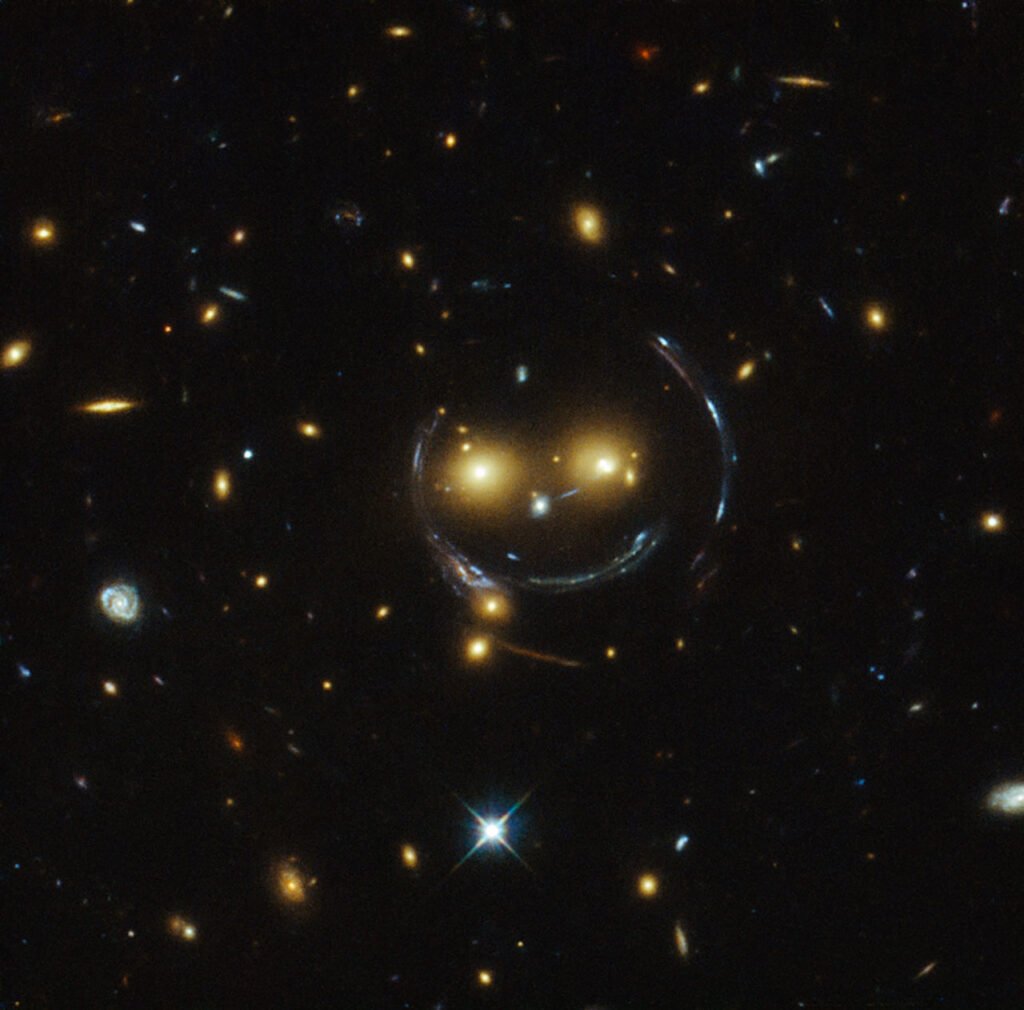
NASA has released a Hubble image of a gravitational lens that astronomers are using to prepare for science with the Nancy Grace Roman Space Telescope. The image, published on October 22, 2026, shows a distant galaxy whose light is stretched into arcs by the mass of a nearer galaxy. This article on Hubble gravitational lens summarizes what NASA says about the lens, how it reveals dark matter and why Hubble’s work now supports Roman.
What does the image show?
NASA’s caption identifies the lens as DESI J194.5345+03.5358 and shows it beside a barred spiral galaxy in the same field of view. The foreground elliptical galaxy is about 4.5 billion light-years away. The background galaxy, whose light is magnified and distorted, is about 8 billion light-years away. The background galaxy appears as an arc and counterarc pair: a large arc to the upper left of the foreground galaxy and a smaller, flipped arc to the lower right. NASA describes the image as one of many gravitational lensing images Hubble has taken, and it gives no total count.
How does a gravitational lens work?
A massive object bends the path of light that passes near it. When a galaxy sits almost exactly between Earth and a more distant galaxy, the bending can stretch and duplicate the distant galaxy’s image. That is the general principle, and it is not a quotation from NASA’s page. It is why astronomers can see arcs around some galaxies. The size and shape of the arcs depend on how much mass the foreground galaxy has and how it is arranged.
Why does this help study dark matter?
NASA explains that researchers measure how much the background galaxy is distorted, which reveals the foreground galaxy’s mass. Visible matter alone does not account for the distortion. That lets researchers estimate how much dark matter the galaxy contains. In other words, the distortion acts as a scale that weighs everything in the lens, including matter that gives off no light. Our article on Euclid’s first data release describes another mission that looks for lens candidates in large numbers.
How does this connect to Roman?
NASA says the images prepare for science with Roman. Hubble can observe these lenses only one at a time, while Roman’s wide view will capture a larger sample. Astronomers are building a Hubble-based computer model to analyze Roman’s large images, and Hubble will follow up on interesting lenses Roman detects. Our report on the Roman Space Telescope entering science commissioning covers the current state of that observatory.
How do Hubble and Roman differ?
NASA says Hubble observes mainly in visible and ultraviolet light with some infrared, while Roman observes mainly infrared with some visible light. The article does not name specific instruments on either telescope. A telescope’s wavelengths matter because distant galaxies are redshifted toward the infrared as the universe expands, a general point that explains why an infrared-focused telescope suits faraway objects. That explanation is ours and is not stated in NASA’s article.
Hubble keeps producing new results in other areas too. Our article on Hubble and missing oxygen in dwarf galaxies is one example, and our guide to the James Webb Space Telescope explains the infrared observatory that complements it.
How to read the numbers
By our own arithmetic, the gap between the two quoted distances is about 3.5 billion light-years. That subtraction assumes both distances are measured in the same way, which the caption does not say, so it should be treated only as a rough scale. The ratio of the distances is about 1.8. These figures tell readers that the lens galaxy is roughly halfway to the source in this rough sense, but they do not give the mass of the lens, which NASA does not state.
What is missing from the report?
NASA’s page does not give the mass of the foreground galaxy, the amount of dark matter found, the number of lenses Roman is expected to detect or the specific instruments used. It also does not say how many lenses Hubble has imaged for this purpose. We have not added any of those from memory. The image is best read as an example of a method and a preview of what Roman may do, not as a new measurement of dark matter.
Why is a computer model needed?
Roman is expected to produce far more images than people can inspect one by one. Astronomers are therefore building a Hubble-based model, which NASA says will help analyze the large images. A model trained on Hubble’s detailed views can in principle help sort and measure lenses in wide-field data. NASA does not describe the model’s design, so this reading is general. It follows a common pattern in astronomy, where a well-studied small sample guides the analysis of a very large one.
Related reading: Cat's Head Nebula in Hubble and Webb Light: What NASA Shows Inside the Carina Nebula.
Glossary
- Gravitational lens: a mass that bends light from a more distant object
- Dark matter: an unseen form of matter detected through its gravity
- Elliptical galaxy: a smooth, rounded galaxy with older stars
- Barred spiral galaxy: a spiral galaxy with a bar-shaped center
- Light-year: the distance light travels in one year
These definitions are general explanations and are not quoted from NASA.
Key facts at a glance
- Lens: DESI J194.5345+03.5358
- Foreground galaxy distance: about 4.5 billion light-years
- Background galaxy distance: about 8 billion light-years
- Hubble observes lenses one at a time
- Roman will capture a larger sample with its wide view
Frequently asked questions
Why are the galaxies arc-shaped?
The foreground galaxy’s mass bends the background galaxy’s light into an arc and a smaller flipped counterarc.
Does the image prove how much dark matter exists?
No. It shows the method, and NASA gives no dark matter amount for this lens.
Who made the image?
NASA, ESA and X. Huang of the University of San Francisco, with processing by Gladys Kober.
More in Science
- CHAPEA Mission 2: NASA's Simulated Mars Crew Marks One Year in a Houston Habitat
- Perseverance Measures Martian Dust Down to 100 Nanometers: What NASA Says About Protecting Crews
- MMX Launches to Mars's Moons: What NASA and ESA Report About the Phobos Sample-Return Mission
- NASA's Swift Observatory Ends Its Science Mission After Nearly 22 Years