Every year on June 5, the world is invited to do something unusual: look at the whole planet as one shared home. World Environment Day is the largest annual occasion for environmental action, and it has been running for more than half a century. It began with a simple idea, that the air, water and living things we depend on do not stop at a border. Its message has changed with the times, from smog and deserts to plastic, climate and restored land, but its question has stayed the same: what are we doing to the only home we have? Like World Water Day, it turns a vast subject into a single date that anyone can join.
From Stockholm to a yearly day
The day grew out of the first great environmental summit. In 1972 the United Nations held its Conference on the Human Environment in Stockholm, and the General Assembly designated June 5, the first day of that conference, as World Environment Day. The resolution carries the symbol A/RES/2994 (XXVII). According to the official campaign history, the Assembly acted on the same day to create the UN Environment Programme, which still leads the observance.
The first celebration came a year later. The official history records it as June 5, 1973, under the slogan “Only One Earth,” with Switzerland as host. The UN’s own observance page counts annual celebrations from 1974, which is why you may see both years. Either way, the slogan tells the story. It reminded people that there is no spare planet to move to when this one is damaged.
What the day is really about
The UN describes the day as a way of engaging governments, businesses, celebrities and citizens to focus their efforts on a pressing environmental issue. Each year UNEP chooses a theme and works with a host country that stages the main event. That rotation matters. A host nation puts its own problems and its own solutions on the world stage, whether that is air pollution in China in 2019, forests and species in Colombia in 2020, or restored land in Saudi Arabia in 2024.
The day is also deliberately practical. It asks ordinary people to act, from planting trees and cleaning rivers to changing what they buy. In 2025, more than 2,500 events marked the day, according to UNEP, and its Tide Turners youth program had engaged over 980,000 young people in more than 60 countries.
Plastic: the numbers behind recent campaigns
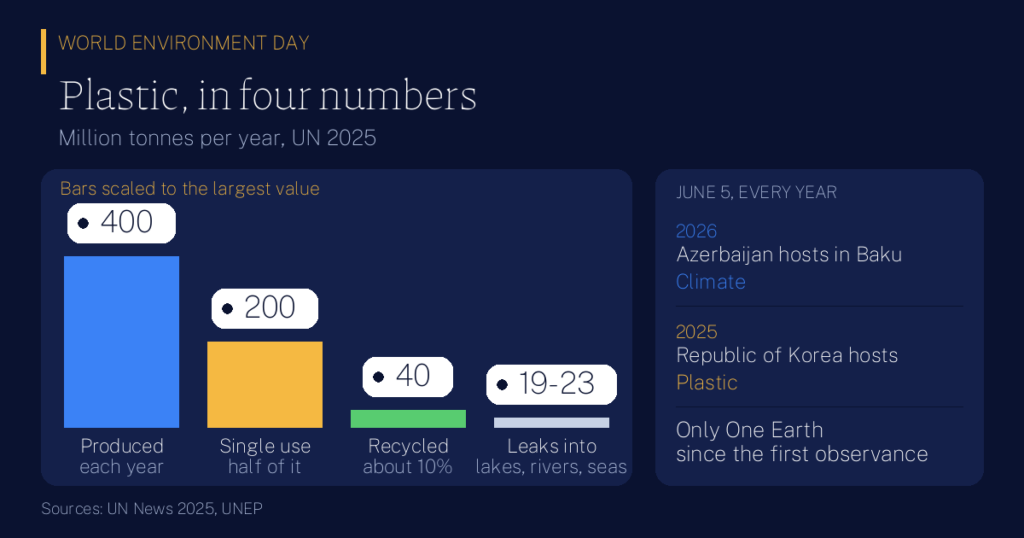
Plastic has been the theme more than once in recent years: India in 2018, Côte d’Ivoire in 2023 and the Republic of Korea in 2025, all under the banner Beat Plastic Pollution. The reason is scale. According to the UN, 400 million tonnes of plastic are produced worldwide every year. Half of it is designed to be used only once, and only about 10 percent is recycled.
The leak is where the harm shows. The UN reports that between 19 and 23 million tonnes of plastic waste leak into aquatic ecosystems each year. Microplastics now turn up in food, water and air, and the average person is estimated to ingest over 50,000 plastic particles a year. Countries have been negotiating a legally binding international agreement on plastic pollution, covering the full life cycle of plastic, under a mandate set by the UN Environment Assembly.
- 400 milliontonnes of plastic produced each year, UN, 2025
- 10%of that plastic is recycled
- 50,000+plastic particles ingested per person per year, estimated
- 2,500+events held for World Environment Day 2025
Example 1: the bottle count. Imagine a town whose people throw away 1,000,000 plastic bottles in a year, with a recycling rate of 10 percent. Only 100,000 bottles come back as material. The other 900,000 are buried, burned or left in the open, where some may drift toward rivers. The numbers are round and illustrative, but they show why designing waste out matters more than cleaning it up.
Climate, nature and land: the themes turn
Plastic is only one chapter. Over the past seven years the day has moved from nature to land to plastic to climate. The 2026 edition focuses on climate change, with Azerbaijan hosting the global commemoration in Baku and a national campaign line of “Inspired by Nature. For Climate. For Our Future.” The shift is a reminder that environmental problems are linked. Forests, soils and oceans store carbon, so protecting nature is also climate policy.
Who is affected, and who acts
Nobody is outside the environment, but the burden is uneven. Communities near rivers choked with waste, farmers on degraded land and coastal families facing rising seas feel the damage first and often have the fewest resources to respond. That is one reason the day rotates its hosts across every region, from Barbados in 2014 and Rwanda in 2010 to Azerbaijan in 2026, so that different realities set the agenda.
Action also comes from every level. Governments set rules and targets. For example, Mexico launched a national strategy on World Environment Day 2025 aiming to eliminate all plastic waste from its beaches and coasts within five years. Businesses redesign products, and schools, faith groups and neighbors organize cleanups and plantings.
Example 2: the school cleanup. Suppose a school collects 30 kilograms of litter each month over a ten-month school year. That is 300 kilograms of litter off the ground. If the same school then cuts single-use items in its canteen by half, the pile at the source could shrink to 150 kilograms. The figures are made up for illustration, but the lesson is real: reducing waste beats collecting it.
How the day is marked, and what progress needs
On June 5 you will see tree plantings, river cleanups, school lessons, public pledges and official ceremonies in the host city. Social media campaigns carry the theme to people who never attend an event. But a single day does not change a country. Lasting progress needs laws that cut waste and emissions at the source, honest data to track results, and investment that reaches the places hit hardest.
It also needs habits. Choosing reusable bags, mending instead of replacing, saving energy and supporting local restoration projects all add up when many people do them together.
Example 3: the reusable bag. Picture 2,500 households that each stop using four single-use bags a week. Over 52 weeks that avoids 520,000 bags. The numbers are round and illustrative, yet they show how small habits multiply when a community acts together.
Key Takeaways
- The day is rooted in 1972. The General Assembly designated June 5 as the first day of the Stockholm Conference on the Human Environment.
- The slogan still fits. “Only One Earth” was the first theme, and it remains the clearest summary of why the day exists.
- Hosts and themes rotate. UNEP works with a different country each year, so the focus moves from nature and land to plastic and climate.
- Plastic is a design problem. About 400 million tonnes are made each year, half for single use, and only about 10 percent is recycled.
- The leak is large. The UN reports 19 to 23 million tonnes of plastic waste entering aquatic ecosystems annually.
- Climate is the 2026 focus. Azerbaijan hosts, and the theme links nature protection with climate action.
- You can take part. Pick one habit, such as reusing, repairing or planting, and join a local event on June 5.
How solid is this? Plastic figures are UN estimates from 2025 and are revised as research improves. The treaty talks described here were still under way at last report, so check the UN Environment Programme for the latest status. Sources differ slightly on the first celebration, 1973 or 1974, and this article notes both. The three worked examples use round, made-up numbers to show an idea. See also World Water Day, the International Days hub and the International Days Calendar.
More in Nature
- United Nations, World Environment Day observance page
- UNEP, World Environment Day history, hosts and themes
- UNEP, World Environment Day 2026 theme and host
- UNEP, World Environment Day 2025 mobilizes commitment and action to end plastic pollution
- UN News, World Environment Day: UN sounds alarm on plastic pollution crisis (June 2025)
- UNEP, Plastic pollution and marine litter