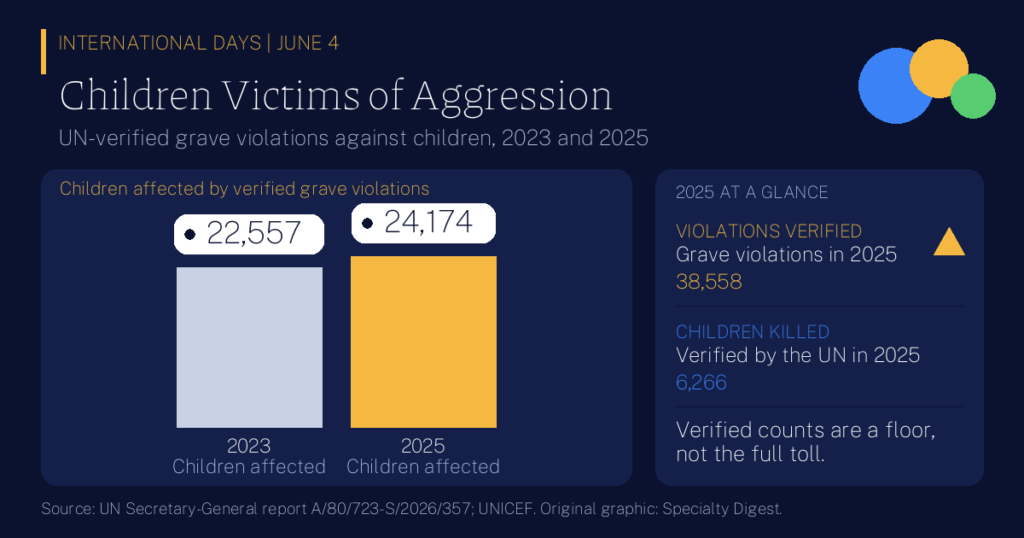
Wars are decided by adults, yet children carry some of the heaviest costs. Every June 4, the United Nations asks the world to pause and recognize the children who suffer from violence they did not choose. The day is named the International Day of Innocent Children Victims of Aggression, and its purpose is simple to state and hard to meet: to acknowledge their pain and to renew the promise to protect their rights. This article explains where the day came from, what the latest United Nations figures show, and what protection looks like in practice. It treats a painful subject with care, and it relies on the words and numbers of the United Nations.
Where the day came from
On August 19, 1982, the General Assembly met in its emergency special session on the question of Palestine. There it decided to commemorate June 4 of each year as the International Day of Innocent Children Victims of Aggression. The decision is recorded as resolution A/RES/ES-7/8.
The United Nations describes the purpose of the day in broad terms. It is meant to acknowledge the pain suffered by children throughout the world who are victims of physical, mental and emotional abuse, and it affirms the organization’s commitment to protect the rights of children. The day has no annual theme.
Later decades added tools to that promise. The Graça Machel report (A/51/306) and General Assembly resolution 51/77 of 1997 led to a standing mandate on children and armed conflict. The UN says that mandate is now 30 years old, and every year the Secretary-General reports to the Security Council on what monitors have verified. That report is the best source of facts for this day.
What the words mean
The word innocent is a reminder of a basic principle: children do not wage war and should not pay for it. The word aggression is used in the resolution’s title, while the UN’s own description of the day speaks of children who are victims of abuse of every kind.
In modern UN monitoring, harm to children in conflict is organized under six grave violations: killing and maiming, recruitment and use by armed forces or groups, sexual violence, abduction, attacks on schools or hospitals, and denial of humanitarian access. Giving each violation a name matters. A violation that has a name can be counted, reported to the Security Council and, in time, answered.
The numbers behind the day
The Secretary-General’s report for 2025, released in June 2026, verified 38,558 grave violations. They affected 24,174 children, many of whom suffered more than one violation, and about a third of the victims were girls. The UN says this is the highest number of children affected since the mandate began 30 years ago. The Special Representative for Children and Armed Conflict, Vanessa Frazier, called 2025 “one of the darkest chapters for child protection since monitoring began.”
The same report counted 8,322 incidents of denied humanitarian access and 1,667 children detained for actual or alleged association with warring parties. Killing and maiming rose by 34 percent and 10 percent respectively. The countries with the highest levels of violations were the Occupied Palestinian Territory and Israel, the Democratic Republic of the Congo, Nigeria, Myanmar and Somalia. For the first time, the report found that government forces were the main perpetrators of grave violations, ahead of non-State armed groups. These are findings attributed to the United Nations report, and they describe verified cases only.
Example 1: why counts are a floor. Imagine a monitoring team receives 200 reports from a district in one year, and it can confirm 120 of them with enough evidence. The verified total is 120, not 200, and it says nothing about the cases no one could safely reach. The numbers are round and illustrative, but they show why UN totals are best read as the minimum the world knows, not the full count.
Growing up near conflict
The wider picture is just as stark. UNICEF reported in December 2024 that over 473 million children, more than one in six worldwide, lived in areas affected by conflict. That is almost 19 percent of the world’s children, roughly double the share of about 10 percent in the 1990s. By the end of 2023, 47.2 million children had been displaced by conflict and violence.
Example 2: what a doubled share means. Picture a group of 100 children chosen at random from around the world. In the 1990s about 10 of them would have lived in a conflict-affected area. Today it would be nearly 19. The group is made up for illustration, but the ratio comes straight from the UNICEF figures.
Why the day still matters
Harm to a child in war rarely ends when the fighting does. A child who is recruited, abducted or injured may lose years of school, health and family life. An attack on a school or hospital hurts far more than the people inside it, because it removes a service a whole community relies on. Denied humanitarian access can mean that food, medicine and vaccines never arrive.
Example 3: a school closed by conflict. Suppose a school with 300 pupils is closed for 20 weeks because the area is unsafe. If each child loses about 20 weeks of a 40-week school year, the community loses 6,000 pupil-weeks of learning. Most of those weeks are never fully recovered. The numbers are illustrative and rounded, but they show how a single closure multiplies across a community.
What protection looks like
The six grave violations also point to six kinds of action. Armed forces can keep schools and hospitals off limits, so that classrooms and clinics stay open. Aid can be allowed through. Children who were recruited or abducted can be released and helped to return to family life and learning. Commanders and governments can be asked to answer for violations, and monitors can keep counting so that no case is invisible. The UN’s annual report exists to make those steps visible and measurable.
The International Day of UN Peacekeepers, observed in May, shows another side of the same effort, since peacekeeping missions often include staff dedicated to child protection. You can read about it in our article on the Blue Helmets.
If a child you know is in immediate danger, contact local emergency services. In a crisis, UNICEF country offices, local child protection services and national child helplines can direct families to safe support.
How the day is marked
June 4 is a day for remembrance and attention, not a celebration. Schools, civil society groups and UN offices use it to explain the rights of children in conflict, to share the latest findings from the Secretary-General’s report, and to ask governments to keep their commitments. An easy way to take part is to read the annual report’s summary and to learn which violations in your region are being tracked.
Key Takeaways
- The day dates to 1982. The General Assembly set June 4 on August 19, 1982, in resolution A/RES/ES-7/8.
- Its aim is broad. The UN describes it as a day to acknowledge children who suffer abuse and to affirm their rights.
- 2025 set a record. The UN verified 38,558 grave violations affecting 24,174 children, the most since the mandate began.
- Six violations guide the work. Killing and maiming, recruitment, sexual violence, abduction, attacks on schools and hospitals, and denied aid each get tracked.
- Verified counts are a floor. The true toll is likely higher than any figure monitors can confirm.
- The share is growing. Almost 19 percent of children, over 473 million, lived in conflict-affected areas in 2024.
- Protection is practical. Open schools, open aid routes, release of recruited children and accountability all help.
How solid is this? The 2025 figures are verified cases from the UN Secretary-General’s report as presented by UN News in June 2026, and the full report was available in unedited form when this was written. The 473 million estimate comes from UNICEF and its research partner PRIO and is a model-based figure. The three worked examples use round, made-up numbers to show an idea. See the International Days hub and the International Days Calendar.
More in Society
- United Nations. International Day of Innocent Children Victims of Aggression, 4 June: Background.
- UN General Assembly. Resolution A/RES/ES-7/8 (19 August 1982).
- UN News. Darkest chapter: Record child violations in 2025, with national forces leading the way (17 June 2026).
- UN Secretary-General. Children and armed conflict, report A/80/723-S/2026/357 (unedited version, June 2026).
- UNICEF. Not the new normal: 2024 one of the worst years in UNICEF’s history for children in conflict (December 2024).
- UN News. 2024 one of the worst years in history for children in conflict (December 2024).