Fishing is one of humanity’s oldest ways of feeding itself, and on most days it is a regulated business with licenses, quotas and logbooks. Yet part of the catch never appears in those books. Fish are taken from closed areas, landed without a report or sold under false papers, and the missing numbers make the sea look healthier than it is. The International Day for the Fight against Illegal, Unreported and Unregulated Fishing, observed every year on June 5, exists to bring that hidden catch into the light. For another observance about fish and the people who depend on them, see World Tuna Day.
A Mediterranean idea becomes a UN day
The day began as a regional proposal. In 2015, the General Fisheries Commission for the Mediterranean, a body of the Food and Agriculture Organization (FAO), proposed an international day against illegal fishing. FAO’s Committee on Fisheries endorsed the idea, and in late 2017 the UN General Assembly proclaimed June 5 as the day in its annual resolution on sustainable fisheries, A/RES/72/72. It was celebrated for the first time on June 5, 2018.
The date has a purpose. On June 5, 2016, the FAO Agreement on Port State Measures entered into force. The UN describes it as the first binding international treaty aimed specifically at illegal, unreported and unregulated (IUU) fishing. Choosing the anniversary of that treaty ties the day to a practical tool, not just a slogan, and FAO has been actively engaged in the observance from the start.
What the three words mean
IUU fishing is a broad term for a wide variety of fishing activity. The UN notes that it occurs both on the high seas and in waters under national jurisdiction, and that it may sometimes be associated with organized crime. In plain language, illegal fishing breaks the rules of a country or a regional fishing body. Unreported fishing is catch that is never reported, or is reported falsely. Unregulated fishing takes place where no rules properly apply, such as on stocks or in areas without management. These are everyday summaries, not legal definitions, and one boat can break all three in a single trip.
Example 1: the invisible tonnes. Imagine a region where honest boats report 170 tonnes of a fish in a season, while illegal boats quietly take another 30 tonnes. Scientists who see only 170 tonnes will think the stock is under less pressure than it is. The numbers are round and illustrative, but the logic is why unreported catch is a problem even before anyone counts the damage.
The numbers behind the day
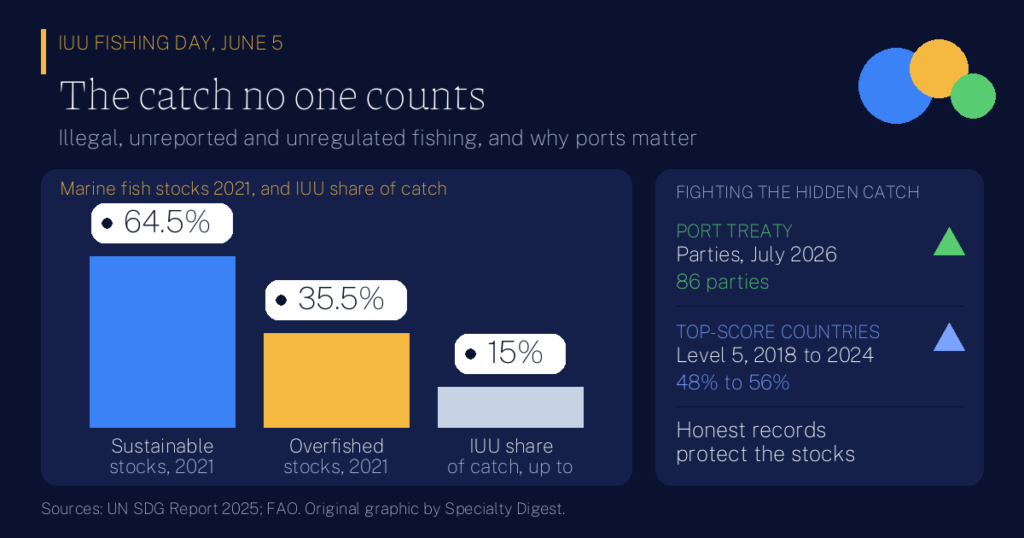
No one can count a hidden catch exactly, so every figure is an estimate. The UN’s Sustainable Development Goals Report 2025 states that IUU fishing accounts for up to 26 million metric tons of fish annually, about 15 percent of global catches. At the 2025 observance, the chair of the Port State Measures Agreement noted that assessments compete and that IUU fishing may be as high as 15 percent of all catches. Treat the figure as an upper range, not a precise count.
The backdrop is a stressed ocean. The same UN report says 64.5 percent of marine fish stocks were fished at biologically sustainable levels in 2021, while 35.5 percent were overfished, and that the overfished share keeps growing by about 1 percent a year. The earlier estimate for sustainable stocks was 62.3 percent. A newer FAO review covering 2,570 marine fish stocks, cited on the UN observance page, also finds that over a third are overexploited.
- 26 milliontonnes a year, at most, caught by IUU fishing (UN, 2025)
- 15%of global catches, upper estimate (UN, 2025)
- 2,570marine fish stocks in FAO’s 2025 review
- 86parties to the FAO port treaty, July 2026
Why a hidden catch matters
The sea is also a livelihood. FAO’s 2026 report on world fisheries and aquaculture, as cited by FAO, found that aquatic production reached a record 235 million tonnes in 2024, generated $184 billion in trade and supported more than 600 million livelihoods. Illegal fishing cuts into that foundation in three ways. It removes fish that honest fishers, who follow the rules and pay for licenses, could have caught. It distorts the data that governments use to set quotas. And because it can be linked to organized crime, it strains the authorities who protect coastal communities.
Example 2: the quota that was too high. Suppose managers allow 100 tonnes a year for a stock, based on a count that missed another 25 tonnes taken illegally. The stock is really losing 125 tonnes. If that continues, the stock shrinks, honest boats catch less each year, and the quota has to fall even further. The figures are round and illustrative, but this feedback loop is the reason accurate catch records are treated as a public good.
Ports are the choke point
A boat can hide at sea, but its fish must eventually come ashore. That is the idea behind port state measures: a country decides which foreign fishing vessels may enter its ports, inspects them and can refuse to let them land their catch. FAO reports that the treaty now has 86 parties, representing 110 FAO Members, as of July 2026, up from 82 parties when the chair spoke on the day in June 2025.
Example 3: the port that said no. Picture a port that checks 50 foreign vessels in a year and finds that 5 cannot show valid papers for their catch. Turning those 5 away means roughly one in ten loads never enters the market. The numbers are round and illustrative, but they show why one honest port can raise the cost of cheating for every boat that calls there.
Progress, and who is left behind
There are signs of movement. The 2025 UN report says that between 2018 and 2024, global implementation of key international instruments against IUU fishing improved from a medium to a high rating, from 3 to 4 on a scale of 1 to 5. The share of countries at the top level of 5 grew from 48 to 56 percent, and small island developing states and least developed countries reached an average score of 4 by 2024. The UN observance page adds that FAO has supported more than 55 countries since 2022, and that FAO, the International Maritime Organization and the International Labour Organization adopted over 50 recommendations in 2024.
Yet the gaps remain. Small-scale fishers, whom the UN page describes as the great majority of the fisheries workforce, are often the ones competing with illegal operators for the same fish, and 2022 was declared the International Year of Artisanal Fisheries and Aquaculture to recognize their role. Coastal states with limited patrol capacity also struggle to watch large waters, which is why shared data and shared ports matter. As a consumer, you can ask where fish was caught and prefer sellers who can answer.
Key Takeaways
- The day is tied to a treaty. June 5 marks the entry into force of the Port State Measures Agreement in 2016.
- IUU stands for three problems. Illegal, unreported and unregulated fishing overlap, and one boat can do all three.
- The scale is large but uncertain. The UN estimates up to 26 million tonnes a year, about 15 percent of global catches.
- Hidden catch harms the stocks. About 35.5 percent of marine stocks were overfished in 2021, and unreported catch makes the picture harder to read.
- Ports are where fish must surface. The treaty has 86 parties as of July 2026, and each one can refuse a doubtful catch.
- Progress is real but incomplete. The share of top-scoring countries rose from 48 to 56 percent between 2018 and 2024.
- You have a role. Asking where your fish came from rewards honest fishers.
How solid is this? The IUU share of catch is an upper estimate and sources disagree, so read 15 percent as a ceiling, not a count. Stock status is for 2021, the port treaty counts are from 2025 and July 2026, and the plain-language definitions of illegal, unreported and unregulated fishing are summaries, not legal text. UN and FAO pages differ on whether the 2017 resolution was adopted in November or December, so this article says late 2017. The three worked examples use round, made-up numbers to show an idea. See also the International Days hub and the International Days Calendar.
More in Nature
- United Nations, International Day for the Fight against Illegal, Unreported and Unregulated Fishing
- FAO, International Day against IUU Fishing
- United Nations, The Sustainable Development Goals Report 2025, Goal 14
- FAO, Statement on the International Day against IUU Fishing, June 5, 2025
- FAO, Members celebrate 10th anniversary of landmark fisheries treaty, 2026