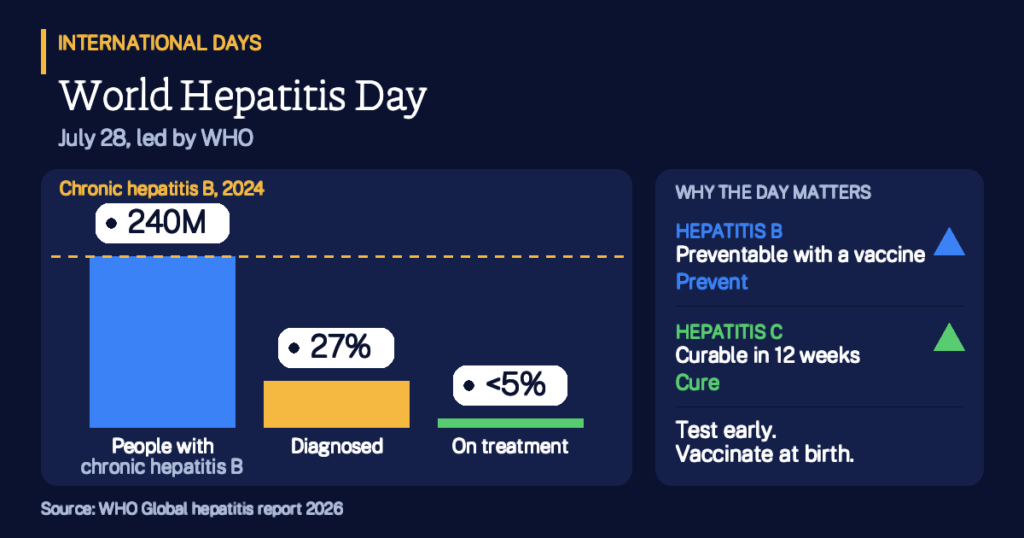
Hepatitis rarely announces itself. A person can carry a virus that slowly scars the liver for decades without a single symptom, and many learn of it only when the damage is advanced. That quiet quality is why the world set aside a day for it. World Hepatitis Day, observed every year on July 28 and led by the World Health Organization (WHO), exists to turn a hidden disease into a visible one, so that people are tested, vaccinated and treated before the liver fails. Its central message is hopeful. Hepatitis B can be prevented with a vaccine, and hepatitis C can be cured. The hard part is reaching the people who need both.
How July 28 became a global day
The date honors a scientist. WHO says July 28 was chosen because it is the birthday of Nobel Prize winner Dr. Baruch Blumberg, who discovered the hepatitis B virus and developed a diagnostic test and a vaccine for it. The day became official on May 21, 2010, when the Sixty-third World Health Assembly adopted resolution WHA63.18 on viral hepatitis. The resolution decided that July 28, or another day chosen by individual member states, should be designated World Hepatitis Day, to give an opportunity for education and greater understanding of viral hepatitis as a global public health problem. Because countries may choose other dates, some national events fall on different days.
Five viruses, one organ
Hepatitis means inflammation of the liver. WHO identifies five main hepatitis viruses, called types A, B, C, D and E. Types A and E generally spread through contaminated food or water, which ties them to the sanitation challenges described on World Toilet Day. Types B, C and D spread through contact with infected blood or body fluids, and hepatitis B can also pass from mother to child at birth. Hepatitis D infects only people who already have hepatitis B.
Types B and C drive the global toll because they can become chronic, meaning the infection lasts for years. Over time, chronic infection can lead to cirrhosis, which is scarring of the liver, and to liver cancer. A vaccine protects against hepatitis B. There is no vaccine for hepatitis C, but a 12-week treatment that became available in 2015 cures about 95 percent of the people who take it, according to WHO.
The numbers behind the day
WHO’s Global hepatitis report 2026 estimates that 287 million people were living with chronic hepatitis B or C in 2024. In that year these two infections caused 1.34 million deaths, and about 1.8 million people were newly infected, which is more than 4,900 new infections every day. Earlier WHO figures for 2022 counted 254 million people with hepatitis B and 50 million with hepatitis C, 1.3 million deaths and 2.2 million new infections. WHO revises its estimates from report to report, so the 2022 and 2024 figures should not be read as a straight trend. There is real progress to report: since 2015, new hepatitis B infections have fallen by 32 percent and hepatitis C deaths by 12 percent.
- 287 millionpeople living with chronic hepatitis B or C, 2024
- 1.34 milliondeaths from hepatitis B and C, 2024
- 1.8 millionnew hepatitis B and C infections, 2024
- 20%of people with hepatitis C treated since 2015
The gap between knowing and treating
The biggest obstacle is not a missing medicine. It is a missing diagnosis. Of the 240 million people with chronic hepatitis B in 2024, only 27 percent had been diagnosed, and fewer than 5 percent were receiving treatment. For hepatitis C, 11 million people who had been diagnosed remained untreated as of 2024, and only 20 percent of the people who needed treatment since 2015 had received it.
Example 1: what the gap looks like. Picture 100 people living with chronic hepatitis B. Using WHO’s 2024 shares, about 27 know they are infected, and fewer than 5 are on treatment. Roughly 73 do not know, and many may not learn it until the liver is badly damaged. The group of 100 is illustrative, but the proportions are WHO’s.
Example 2: the cure that waits. Imagine 100 people with hepatitis C who need treatment. At the global rate of 20 percent, 20 have been cured with a 12-week course that works for about 95 percent of patients, and 80 are still waiting. The numbers are round and illustrative, but they show why testing comes first: a cure cannot reach someone who has never been tested.
Protecting babies from the first day
Hepatitis B infection early in life is more likely to become chronic, which is why WHO stresses a vaccine dose within 24 hours of birth. In 2024 only 45 percent of babies worldwide received that birth dose. In the WHO African Region the figure was 17 percent, even though the region accounted for 68 percent of new hepatitis B infections. Still, vaccination is working: chronic hepatitis B prevalence among children under five has fallen to 0.6 percent, and 85 countries have reached or passed the 2030 target of less than 0.1 percent.
Example 3: one maternity ward. Suppose 1,000 babies are born in a year. At the global rate of 45 percent, 450 receive the birth dose in time and 550 do not. At the African Region rate of 17 percent, only 170 do. The ward is imaginary and the figures are rounded, but each missed dose is a chance for a lifelong infection that a low-cost vaccine could have prevented.
What the 2030 goals ask, and how the day is marked
WHO’s elimination strategy aims to bring new hepatitis infections down to 520,000 a year and hepatitis deaths down to 450,000 by 2030. That would be a 90 percent cut in new infections and a 65 percent cut in deaths compared with 2015. WHO has also set a goal of treating 80 percent of people living with chronic hepatitis B and C by 2030. Meeting it means more testing, earlier vaccination and treatment that is within reach of every patient.
The 2025 and 2026 campaigns share the theme “Hepatitis: Let’s break it down,” a call for urgent action to dismantle the financial, social and systemic barriers that keep people from care. WHO regional offices and health authorities mark the day with events and public messages, and anyone can use it to ask a simple question: have I been tested?
- 2013Know it, Confront it
- 2014Think again
- 2025Hepatitis: Let’s break it down
- 2026Hepatitis: Let’s break it down
Key Takeaways
- Hepatitis is quiet. Chronic infection can damage the liver for years before any symptom appears.
- The scale is large. An estimated 287 million people lived with chronic hepatitis B or C in 2024, and 1.34 million died.
- One is preventable, one is curable. A vaccine prevents hepatitis B, and a 12-week course cures about 95 percent of hepatitis C cases.
- Diagnosis is the bottleneck. Only 27 percent of people with chronic hepatitis B had been diagnosed in 2024.
- The first day of life matters. Only 45 percent of babies received the hepatitis B birth dose worldwide, and 17 percent in Africa.
- The goals are clear. WHO aims for a 90 percent cut in new infections and a 65 percent cut in deaths by 2030, against 2015.
- Ask about a test. If you have never been tested or vaccinated, July 28 is a good reason to talk to a health worker.
How solid is this? The 2024 figures are WHO estimates from the Global hepatitis report 2026, and the 2022 figures come from earlier WHO reports, so they are revised over time and not strictly comparable. The three worked examples use round, made-up groups to show an idea. This article is general information, not medical advice. See also the International Days hub and the International Days Calendar.
More in Health
- WHO, World Hepatitis Day campaign page
- WHO, World Hepatitis Day 2026
- World Health Assembly resolution WHA63.18, Viral hepatitis (May 21, 2010)
- WHO, Efforts to eliminate hepatitis deliver gains but more action needed (April 28, 2026)
- WHO, Global hepatitis report 2026
- WHO, Elimination of hepatitis by 2030
- WHO, Viral hepatitis infections claiming 3500 lives each day (April 9, 2024)