Tobacco is the rare consumer product whose most common use harms the person using it, and in many cases the people nearby. It is also one of the most studied threats in public health, which means the case for acting does not rest on guesswork. World No Tobacco Day, observed every year on May 31, asks the world to look at that evidence and to act on it. WHO describes tobacco as killing more than 7 million people each year. The day exists so that number is never treated as background noise.
How a health assembly created a day
The Member States of the World Health Organization created World No Tobacco Day in 1987. In that year the World Health Assembly passed Resolution WHA40.38, which called for April 7, 1988, to be a world no-smoking day. The following year it went further. Resolution WHA42.19, passed in 1988, called for World No Tobacco Day to be celebrated every year on May 31, and that is the date the world has used since.
The change in wording matters. “No smoking” became “no tobacco” because the harm does not come from cigarettes alone. Smokeless products, water pipes, heated tobacco and newer nicotine products all carry risk. The day is a campaign, not a legal instrument, so it has no enforcement power. Its strength is that it gives health ministries, schools, hospitals and community groups a shared moment each year to press for the same goal.
What the day is really about
It is tempting to treat tobacco as a question of personal willpower. WHO frames it differently. Nicotine is addictive, and the products are designed, priced and marketed to attract new users and keep existing ones. Each year WHO picks a theme that exposes one part of that system. The 2025 theme was “Unmasking the appeal,” and the 2026 theme is “Unmask the appeal,” which keeps the focus on how tobacco and nicotine products are made attractive, especially to young people, and on how governments can counter it.
The WHO Framework Convention on Tobacco Control, adopted by WHO Member States in 2003, is the legal backbone behind those efforts. It entered into force in 2005 and, according to WHO, now has 183 Parties covering more than 90 percent of the world’s population. WHO’s practical package for countries is known as MPOWER: monitor use, protect people from smoke, offer help to quit, warn about the dangers, enforce advertising bans and raise taxes.
The numbers behind the day
The headline toll is large. WHO’s fact sheet says tobacco kills more than 7 million people each year, including over 1.6 million non-smokers who are exposed to secondhand smoke. WHO also states that there is no safe level of exposure to tobacco smoke.
- 7 million+deaths from tobacco each year, WHO fact sheet
- 1.6 million+of those are non-smokers exposed to secondhand smoke
- 100 million+people worldwide now vape, WHO estimate, 2025
- 15 million+children aged 13 to 15 already use e-cigarettes
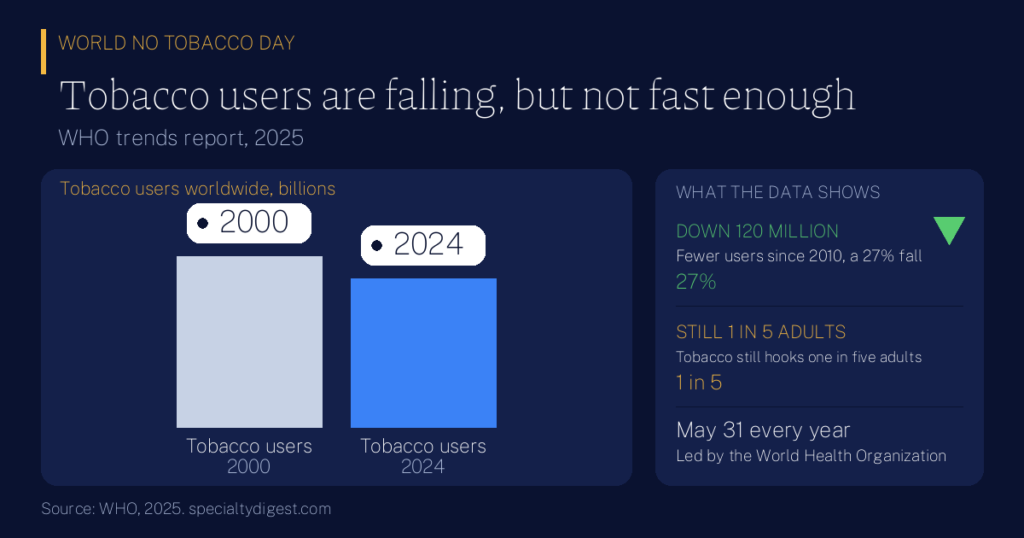
There is encouraging news as well. WHO’s 2025 trends report found that the number of tobacco users fell from 1.38 billion in 2000 to 1.2 billion in 2024. Since 2010 the number has dropped by 120 million, a 27 percent fall in relative terms. The decline is real, but WHO notes that tobacco still hooks one in five adults worldwide and that the world is falling short of its 2025 target by about 50 million users.
Example 1: what one in five looks like. Picture a town of 1,000 adults. If tobacco hooks one in five, about 200 of them use it. Suppose the town runs a quit program and 20 of those users stop in a year. The town has cut use by ten percent among users, a real gain, yet 180 people are still exposed to the risk. The numbers are round and illustrative, but they show why WHO treats steady progress as necessary and not yet sufficient.
Who smokes, and where
Tobacco use is not spread evenly. According to WHO, around 80 percent of the world’s 1.2 billion tobacco users live in low- and middle-income countries. Men use far more than women, though both groups have seen declines. Among men, prevalence fell from 41.4 percent in 2010 to 32.5 percent in 2024. Among women it fell from 11 percent to 6.6 percent over the same period.
Regions differ too. WHO reports that Europe has the highest prevalence at 24.1 percent in 2024, while Africa stands at 9.5 percent. The Western Pacific stands at 22.9 percent, down from 25.8 percent in 2010. These gaps reflect policy, price, culture and the reach of industry marketing, not any difference in how people respond to nicotine.
A new generation, new products
The industry has not stood still. WHO’s 2025 estimate, its first of this kind, is that more than 100 million people worldwide now vape, including at least 86 million adults, mostly in high-income countries. At least 15 million children aged 13 to 15 already use e-cigarettes, and in countries with data children are on average nine times more likely than adults to vape. WHO’s fact sheet describes nicotine pouches as having high addiction potential and strong youth appeal.
This is the heart of the “unmask the appeal” message. Flavors, bright packaging, social media and low sticker prices are tools that make a harmful, addictive product look harmless or fashionable. Naming those tactics is the first step toward restricting them.
What works
The evidence on solutions is just as clear as the evidence on harm. WHO reports that over 6 billion people are covered by at least one MPOWER measure at best-practice level. Coverage varies a lot by measure, as the chart shows.
Taxes stand out as the gap. Only 41 countries, covering 12 percent of the world’s population, have introduced taxes at the standard WHO measures, even though price is one of the most direct ways to discourage use. Warnings, smoke-free laws and advertising bans are further along, but each leaves large parts of the world’s population unprotected.
Example 2: a tax in practice. Imagine a pack of cigarettes costs $5 and a government adds a $2 tax. The price rises by 40 percent, and the same policy also raises revenue. A ministry could direct that money toward quit services. The figures are made up and rounded, but the logic, higher price and funded help, is the one WHO promotes.
Example 3: the cost to a household. Say a person spends $4 a day on tobacco. Over a year that is $1,460, money not spent on food, school fees or savings. If the person quits, the household gains that income back, along with lower health risks. The numbers are illustrative, but they show why tobacco is often called a thief of both health and wealth.
How the day is marked
Each year WHO and its regional offices publish campaign material, and countries hold events from school talks to hospital quit clinics. WHO also gives World No Tobacco Day awards to individuals and organizations that have advanced tobacco control. Ordinary people can take part by learning the facts, supporting smoke-free spaces and talking with young people about how products are marketed. Anyone who wants to quit can ask a doctor, pharmacist or national quitline about support.
Key Takeaways
- The day has a clear origin. The World Health Assembly created it in 1987 and fixed May 31 as the annual date in 1988.
- The toll is large. WHO says tobacco kills more than 7 million people a year, including over 1.6 million non-smokers.
- Progress is real. Users fell from 1.38 billion in 2000 to 1.2 billion in 2024, yet one in five adults is still hooked.
- The burden is uneven. About 80 percent of users live in low- and middle-income countries, and men use far more than women.
- New products target the young. More than 100 million people vape, and at least 15 million children aged 13 to 15 use e-cigarettes.
- Policy works, but unevenly. Over 6 billion people are covered by at least one best-practice measure, while taxes remain underused.
- Help exists. Quitlines, clinicians and community programs can support anyone ready to stop.
How solid is this? Figures come from WHO’s fact sheet and its 2025 trends report, and prevalence numbers are modeled estimates that WHO revises with each edition. The vaping estimate is WHO’s first global one. The three worked examples use round, made-up numbers to show an idea. See also the International Days hub and the International Days Calendar.
More in Health
- WHO, Tobacco and nicotine fact sheet
- WHO, Tobacco trends report: 1 in 5 adults still addicted to tobacco (October 6, 2025)
- WHO, Global report on trends in prevalence of tobacco use 2000 to 2024 and projections 2025 to 2030
- WHO, Report on the global tobacco epidemic 2025
- WHO, World No Tobacco Day campaign page
- WHO Framework Convention on Tobacco Control