Every person alive was raised by someone. A mother, a father, a grandparent, an aunt, an older sibling, a foster carer: somebody fed us, held us and taught us to speak. That daily, mostly unpaid work shapes health, learning and character more than almost any school or clinic can. The Global Day of Parents, observed every June 1, asks the world to notice it. It is a day of thanks, but it is also a day of questions. Do parents have the time, the money, the knowledge and the support they need to do this work well?
Why the United Nations honors parents
In 2012, the General Assembly proclaimed June 1 as the Global Day of Parents, to be observed each year in honor of parents throughout the world. The resolution is numbered 66/292. According to the UN, the day stresses the critical role of parents in rearing children and recognizes that the family has the primary responsibility for the nurturing and protection of children. It also repeats a principle from the Convention on the Rights of the Child: for the full and harmonious development of their personality, children should grow up in a family environment, in an atmosphere of happiness, love and understanding.
The day is meant as a chance to appreciate parents for their selfless commitment to children. The UN adds that families, parents and caregivers play a central role in child well-being and development, offering identity, love, care, provision and protection. It sits alongside the International Day of Families on May 15, and the two days ask related questions at different scales: one about the household, the other about the person at its center.
What counts as a parent
The word is broader than it first appears. In practice, a parent is whoever takes steady responsibility for a child, whether through birth, adoption, fostering, kinship care or simply showing up every day. Many children are raised by grandparents while their parents work far away. Others are raised by a single parent, by two parents of the same sex, or by an older sibling. The day honors the function, not a particular family shape.
What does good parenting actually consist of? The Nurturing Care Framework, launched by the World Health Organization, UNICEF, the World Bank and partners at the World Health Assembly in 2018, gives a useful answer. It names five indivisible components and focuses on the period from pregnancy to age three, when children are most sensitive to their surroundings.
Example 1: fifteen minutes. Imagine a parent who spends just 15 minutes each day singing, naming objects and talking with a toddler. Over a year that adds up to about 90 hours of responsive attention. The numbers are round and illustrative, but the idea is real: responsive caregiving is built from small, repeated moments, not from expensive equipment.
The first years in numbers
Responsive attention is not guaranteed. UNICEF reports that approximately 4 in 10 children aged 2 to 4 do not get enough responsive interaction or stimulation at home, and around 1 in 10 miss out on activities with caregivers such as reading, storytelling, singing and drawing. Over 80 million children aged 2 to 4, around 1 in 5, do not play with their caregivers at home. More than 90 million children under 5, or 1 in 7, have no playthings of any kind at home, whether store-bought toys or household objects. These figures come from household surveys compiled by UNICEF.
- 4 in 10children aged 2 to 4 lack enough responsive interaction at home
- 80 million+children aged 2 to 4 do not play with caregivers
- 90 million+children under 5 have no playthings at home
- 1 in 10miss reading, storytelling, singing or drawing with caregivers
Behind these numbers sits a plain message. Poverty, long working hours, stress and a lack of information make it hard for parents to give what they most want to give. The remedy is rarely blame. It is support.
The hidden cost of care
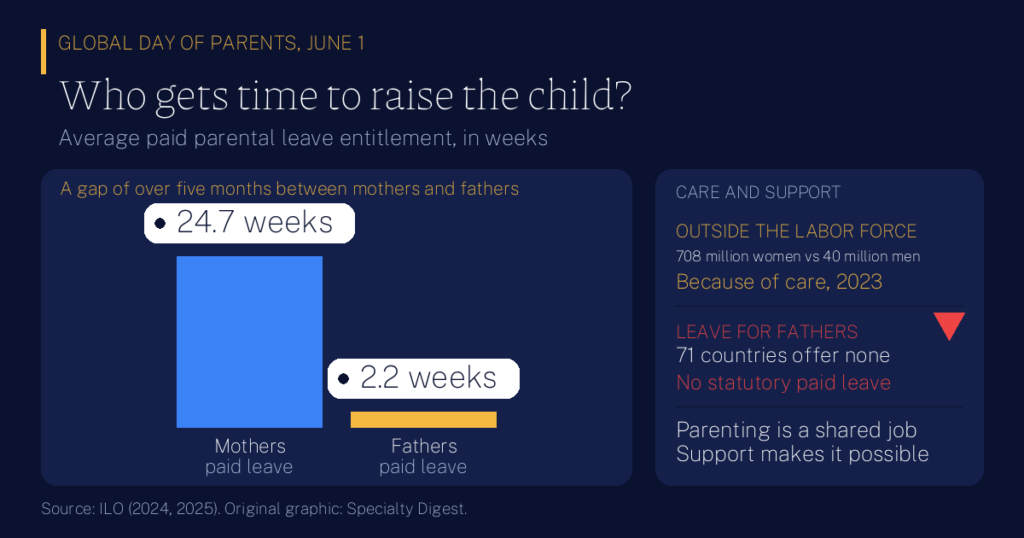
Raising children is work, and most of it is unpaid. The International Labour Organization estimates that in 2023, 748 million people aged 15 or older were outside the global labour force because of care responsibilities. Of these, 708 million were women and 40 million were men. The estimates draw on data from 125 countries, and care accounts for about a third of all working-age people outside the labor force. Globally, 45 percent of women outside the labor force cite care, against 5 percent of men.
The share varies sharply by region, which shows that policy and services matter as much as culture.
Example 2: the long day. Picture a woman offered a job that needs 8 hours at work and 1 hour of commuting. If daily care for two young children and an elderly parent takes 5 hours, her day becomes 14 hours before any rest. With no affordable child care, declining the job can look like the only choice. The hours are made up for illustration, but this is the trade-off behind the ILO figures.
Leave: time to be a parent
One of the clearest tools for supporting parents is paid leave. The ILO reports that mothers are entitled to an average of 24.7 weeks of paid parental leave, while fathers receive just 2.2 weeks, a gap of over five months. It also finds that 71 countries give fathers no statutory paid parental leave, and that in 28 countries the difference exceeds one year. On the other hand, 121 countries recognize a right to paternity leave, 105 provide it with pay, and 37 introduced or extended it in the past decade.
The ILO estimates that guaranteeing at least 14 weeks of paid leave at 67 percent of previous earnings for all women and men would require an additional global investment of US$142 billion a year by 2035. That averages 0.13 percent of GDP, and the ILO says it could generate over four million formal jobs.
Example 3: sharing the weeks. Suppose a country gives a mother 24 weeks and a father 2. Of the 26 weeks the couple can use, the father holds about 8 percent. If the same 26 weeks were split evenly, each parent would have 13, and the father could learn the daily routines of care from the first month. These weeks are illustrative round numbers, not any country’s law.
Protecting children, supporting parents
Most parents want to do right by their children, and some are overwhelmed. The World Health Organization estimates that up to 1 billion children aged 2 to 17 have experienced physical, sexual or emotional violence or neglect, a figure based on a 2016 study. WHO also reports that an estimated 1.2 billion children aged 0 to 18 are subjected to corporal punishment at home each year. WHO states that parenting interventions increase positive parenting and reduce child maltreatment and harsh parenting. Its 2023 guidelines recommend that evidence-based parenting programs be readily accessible to all parents and caregivers of children aged 0 to 17. Anyone worried about a child, or struggling as a parent, can contact local child protection services or a national child helpline.
How the day is marked
The Global Day of Parents has no fixed program. Governments, schools, community groups and families mark it in their own ways, from thank-you messages to workplace events. For 2026 the theme is Together for Parents, and UNICEF launches the day on June 1 with its Becoming a Parent video. The theme carries a simple point: raising children is a shared job. It is shared with grandparents, teachers, nurses, employers, neighbors and lawmakers, and the day is a good time to ask what each of them could do to make a parent’s task a little lighter. A related day is World Children’s Day, which looks at the same relationship from the child’s side.
Key Takeaways
- The day honors a function, not a family shape. A parent is anyone who takes steady responsibility for a child.
- The UN set the day in 2012. Resolution 66/292 made June 1 the Global Day of Parents, stressing the family’s primary responsibility for nurturing and protecting children.
- Small moments build development. Yet about 4 in 10 children aged 2 to 4 lack enough responsive interaction at home, according to UNICEF.
- Care work is unevenly shared. In 2023, 708 million women and 40 million men were outside the labor force because of care duties, according to the ILO.
- Leave policy shapes who cares. Mothers average 24.7 weeks of paid leave and fathers 2.2 weeks.
- Support beats blame. WHO says parenting programs reduce harsh parenting and maltreatment, and should be accessible to all.
- Parenting is a shared job. Employers, schools, health workers and governments all help decide whether parents can succeed.
How solid is this? Figures are drawn from UN, ILO, WHO and UNICEF publications. The ILO care estimates are modeled global estimates released in 2024 for 2023, and the leave averages are from a 2025 ILO brief. The WHO violence estimates carry no year in the cited fact sheets and rest on earlier studies. The three worked examples use round, made-up numbers to show an idea. See also the International Days hub and the International Days Calendar.
More in Society
- United Nations, Global Day of Parents
- ILO, Unpaid care work prevents 708 million women from participating in the labour market (2024)
- ILO, Brief highlights global five-month gender gap in paid parental leaves (2025)
- WHO, Violence against children fact sheet
- WHO, New guidelines on parenting (2023)
- UNICEF Data, Early childhood development: home environment
- WHO, UNICEF, World Bank, Nurturing Care Framework launch (2018)