The potato rarely gets credit for how much it does. It sits quietly in kitchens around the world, yet it ranks among the three most important food crops on Earth and is eaten by about two thirds of the world’s people. International Day of Potato, observed every year on May 30, asks us to look again at a familiar food and see what it really is: a tool for food security, nutrition and rural livelihoods. It sits comfortably beside World Pulses Day, another day devoted to an affordable, nutritious crop that feeds far more people than its modest image suggests.
From the Andes to the United Nations
The story starts in the Andes of South America, where the peoples of Peru and Bolivia first domesticated the plant. The Food and Agriculture Organization of the United Nations (FAO) describes it as a millennia-old food that reached Europe in the 16th century and then spread across the globe, helped along by the exchange of crops between the Americas and the rest of the world. Its power to feed people also carries a hard lesson. The Irish Potato Famine, mentioned in FAO’s own history of the crop, shows what can happen when a population leans too heavily on a single food and a single narrow set of varieties.
Modern recognition came in steps. The world marked the International Year of the Potato in 2008. Peru later championed the idea of a permanent day, and the proposal drew on an FAO Conference resolution of July 7, 2023. In December 2023 the UN General Assembly adopted resolution A/RES/78/123, titled International Day of Potato, without a vote. It established May 30 as the annual date. The first observance took place in 2024, which makes 2026 the third.
What makes this crop special
The potato is the world’s leading non-grain food crop, and that matters. Most of humanity’s calories come from grains such as rice, wheat and maize, so a staple from a different plant family adds resilience to the global food system. FAO describes the potato as a low-fat, high-fiber source of healthy carbohydrates, rich in antioxidants and nutrients. It supplies vitamin C, B vitamins, folate, potassium, phosphorus and magnesium, along with the carbohydrates that serve as a primary source of energy.
It is also frugal. FAO notes that the crop has relatively low natural resource requirements and generates lower greenhouse gas emissions than other major crops. In 2022 FAO also observed that world production had risen even as the land devoted to potatoes had shrunk, a sign that better yields, not simply more fields, were driving growth. And the crop is remarkably varied. The gene bank of the International Potato Center in Lima conserves more than 7,000 native varieties and wild relatives, a living library that plant breeders can draw on as climates shift.
The numbers behind the day
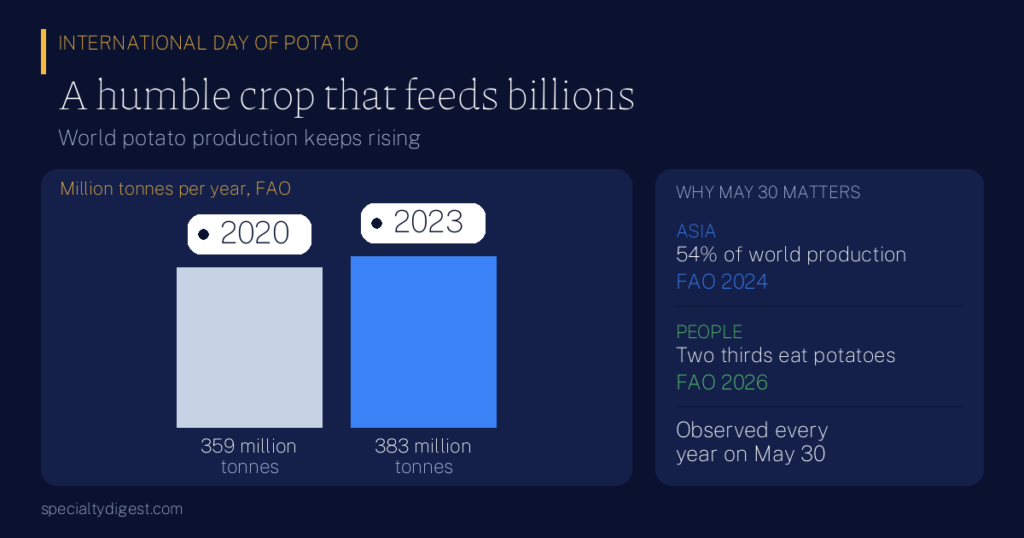
Global production reached a record 383 million tonnes in 2023, according to FAO. Three years earlier, in 2020, the figure was 359 million tonnes. That is a gain of about 24 million tonnes, or roughly 7 percent in three years. Over the past decade, FAO reports, world potato production has grown by about 10 percent. FAO describes the crop as grown in more than 100 countries.
- 383 milliontonnes produced worldwide in 2023, a record
- 100+countries where the crop is grown
- 54%of world production comes from Asia
- 2 in 3people in the world eat potatoes
Example 1: what another decade could bring. Suppose production grew by another 10 percent from the 2023 record of 383 million tonnes. The total would reach about 421 million tonnes, an extra 38 million tonnes. The arithmetic is round and illustrative, not a forecast, but it shows how modest percentage gains add up to a very large amount of food.
Why it matters for food security and prices
One quirk of the potato makes it central to food security. It is not traded across borders in large volumes, so local prices are driven mainly by domestic production. When a harvest is good, local markets are well supplied and food is affordable. When it fails, there is little imported supply to cushion the blow.
Example 2: a bad season. Imagine a country that normally harvests 10 million tonnes and loses 10 percent of the crop to drought and disease. A shortfall of 1 million tonnes cannot easily be filled by imports, so prices at local markets may climb. Households that spend a large share of their income on food feel it first. The numbers are made up for illustration, but the mechanism matches what FAO describes.
The threats are real. FAO says that sustaining growth is challenged by climate shocks, pests and diseases, and weak value chains, the links between farm, storage, transport and market.
Who grows it, and who is left behind
Potatoes are no longer a crop of the cool north alone. Developing countries now account for more than half of world output, and Asia leads with 54 percent of the global total, according to FAO’s 2024 statistical yearbook. In 2022 FAO also described Asia and Africa as the fastest-growing regions, while output was declining in Europe and North America. That shift puts smallholder farmers at the center of the story, and it explains why the 2026 theme focuses on farmers and their livelihoods.
Example 3: the cost of a weak link. Picture a cooperative of 50 farmers that harvests 1,000 tonnes in a season. Because storage and transport are poor, 100 tonnes spoil before reaching a buyer. Better storage that saves even half of that loss would add 50 tonnes of food and income without planting a single extra field. The figures are round and illustrative, but they show why strong value chains are named among the keys to growth.
How the day is marked
FAO leads the observance each year with a theme, a guide for organizers and events at its headquarters and country offices, including a celebration in Brussels. Farmers, chefs, schools, researchers and ministries are all invited to join, and many hold tastings, seed exhibitions and public talks. The call is simple: celebrate the crop, and invest in the people who grow it.
- 2024Harvesting diversity, feeding hope
- 2025Shaping history, feeding the future
- 2026Where potatoes grow, livelihoods flourish
Key Takeaways
- It began in the Andes. The potato was domesticated by the peoples of Peru and Bolivia and reached Europe in the 16th century.
- The day is young. The UN adopted resolution A/RES/78/123 in December 2023, and the first observance took place in 2024.
- It is a major food crop. Production hit a record 383 million tonnes in 2023, and about two thirds of the world’s people eat potatoes.
- It is efficient and nutritious. FAO cites low resource needs, lower emissions than other major crops, and vitamin C, potassium and folate.
- Prices follow the local harvest. Because potatoes are not traded in large volumes, a failed crop hits local markets hard.
- The future is in developing countries. They produce more than half of the world’s potatoes, and Asia alone produces 54 percent.
- Value chains matter. Climate shocks, pests and weak storage and transport remain the main obstacles to growth.
How solid is this? Production and share figures are FAO statistics and are revised as new data arrive. The Asia share comes from FAO’s 2024 yearbook, and country counts differ between FAO publications from different years, so this article says only that the crop is grown in more than 100 countries. The three worked examples use round, made-up numbers to show an idea. See also the International Days hub and the International Days Calendar.
More in Nature
- FAO, FAO welcomes decision to celebrate International Day of Potato annually on May 30 (2023)
- UN Digital Library, International Day of Potato, resolution A/RES/78/123 (2023)
- FAO, International Day of Potato 2026 theme (2026)
- FAO, Theme for International Day of Potato 2025 (2025)
- FAO, Potatoes: So Familiar, So Much More to Learn (2025)
- FAO, Doubling global potato production in 10 years is possible (2022)