Approaches to Crowd Management
Modern crowd management philosophy generally emphasizes a graduated response that begins with planning and communication rather than force. Before a large gathering such as a protest, parade, or sporting event, security planners typically coordinate with organizers to establish expected routes, timing, and crowd size, positioning officers to facilitate rather than confront participants under normal circumstances. Visible but non confrontational police presence, clear communication about expectations and restricted areas, and designated space for lawful assembly all represent preventive measures intended to reduce the likelihood that a gathering escalates into disorder requiring more forceful intervention.
Equipment and Tactics
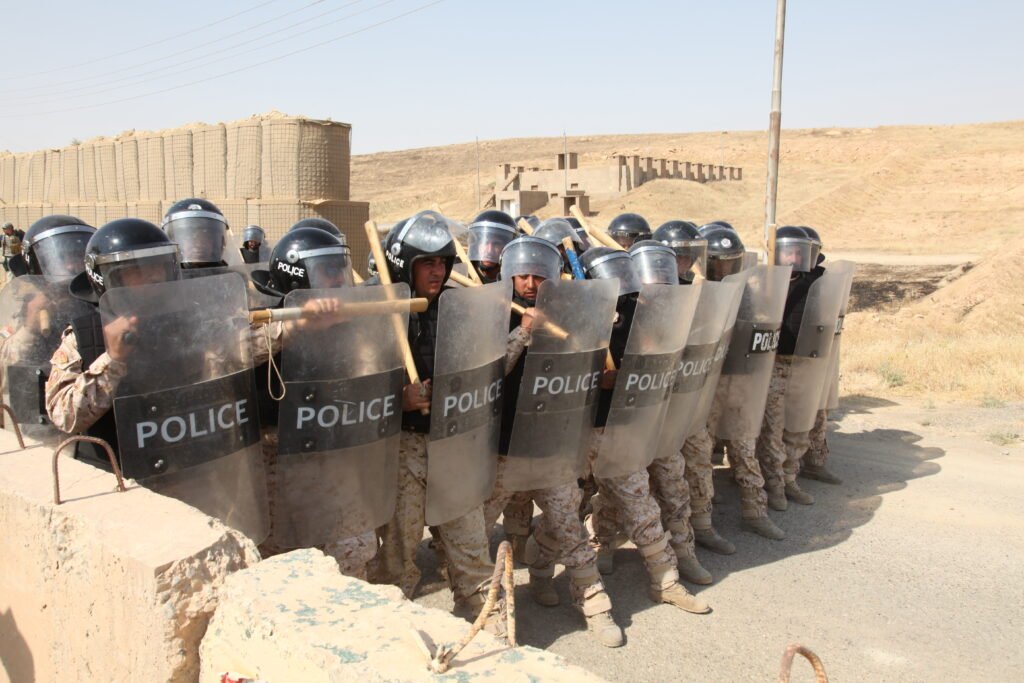
When a gathering turns disorderly or violent, security forces may employ a range of equipment and tactics calibrated to the severity of the threat, including forming physical lines with protective shields to control movement, deploying barriers to separate opposing groups, and in more serious situations using less-lethal tools such as tear gas, pepper spray, or rubber projectiles to disperse crowds that pose a danger. Many agencies have adopted specific protocols requiring clear warnings before using chemical agents or projectiles, along with documentation requirements intended to ensure accountability for force used during these operations. Specialized units often receive extensive training specifically focused on formation movements and equipment use in crowd settings.
Controversies and Reform Efforts
Riot control tactics have drawn significant public scrutiny and criticism, particularly regarding the use of chemical agents and projectile weapons that can cause serious injury even when officially classified as less-lethal, as well as concerns about tactics that fail to distinguish between violent individuals and peaceful participants caught in a broader crowd. High profile incidents involving crowd control tactics have prompted policy reviews and reforms in numerous jurisdictions, with many agencies revising use of force policies, improving officer training in deescalation techniques, and establishing clearer thresholds for when more forceful crowd control measures become appropriate rather than defaulting to them early in a response.
Training and Accountability Measures
Officers assigned to crowd control and riot management duties typically receive specialized training beyond standard police academy instruction, covering formation movements, communication within units during chaotic conditions, and decision making frameworks for determining when escalation is warranted. Training increasingly emphasizes deescalation techniques and recognizing the difference between a tense but still peaceful gathering and one that has genuinely turned dangerous, reflecting lessons learned from incidents where overly aggressive early intervention contributed to further escalation rather than resolving a situation. Many agencies now require body worn cameras or other documentation during crowd control operations specifically to create an accountability record, given the high public scrutiny these operations typically receive and the difficulty of reconstructing exactly what happened during fast moving, chaotic events without contemporaneous video evidence. After action reviews following significant crowd control incidents have become standard practice in many jurisdictions, examining whether force used was proportional to the actual threat, whether adequate warnings were given before escalation, and whether command decisions properly accounted for the presence of peaceful participants mixed among any disorderly elements within a larger crowd. Independent oversight bodies, including civilian review boards in some jurisdictions, have taken on expanded roles reviewing controversial crowd control incidents, reflecting broader public demand for accountability mechanisms beyond internal police review processes alone.
Legal Frameworks Governing Assembly and Response
Crowd control operations take place within a legal framework that generally protects the right to peaceful assembly while allowing authorities to impose reasonable restrictions related to time, place, and manner when necessary to protect public safety. Courts in many democratic countries have established standards requiring that any restriction on assembly rights be narrowly tailored to address genuine safety concerns rather than used as a pretext to suppress disfavored speech or viewpoints, creating an ongoing legal tension that crowd control commanders must navigate in real time during fast moving events. Permit systems requiring advance notice for large planned gatherings allow authorities to prepare appropriate staffing and traffic management, though spontaneous gatherings responding to breaking news events present particular challenges since they occur without the advance coordination that permit systems assume. International human rights frameworks have increasingly influenced domestic crowd control standards, with various treaty bodies and courts establishing principles regarding proportionality and necessity that inform national level use of force policies even in countries not directly bound by specific international rulings. The ongoing evolution of legal standards in this area reflects broader societal debate about the appropriate balance between public order and civil liberties, a tension unlikely to be permanently resolved given its roots in genuinely competing values rather than simple questions of pure technical implementation.
Equipment Procurement Debates
The acquisition of military surplus equipment by civilian police departments for crowd control purposes has generated considerable public debate in recent years, with critics arguing that armored vehicles and military grade gear contribute to an overly aggressive posture toward civilian protesters, while supporters contend that such equipment provides officers necessary protection during genuinely dangerous riot conditions. Some jurisdictions have restricted or banned specific categories of military equipment transfer to local police following high profile incidents, while others have maintained these programs citing officer safety concerns during the most volatile crowd control situations.
Ongoing research into crowd psychology and behavior continues to refine best practices, helping commanders better anticipate how specific tactical choices are likely to affect crowd mood and behavior in real time, informing more evidence based decision making during fast moving events rather than relying solely on traditional institutional practice passed down through standard training programs.
Officer wellness and fatigue management have also become recognized factors in crowd control effectiveness, since extended deployments during prolonged unrest can impair judgment and increase the likelihood of poor tactical decisions, prompting many agencies to establish rotation schedules that limit continuous duty time during extended operations.
More in Emergency and Disaster Security Operations
Key facts
- Includes tactics ranging from verbal communication to physical barriers and less-lethal weapons
- Distinguishes between peaceful assembly and violent disorder
- Equipment includes shields, batons, and chemical agents such as tear gas
- Training emphasizes proportional response and deescalation
Related concepts
Quick checkWhat is the difference between crowd management and riot control tactics?Show answer
Crowd management focuses on facilitating safe, peaceful assembly through communication, planning, and gentle guidance, while riot control tactics involve more forceful intervention, including physical barriers and less-lethal weapons, used specifically when a gathering turns violent or poses a clear danger to public safety.
Sources
- Police Executive Research Forum crowd management guidelines
- National Institute of Justice studies on less-lethal force
Editorially reviewed by Specialty Digest Editorial TeamLast reviewed November 4, 2026Researched and drafted with AI assistanceReport an issue