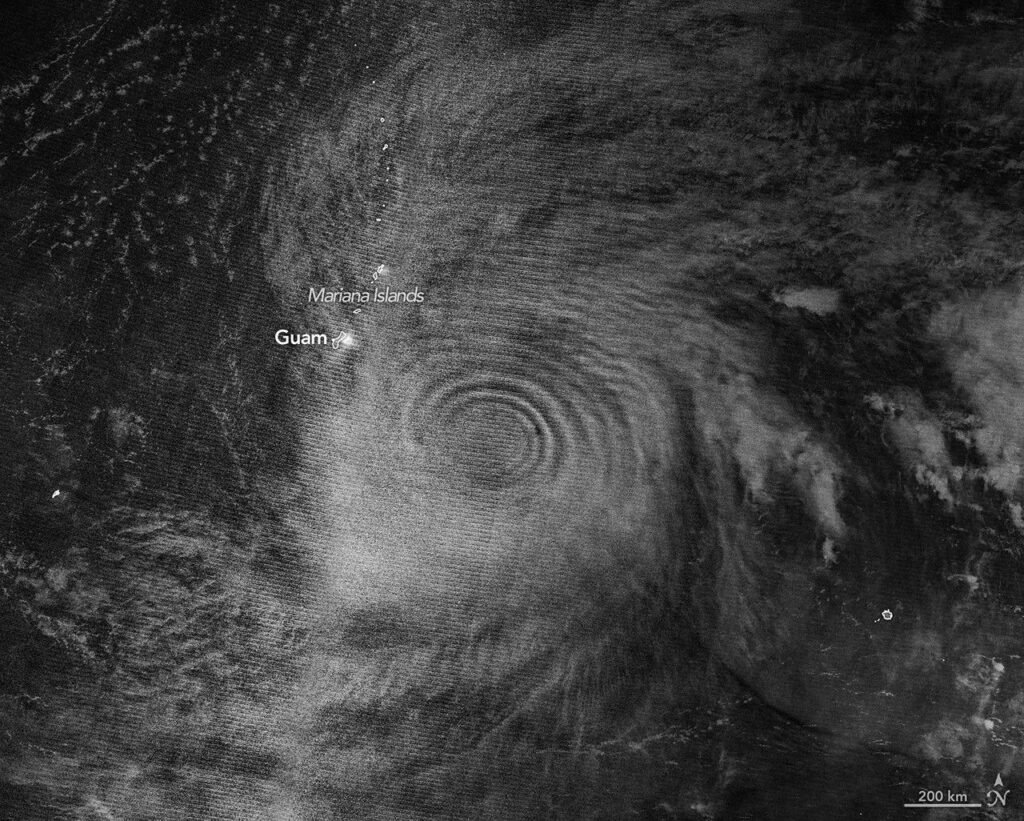
NASA says its Atmospheric Waves Experiment, known as AWE, has finished its mission on the International Space Station after capturing more than 80 million nighttime images of waves in the upper atmosphere. Ground controllers powered the instrument down on May 21, 2026. This article summarizes NASA’s account of what AWE watched, what it found about the size of the waves that matter most and what replaces it.
What was AWE?
AWE was an instrument mounted on the outside of the International Space Station. Utah State University’s Space Dynamics Laboratory built it and provided the mission operations center. It launched on November 9, 2023. NASA says it stayed on the station for 30 months, longer than its planned two-year mission. Ludger Scherliess of Utah State University was the principal investigator, and NASA’s Goddard Space Flight Center in Greenbelt, Maryland managed it through the Explorers Program Office.
What did it study?
AWE studied atmospheric gravity waves, which carry energy from weather events upward into space, and how they contribute to space weather. These waves are ripples in the atmosphere, not related to the gravitational waves of astrophysics. That clarification is general and is not a NASA quotation. The instrument captured four infrared images per second, which NASA says added up to more than 80 million nighttime images.
What did it observe?
NASA lists several events the instrument watched. They include a tornado outbreak across the central United States in May 2024, a hurricane that struck Florida’s Gulf coast in September 2024, observed on September 26, 2024, and a north Texas thunderstorm on May 26, 2024. NASA says that storm produced smaller, more irregular waves than storms earlier that month. We mention these events only as observations of the atmosphere and do not discuss their effects on people.
What is the key finding?
NASA reports that the gravity waves with the greatest influence on the upper atmosphere have horizontal wavelengths of 30 to 300 kilometers. A horizontal wavelength is the distance between successive crests of a wave measured along the ground. That finding tells scientists which size of wave to prioritize when modeling how weather affects space weather. NASA’s page does not give further numbers about energy or heights, so we do not add any.
How to read the numbers
By our own arithmetic, 80 million images at four per second equals about 20 million seconds of imaging, or roughly 231 days of observing time. The instrument only imaged at night, so that time was collected over 30 months. The 30-month stay is six months, or 25%, longer than the planned two years. The range of 30 to 300 kilometers spans a factor of ten between the shortest and longest important waves. These calculations are ours and are not NASA statements.
What happens to the instrument?
NASA says the station’s Canadarm2 robotic arm will remove AWE, and it will be disposed of on a SpaceX Dragon cargo spacecraft that will burn up on reentry. Another instrument, CLARREO Pathfinder, will take its place. NASA says CLARREO Pathfinder will measure reflected sunlight five to 10 times more accurately than existing sensors. The page does not describe the schedule for either step.
Why does space weather matter?
Space weather affects satellites, radio signals and navigation systems. The better scientists understand how the lower atmosphere influences the upper layers, the better they can model those effects. That is a general rationale and is not quoted from NASA, which describes the mission goal more narrowly. For the broader picture of solar activity, our article on the solar maximum announced by NASA and NOAA explains what the Sun is doing now.
How does it connect to other coverage?
The station hosts many experiments that are mounted outside, and the arm that will remove AWE is part of the same infrastructure. Our article on the NASA ISAM State of Play covers technologies for servicing and assembly in orbit, and our report on the end of the Swift mission covers another NASA science spacecraft that reached the end of its life this fall. Together, they show how missions are retired as new instruments arrive.
What is the difference between a mission end and a result?
Powering down an instrument ends data collection but not analysis. With more than 80 million images, researchers will keep working for years. NASA’s summary reports the headline finding about wavelength, but fuller results will appear in scientific papers, which can take time. Readers should treat the 30 to 300 kilometer range as the main result NASA highlights so far, not as the last word.
Glossary
- Gravity wave: a ripple in the atmosphere driven by buoyancy, such as air pushed up by a storm
- Space weather: conditions in near-Earth space that can affect technology
- Wavelength: the distance between two crests of a wave
- Infrared image: a picture made with heat-sensitive light rather than visible light
- Residency: the time an instrument stays on a platform such as the station
These definitions are general explanations and are not quoted from NASA.
What is not covered here?
NASA’s page does not give the altitude range AWE observed, the energy in the waves or the paper in which the wavelength result was published. We have not added them. Readers can look for those details in NASA’s mission pages and the scientific literature.
Key facts at a glance
- Launch: November 9, 2023, to the International Space Station
- Powered down: May 21, 2026, after 30 months
- Images: four per second, more than 80 million at night
- Key finding: influential waves have wavelengths of 30 to 300 kilometers
- Replacement: CLARREO Pathfinder
Frequently asked questions
Did AWE watch gravitational waves?
No. It watched atmospheric gravity waves, which are ripples in the air.
How long did it operate?
Thirty months, beyond a planned two-year mission.
What happens to it now?
Canadarm2 will remove it and it will burn up on a Dragon cargo spacecraft.
More in Science
- ISS Science in 2025: NASA Reports More Than 750 Investigations and Six Highlights
- NASA Adds Three Moon Base Science Investigations: A Lava Tube Scan, Ice Imaging and a Hazard Station
- Cat's Head Nebula in Hubble and Webb Light: What NASA Shows Inside the Carina Nebula
- Juice Flew Past Earth: DLR Reports 740 Images on the Way to Jupiter