NASA has added three new science investigations to its Moon Base program, selected through a payload program called PRISM. The release, dated September 30, 2026 and updated October 2, describes one station to monitor hazards near the lunar south pole, one set of instruments to look for a lava tube and one imager to measure ice in permanently cold spots. This article on Moon Base science investigations summarizes what NASA says about each, how they will reach the Moon and what the release leaves out.
What did NASA announce?
NASA selected three investigations and their payload suites through its Payloads and Research Investigations on the Surface of the Moon program, known as PRISM. The payloads will reach the lunar surface through NASA’s Commercial Lunar Payload Services initiative, as part of the Moon Base Program, whose goal NASA describes as building humanity’s first lunar outpost. The release was updated on October 2, 2026 to correct the full names of the DISCO and GIMLI payloads. The release gives no launch or landing dates.
What is LEMS-SP?
The Lunar Environment Monitoring Station, South Pole, is an autonomous, long-term station for monitoring environmental hazards. NASA says it tracks falling micrometeoroids and volatiles entering the Moon’s thin atmosphere, and it uses a short-period seismometer to detect seismic events. A micrometeoroid is a tiny particle of space rock, and a seismometer measures ground shaking. The principal investigator is Mehdi Benna of the University of Maryland, Baltimore County.
What is GIMLI?
The Geophysical Instruments for Marius Lunar pit Investigation will be deployed at the Marius Hills Pit to scan beneath the surface for a possible large lava tube. NASA notes that underground lava tubes could offer natural shelter from temperature extremes and radiation. The principal investigator is Nathaniel Putzig of the Planetary Science Institute. The release describes the lava tube as possible, so its existence is not established.
What is DISCO?
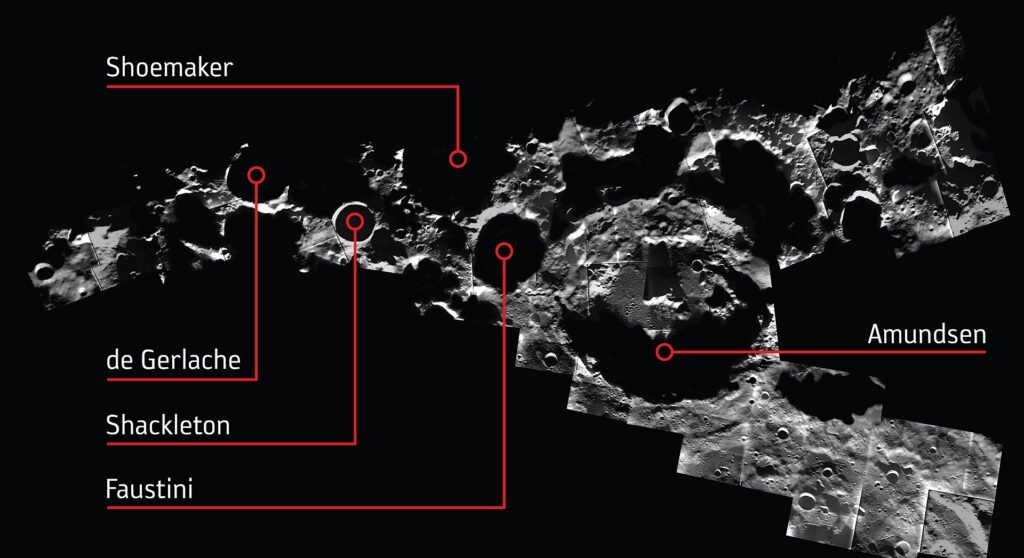
The Depth Imager with Spectral and Color Optics aims to make the first direct, on-the-ground measurements of ice in lunar micro-cold traps. A cold trap is a place so cold that frozen water can survive for a very long time. NASA says DISCO will also study how the surface responds to rocket exhaust and how stable it is for mobility, and it will support future work on turning ice into a usable resource. The principal investigator is Ariel Deutsch of NASA’s Ames Research Center.
How to read the announcement
These are selections, not results. Each instrument has to be built, delivered and landed before it can measure anything. The words possible, aims and will describe goals. By our own arithmetic, the release names three investigations and three principal investigators, one for each. The release gives no cost, mass or schedule, so we cannot say when any data will arrive. Our summary is therefore a preview of planned science and not a report of lunar findings.
Why do these three topics matter?
Hazards, shelter and water are the main practical questions for a long stay on the Moon. Monitoring micrometeoroids and moonquakes helps planners understand risks. Finding a lava tube could offer a protected space, and finding ice that can be used would reduce the amount of water that must be carried from Earth. That linking of the three topics to a lunar outpost is our general reading, and NASA’s release states the shelter and resource points more briefly.
How does a commercial delivery program work?
NASA says the payloads will travel through its Commercial Lunar Payload Services initiative. In general terms, that means NASA buys delivery from private companies, which build and fly the landers, while NASA supplies the science instruments. The release does not name the lander companies for these three payloads, so we do not either. The approach lets NASA add science to flights without building each lander itself.
What should readers watch for next?
The next news will be the choice of landers and landing dates, which NASA has not announced in this release. Until then, the selections show what science NASA wants on the surface early in a lunar outpost, not when it will happen. Readers should also watch for how the investigations are described once instruments are built, because plans often change as hardware is tested. NASA corrected two payload names within days of the first release, which is a reminder that early details can be revised.
How does it connect to other coverage?
These payloads are part of the larger effort to return people to the Moon. Our article on Artemis III covers the 2027 mission that tests lunar landers in Earth orbit, and our report on the Artemis II science data release covers material from the first crewed flyby. Our summary of Artemis II describes that flight, and the article on the NASA ISAM State of Play covers technologies for building in space. The pieces fit together as steps toward a lasting presence.
Glossary
- Moon Base: NASA’s name for its planned first long-term lunar outpost
- PRISM: a NASA program for payloads and research investigations on the lunar surface
- CLPS: NASA’s initiative to buy commercial deliveries to the Moon
- Lava tube: an underground tunnel left by flowing lava
- Cold trap: a permanently cold spot where ice can last
These definitions are general explanations and are not quoted from NASA.
What is not covered here?
The release does not give landing sites beyond the Marius Hills Pit and the south pole, the instruments’ masses or their costs, and it does not say which companies will deliver them. We have not added these.
Key facts at a glance
- Program: PRISM, under the Moon Base Program
- Selected: three investigations
- Delivery: through Commercial Lunar Payload Services
- Investigations: LEMS-SP, GIMLI and DISCO
- Release: September 30, 2026, updated October 2
Frequently asked questions
Do we know if a lava tube exists?
No. GIMLI is meant to scan for a possible one.
When will they launch?
NASA’s release gives no dates.
What does DISCO measure?
Ice in lunar micro-cold traps, and how the surface responds to rocket exhaust.
More in Science