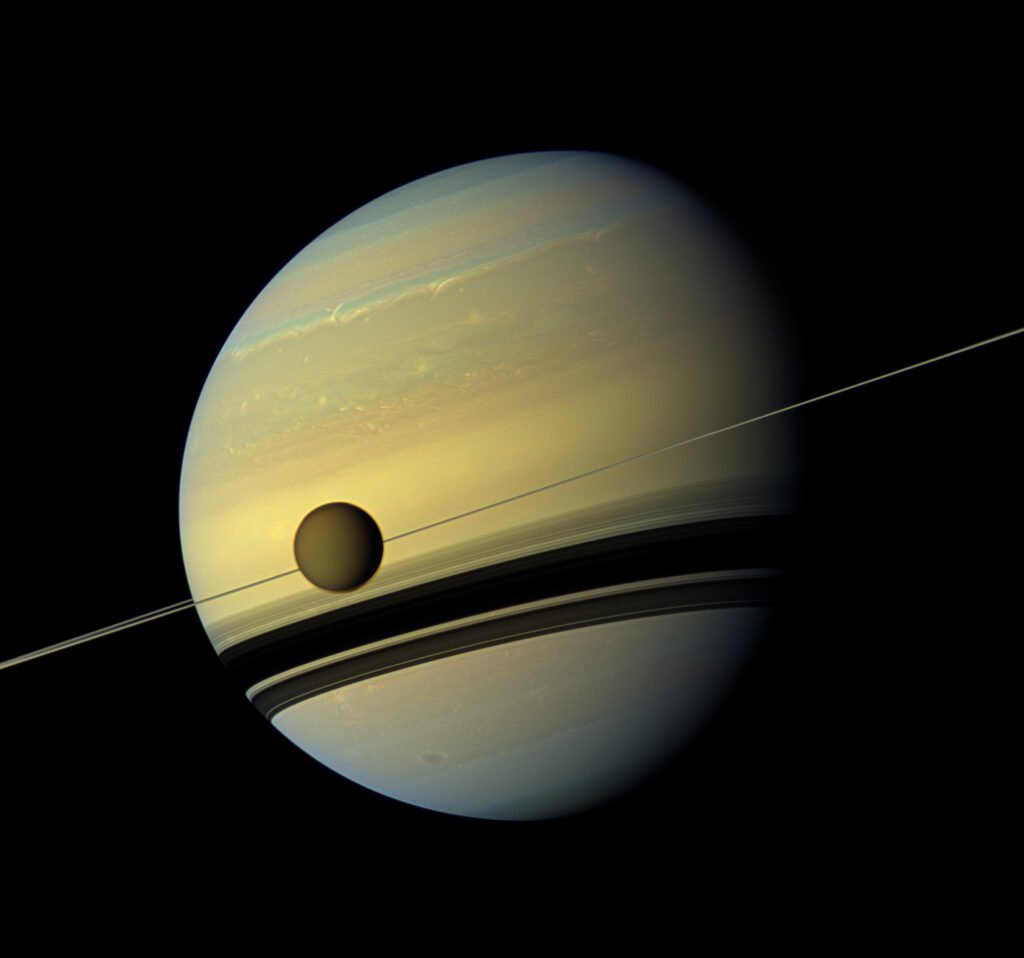
NASA’s Dragonfly team completed the mission’s first simulated flight on October 23, 2026, according to a NASA mission blog. Dragonfly is a rotorcraft designed to fly across the surface of Titan, the largest moon of Saturn. This article summarizes what NASA reported about the test, explains what a simulated flight shows and flags what it does not.
What did the test involve?
NASA says the test ran in real time on flight-like avionics at the Johns Hopkins Applied Physics Laboratory in Laurel, Maryland. In the simulation, the rotorcraft flew over a safe landing site, circled back and began its final descent. The navigation software used simulated inputs from the sensors the real vehicle will carry: navigation cameras, inertial measurement units and lidar. NASA also reported that rendering the simulated scene took about 20 to 70 milliseconds.
Why does a simulated flight matter?
Dragonfly will fly on a world with no pilot in range. Radio signals take a long time to reach Titan, so the vehicle must find a landing site and land on its own. A test that runs the real flight software on flight-like hardware checks that the pieces work together under timing limits. This general explanation is ours and is not quoted from NASA. By our own arithmetic, a scene render of 20 to 70 milliseconds means the software can process roughly 14 to 50 simulated views each second, though NASA does not describe it that way.
What is the mission timeline?
NASA lists these dates and durations for the mission:
- Launch: no earlier than 2028
- Cruise: about six years
- Arrival at Titan: 2034
- Flying between sites: about three years
The blog describes Dragonfly’s first flight on Titan as taking place nearly a billion miles from Earth. The dates are targets and can change.
Why is Titan a target?
Titan has a thick atmosphere, which makes flight by rotorcraft practical in a way that is hard on many other worlds. That is a general point and not a claim from the blog we read. For other recent outer solar system missions, see our reports on Europa Clipper and Voyager.
What does each sensor contribute?
NASA names three sensor types in the simulation. The following roles are general descriptions of how such sensors are used and are not quoted from the blog. Navigation cameras supply images of the ground that software can match against a map or use to spot hazards. Inertial measurement units track how the vehicle accelerates and turns between images. Lidar measures the distance to the surface, which helps judge height and the roughness of a landing area. Combining the three lets the software estimate where the vehicle is and whether a site is safe, which is the task NASA described when the rotorcraft flew over a safe landing site and then began its final descent.
What is the difference between a simulation and a flight test?
In a real-time simulation, the actual flight software and avionics run as if they were flying, while the world around them is modeled by a computer. That is different from a flight test, where a physical vehicle moves through real air. The value of the first is that mistakes in timing, data handling and decision logic show up on the ground, where they can be fixed cheaply. The limit is that the modeled world may differ from the real one. The NASA blog presents the result as a milestone for the flight system and not as proof of performance on Titan. This framing is our reading of the blog and is not a quotation.
What does the timeline imply?
By our own arithmetic, a launch no earlier than 2028 plus a six-year trip is consistent with the stated 2034 arrival. The three years of flying between sites then follow arrival. NASA gives the dates as plans, and any slip in launch would move the later dates. Readers who want to track the mission should watch for announcements on integration and testing rather than any single date.
How to read the news
A simulated flight is a software and avionics test, so it shows that the control logic works against modeled conditions. It does not show how the vehicle behaves in Titan’s actual air, ground and temperature. The NASA blog reports the milestone and does not claim otherwise. Readers should treat the timeline as the plan today.
How does Dragonfly connect to other missions?
Dragonfly belongs to a family of missions that use autonomy and remote testing before launch. Our articles on Psyche and Hera describe other spacecraft heading to small or distant targets, and the report on the James Webb Space Telescope covers an observatory that studies the outer solar system from afar.
What should readers watch for next?
The next steps are further testing of the flight system, integration of the vehicle and preparation for a launch window no earlier than 2028. NASA has not announced more simulated flights in the blog we read.
Glossary
- Rotorcraft: an aircraft that gets lift from rotating blades
- Avionics: the electronic systems that control a flying vehicle
- Inertial measurement unit: a sensor that measures acceleration and rotation
- Lidar: a sensor that measures distance with laser light
- Titan: Saturn’s largest moon
These definitions are general explanations and are not quoted from NASA.
What is not covered here?
We read one NASA blog post. We did not read the mission’s technical papers and we give no performance figures beyond those in the post.
Key facts at a glance
- Date of test: October 23, 2026
- Place: Johns Hopkins APL, Laurel, Maryland
- Sensors simulated: cameras, inertial units, lidar
- Launch: no earlier than 2028; arrival 2034
Frequently asked questions
Did Dragonfly fly on Titan?
No. The flight was a simulation on the ground.
When does Dragonfly launch?
NASA lists no earlier than 2028.
Why must it fly itself?
Titan is too far away for live piloting, which is our general explanation.
More in Science