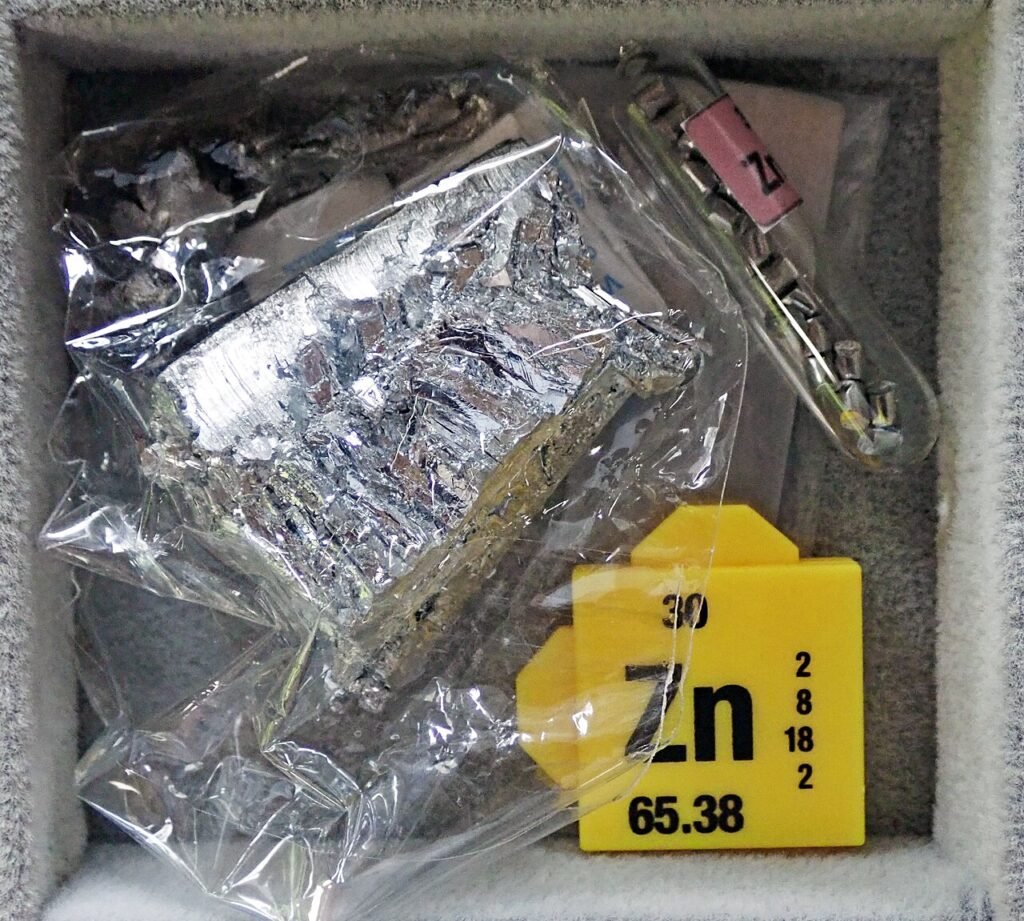
Zinc is the chemical element with atomic number 30 and the symbol Zn. It is a silvery-white metal with a blue tinge that tarnishes in air, and it sits in group 12 of the periodic table. Most zinc is used to protect steel from rusting, and the element is also essential to every living thing.
History of zinc
Zinc was known to the Greeks and Romans before 20 BC, but it was rarely used as a metal. It was first recognized as a metal in its own right in India. The waste from a zinc smelter at Zawar, in Rajasthan, testifies to the large scale on which zinc was refined there between about 1100 and the 1500s. Refining in China was also carried out on a large scale by the 1500s.
Evidence of the Chinese trade survives in an unusual way. An East India Company ship that sank off the coast of Sweden in 1745 was carrying a cargo of Chinese zinc, and analysis of the ingots that were recovered showed them to be almost pure metal.
In 1668 a Flemish metallurgist, P. Moras de Respour, reported extracting metallic zinc from zinc oxide. As far as Europe was concerned, however, zinc was discovered by the German chemist Andreas Marggraf in 1746, and he was the first to recognize it as a new metal. The name comes from the German word zinc, which may in turn come from the Persian word sing, meaning stone.
The Royal Society of Chemistry gives 1746 as the year zinc was identified as an element and names Marggraf as the discoverer, while noting that the metal was known to the Greeks and Romans before 20 BC. A zinc-nickel alloy called pai-t’ung, or white copper, was also in use in China as long ago as 200 BC.
Properties of zinc
Zinc has a standard atomic weight of about 65.38, which NIST lists with an uncertainty of 2 in the last digit. A zinc atom has 30 protons and an electron configuration of [Ar] 4s2 3d10, meaning the arrangement of argon plus two electrons in the 4s level and a full set of ten in the 3d level.
At room temperature zinc is a solid with a density of 7.134 grams per cubic centimeter. Its melting point is 692.68 kelvins, about 420 degrees Celsius, and PubChem gives a boiling point of 1,180 kelvins, about 907 degrees Celsius. These values are much lower than those of neighbors such as iron, copper and nickel. In compounds zinc has a single common oxidation state, plus 2, where an oxidation state is a number that tracks how many electrons an atom has lost or shared.
Zinc and copper both have a completely filled 3d level of ten electrons, but copper has two common oxidation states while zinc has only one. The Royal Society of Chemistry describes zinc as a silvery-white metal with a blue tinge.
PubChem also records an electronegativity of 1.65 on the Pauling scale, a first ionization energy of 9.394 electronvolts and an atomic radius of 139 picometers. The Royal Society of Chemistry notes that the metal tarnishes in air.
Occurrence and production of zinc
Zinc is found in several ores. The principal ones are zinc blende, which is zinc sulfide, and calamine, which is zinc silicate. The principal mining areas are in China, Australia and Peru.
Commercially, zinc is obtained by concentrating and roasting the ore and then reducing it to the metal, either by heating with carbon or by electrolysis. Roasting turns the sulfide into an oxide, and reduction removes the oxygen. According to the Royal Society of Chemistry, world production is more than 11 million tonnes a year. Zinc refining is also the main source of another element: gallium is produced mainly as a by-product of zinc refining.
Concentrating an ore means separating the zinc-bearing mineral from waste rock, and roasting it in air converts zinc sulfide into zinc oxide, which can then be reduced to the metal.
Uses of zinc
Most zinc is used to galvanize other metals, such as iron, to prevent rusting. Galvanizing means coating a metal with zinc. Galvanized steel is used for car bodies, street lamp posts, safety barriers and suspension bridges. Zinc protects the steel beneath it from corrosion.
Large quantities of zinc are also used to make die-castings, which are metal parts formed by forcing molten metal into a mold. They are important in the automobile, electrical and hardware industries. Zinc is used in alloys such as brass, nickel silver and aluminum solder.
Zinc oxide is widely used in the manufacture of paints, rubber, cosmetics, pharmaceuticals, plastics, inks, soaps, batteries, textiles and electrical equipment. Zinc sulfide is used to make luminous paints, fluorescent lights and X-ray screens.
Isotopes of zinc
NIST lists five stable isotopes of zinc: zinc-64, zinc-66, zinc-67, zinc-68 and zinc-70. Zinc-64 is the most abundant, at about 49.17 percent of natural zinc, followed by zinc-66 at about 27.73 percent and zinc-68 at about 18.45 percent. Zinc-67 accounts for about 4.04 percent and zinc-70 for about 0.61 percent. An isotope is a form of an element with a particular number of neutrons.
Zinc-64, zinc-66 and zinc-68 together make up about 95.35 percent of natural zinc.
Zinc in life and the environment
Zinc is essential for all living things. It forms the active site of more than 20 metalloenzymes, which are enzymes that need a metal atom to work. The average human body contains about 2.5 grams of zinc and takes in about 15 milligrams a day. Some foods have above-average levels of zinc, including herring, beef, lamb, sunflower seeds and cheese.
The Royal Society of Chemistry also warns that zinc can be carcinogenic in excess. If freshly formed zinc(II) oxide is inhaled, a disorder known as oxide shakes or zinc chills can occur. The information here is general background rather than health advice.
Key facts
- Zinc has atomic number 30, symbol Zn, and sits in group 12 and period 4 of the periodic table.1
- Andreas Marggraf recognized zinc as a new metal in 1746, though it was refined in India and China centuries earlier.1
- Zinc is a solid at room temperature with a density of 7.134 grams per cubic centimeter and melts at 692.68 kelvins.2
- Zinc has five stable isotopes, and zinc-64 makes up about 49.17 percent of natural zinc.3
- The main zinc ores are zinc blende and calamine, and world production is more than 11 million tonnes a year.1
Related concepts
In the news
Quick checkWhat is zinc mostly used for?Show answer
Most zinc is used to galvanize other metals such as iron, coating them to prevent rusting. It is also used in alloys such as brass and in zinc oxide products.
Sources
- Royal Society of Chemistry, Periodic Table: Zinc, https://periodic-table.rsc.org/element/30/zinc
- National Center for Biotechnology Information, PubChem Periodic Table: Zinc, https://pubchem.ncbi.nlm.nih.gov/element/30
- National Institute of Standards and Technology, Atomic Weights and Isotopic Compositions for Zinc, https://physics.nist.gov/cgi-bin/Compositions/stand_alone.pl?ele=Zn
Editorially reviewed by Specialty Digest Editorial TeamLast reviewed November 4, 2026Researched and drafted with AI assistanceReport an issue