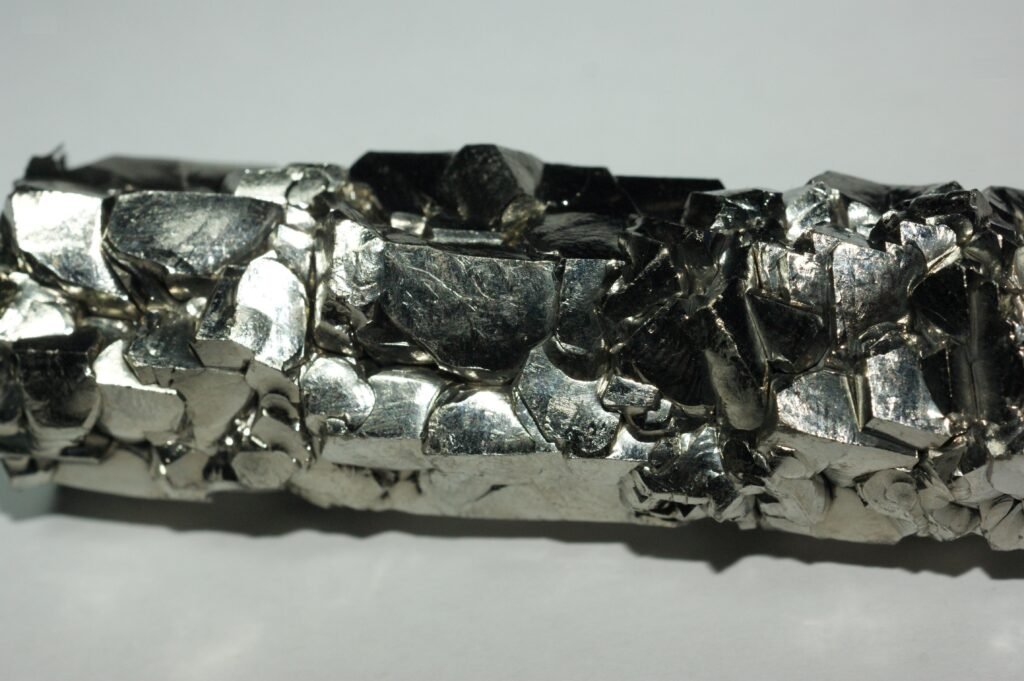
Zirconium is the chemical element with atomic number 40 and the symbol Zr. It is a hard, silvery transition metal in group 4 of the periodic table, and it is very resistant to corrosion. More than 90 percent of the metal is used in nuclear power stations, because it hardly absorbs neutrons.
History of zirconium
Gems that contain zirconium were known in ancient times under the name zircon. In 1789 the German chemist Martin Klaproth analyzed a zircon and separated zirconium in the form of its earth, zirconia, which is the oxide ZrO2. Klaproth could not isolate the pure metal, and Humphry Davy also failed when he tried electrolysis in 1808.
The element was first isolated in 1824 by the Swedish chemist Jöns Jacob Berzelius. He heated potassium hexafluorozirconate with potassium metal and obtained some zirconium as a black powder. Completely pure zirconium was produced only in 1925 by the Dutch chemists Anton Eduard van Arkel and Jan Hendrik de Boer, who decomposed zirconium tetraiodide.
The Royal Society of Chemistry gives 1789 as the discovery date and credits Klaproth. The name comes from zircon, the form in which the element was first found.
Properties of zirconium
Zirconium is a solid at 20 degrees Celsius. It melts at 1854 degrees Celsius, boils at 4406 degrees Celsius and has a density of 6.52 grams per cubic centimeter. NIST gives its standard atomic weight as 91.224. The electron configuration is [Kr] 4d2 5s2, and the common oxidation state listed by PubChem is plus 4, which corresponds to all four outer electrons being given up.
The metal is protected by a thin oxide layer that makes it exceptionally resistant to corrosion by acids, alkalis and seawater. Corrosion is the gradual wearing away of a metal by chemical attack, and the oxide film on zirconium acts as a barrier against it. The Royal Society of Chemistry describes the appearance as a hard, silvery metal.
PubChem lists an electronegativity of 1.33, a first ionization energy of 6.634 electronvolts and an electron affinity of 0.426 electronvolts. The Royal Society of Chemistry gives a covalent radius of 1.64 angstroms and a non-bonded radius of 2.23 angstroms. Electron affinity is the energy released when an electron is added to a neutral atom. With niobium, zirconium becomes superconducting at low temperatures, which means it carries electric current with no resistance.
The Royal Society of Chemistry lists the first five ionization energies of zirconium as 640.074, 1264, 2218.2, 3313.31 and 7752.404 kilojoules per mole. The first four rise gradually, and the fifth is much larger, which is consistent with the plus 4 oxidation state. The same source says that niobium-zirconium alloys are used to make superconducting magnets.
Occurrence and production of zirconium
Zirconium occurs in about 30 mineral species, and the major ones are zircon and baddeleyite. More than 1.5 million tonnes of zircon are mined each year, mainly in Australia and South Africa. Most baddeleyite is mined in Brazil.
The metal is made commercially in two steps. Zircon is first converted to zirconium chloride, and then the chloride is reduced with magnesium to give the metal. This method replaced the laboratory techniques of the nineteenth century and allows the metal to be produced in bulk.
Uses of zirconium
The main use of zirconium comes from its unusual behavior toward neutrons. In a reactor, neutrons sustain the chain reaction, so the metal that surrounds the fuel should not soak them up. Because zirconium does not absorb them, it is an ideal material for use in nuclear power stations, and more than 90 percent of the metal is used this way. A nuclear reactor can contain more than 100,000 meters of zirconium alloy tubing. Zirconium alloys are also used by the chemical industry because of their resistance to corrosion.
Zirconium(IV) oxide is used in ultra-strong ceramics. It is made into crucibles that withstand heat shock, furnace linings, foundry bricks and abrasives, and it is used by the glass and ceramics industries. Zirconium(IV) oxide is also the basis of other products. The ceramic is strong enough that even scissors and knives can be made from it. The Royal Society of Chemistry adds that it is used in cosmetics, antiperspirants and food packaging, and to make microwave filters.
Zircon is a semi-precious gemstone found in a variety of colors, and the most desirable stones have a golden hue. Cubic zirconia, which is zirconium oxide, is a synthetic gemstone whose colorless cut stones resemble diamonds. Zircon mixed with vanadium or praseodymium makes blue and yellow pigments for glazing pottery.
The words zircon, zirconia and zirconium are related but not interchangeable. Zircon is the mineral and gemstone, zirconia is the oxide ZrO2, and zirconium is the element itself. Cubic zirconia is the synthetic stone made from the oxide.
Isotopes of zirconium
Isotopes are atoms of the same element with different numbers of neutrons. NIST lists five naturally occurring isotopes of zirconium: zirconium-90 at 51.45 percent, zirconium-91 at 11.22 percent, zirconium-92 at 17.15 percent, zirconium-94 at 17.38 percent and zirconium-96 at 2.80 percent. Zirconium-90 makes up about half of natural zirconium, and the Royal Society of Chemistry lists zirconium-90, zirconium-92 and zirconium-94 as key isotopes. Zirconium-96 is the rarest at 2.80 percent. NIST attaches an uncertainty of 40 in the last two digits to the zirconium-90 value, which signals that natural samples vary somewhat in their composition.
Health and environmental effects of zirconium
The Royal Society of Chemistry reports that zirconium has no known biological role and has low toxicity. Its main connection to safety is through nuclear power, where its low neutron absorption and corrosion resistance are valued in reactor components. The information here is general background and not advice.
Key facts
- Zirconium has atomic number 40, symbol Zr, and sits in group 4 and period 5 of the periodic table.1
- Zirconium melts at 1854 degrees Celsius, boils at 4406 degrees Celsius and has a density of 6.52 grams per cubic centimeter.1
- Martin Klaproth separated zirconia from zircon in 1789, and pure zirconium was first made in 1925 by van Arkel and de Boer.1
- More than 90 percent of zirconium is used in nuclear power stations because it does not absorb neutrons.1
- Zirconium has five naturally occurring isotopes, and zirconium-90 is the most abundant at 51.45 percent.2
Related concepts
Quick checkWhy is zirconium used in nuclear reactors?Show answer
It does not absorb neutrons and resists corrosion, so alloy tubing made from it can be used in reactors. More than 90 percent of zirconium is used this way.
Sources
- Royal Society of Chemistry, Periodic Table: Zirconium, https://periodic-table.rsc.org/element/40/zirconium
- National Institute of Standards and Technology, Atomic Weights and Isotopic Compositions for Zirconium, https://physics.nist.gov/cgi-bin/Compositions/stand_alone.pl?ele=Zr&ascii=html&isotype=some
- National Center for Biotechnology Information, PubChem Periodic Table: Zirconium (element 40), https://pubchem.ncbi.nlm.nih.gov/element/40
Editorially reviewed by Specialty Digest Editorial TeamLast reviewed November 4, 2026Researched and drafted with AI assistanceReport an issue