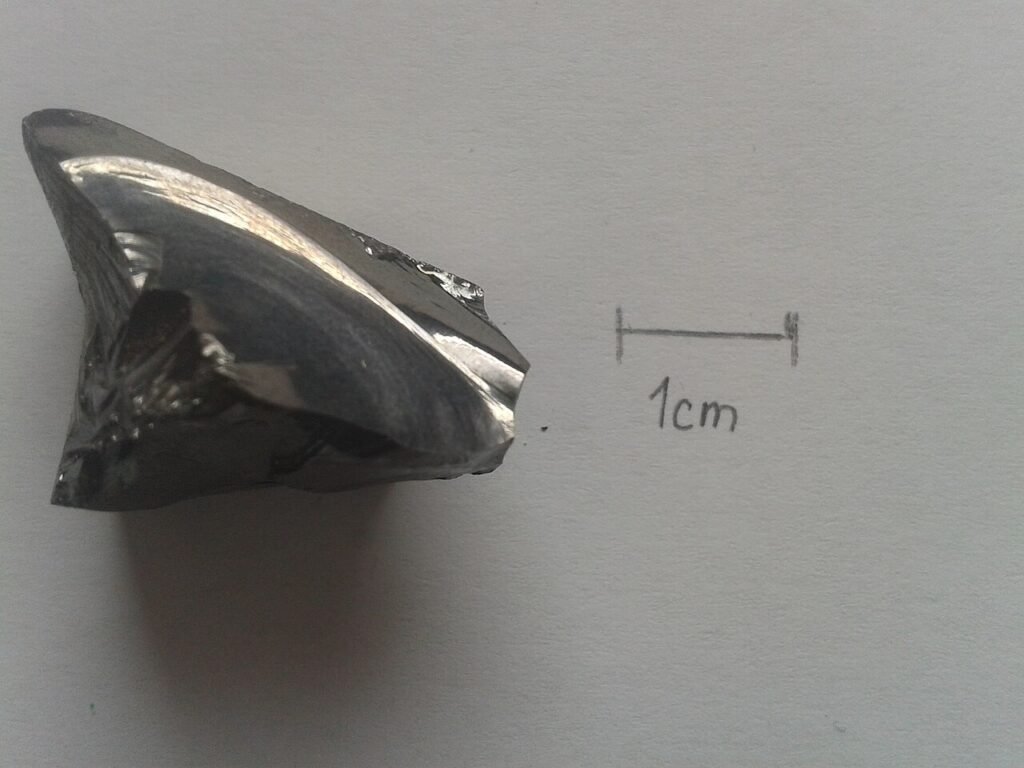
Selenium is the chemical element with atomic number 34 and the symbol Se. It sits in group 16 of the periodic table, below sulfur, and it exists as a silvery gray solid and as a red powder. The Royal Society of Chemistry calls it a semi-metal, while PubChem classifies it as a nonmetal. Selenium is best known as an additive in glass, as a material in light-sensitive electronics and as an essential trace nutrient.
History of selenium
Selenium was discovered by the Swedish chemist Jons Jacob Berzelius in Stockholm in 1817. He had shares in a sulfuric acid works, and he was intrigued by a red-brown sediment that collected at the bottom of the chambers in which the acid was made.
At first Berzelius thought the sediment was the element tellurium, because it gave off a strong smell of radishes when heated. He eventually realized that it was in fact a new element, with properties intermediate between sulfur and tellurium. He also found selenium in samples of tellurium, and it was the selenium that gave tellurium its characteristic smell.
Berzelius became affected by the new element personally. The Royal Society of Chemistry reports that selenium can be absorbed through the skin, and that it caused him to experience the bad breath associated with people who work with it. The name comes from selene, the Greek name for the Moon.
Properties of selenium
Selenium has a standard atomic weight of about 78.971, and NIST lists the value with an uncertainty of 8 in the last digit. A selenium atom has 34 protons and an electron configuration of [Ar] 4s2 3d10 4p4, meaning the arrangement of argon plus two electrons in the 4s level, ten in the 3d level and four in the 4p level.
Selenium can exist in two forms, a silvery metal and a red powder, and it has red, grey and black allotropes, which are different structural forms of the same element. At room temperature it is a solid with a density of 4.809 grams per cubic centimeter. PubChem gives a melting point of 493.65 kelvins, about 220.5 degrees Celsius, and a boiling point of 958 kelvins, about 685 degrees Celsius.
PubChem lists the common oxidation states of selenium as plus 6, plus 4 and minus 2. An oxidation state is a number that tracks how many electrons an atom has lost, gained or shared in a compound. PubChem also records an electronegativity of 2.55 on the Pauling scale, a first ionization energy of 9.752 electronvolts, an electron affinity of 2.021 electronvolts and an atomic radius of 190 picometers.
Occurrence and production of selenium
Selenium is found in a few rare minerals. Most of the world’s selenium is obtained from the anode muds that are produced during the electrolytic refining of copper. In electrolytic refining, an electric current moves copper from an impure anode to a pure cathode, and the unwanted elements that do not dissolve settle as a mud at the bottom of the cell.
To release the selenium, these muds are either roasted with sodium carbonate or sulfuric acid, or smelted with sodium carbonate. Most selenium production is therefore linked to the copper industry.
Uses of selenium
The biggest use of selenium is as an additive to glass. Some selenium compounds decolorize glass, while others give it a deep red color. Selenium can also reduce the transmission of sunlight through architectural glass and give it a bronze tint. It is used to make pigments for ceramics, paint and plastics.
Selenium has both a photovoltaic action, which means it converts light into electricity, and a photoconductive action, which means its electrical resistance falls as the illumination increases. These properties make it useful in photocells, solar cells and photocopiers. It can also convert alternating current to direct current, so it has been used extensively in rectifiers.
Selenium is toxic to the scalp fungus that causes dandruff, so it is used in some anti-dandruff shampoos. It is also used as an additive in making stainless steel, which is an alloy of iron with other metals.
Isotopes of selenium
NIST lists six stable isotopes of selenium: selenium-74, selenium-76, selenium-77, selenium-78, selenium-80 and selenium-82. Selenium-80 is the most abundant at about 49.61 percent of natural selenium, followed by selenium-78 at about 23.77 percent and selenium-76 at about 9.37 percent.
Selenium-82 makes up about 8.73 percent, selenium-77 about 7.63 percent and selenium-74 about 0.89 percent. An isotope is a form of an element with a particular number of neutrons, and the number after the name is the combined count of protons and neutrons. NIST gives the atomic weight as 78.971 with an uncertainty of 8 in the last digit.
Health and environmental effects of selenium
Selenium is an essential trace element for some species, including humans. MedlinePlus, the health information service of the United States National Library of Medicine, explains that the body needs it only in small amounts and uses it to make special proteins called antioxidant enzymes, which play a role in preventing cell damage. The Royal Society of Chemistry puts the amount in the human body at about 14 milligrams.
Plant foods are the most common food sources of selenium, and the amount in vegetables depends on how much of the mineral was in the soil where they grew. Brazil nuts are a very good source. Fish, shellfish, red meat, grains, eggs, chicken, liver and garlic are also good sources. MedlinePlus notes that taking a selenium supplement in addition to food sources is not currently recommended for conditions such as preventing certain cancers, and that more studies are needed.
Too little selenium can cause health problems, but too much is also dangerous. The Royal Society of Chemistry states that in excess it is carcinogenic and teratogenic, meaning it can disturb the development of an embryo or fetus. The information here is general background rather than health advice.
Key facts
- Array
This entry explains a medical term. It is not medical advice. If you are concerned about your health, speak with a qualified health professional.
Related concepts
Quick checkIs selenium needed by the human body?Show answer
Yes. Selenium is an essential trace element that the body uses in small amounts to make antioxidant enzymes, but too much is dangerous, according to MedlinePlus and the Royal Society of Chemistry.
Sources
- Array
Editorially reviewed by Specialty Digest Editorial TeamLast reviewed November 4, 2026Researched and drafted with AI assistanceReport an issue