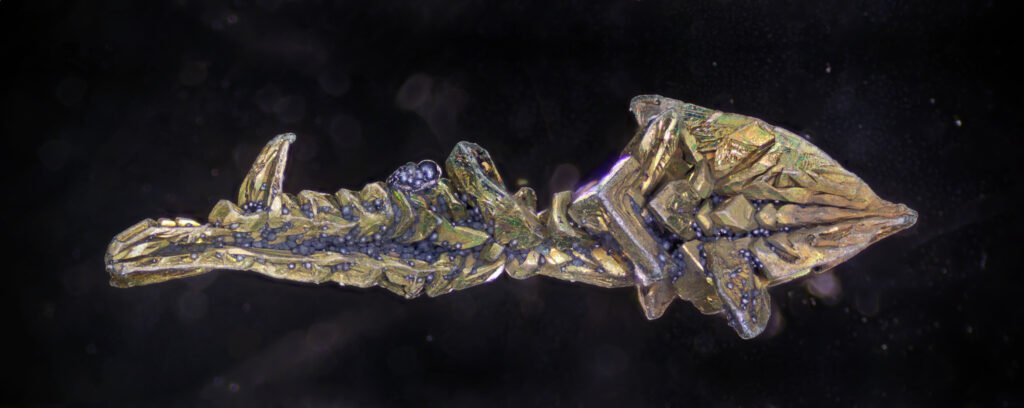
Vanadium is the chemical element with atomic number 23 and the symbol V. It is a hard, silvery transition metal in group 5 of the periodic table that resists corrosion. About four-fifths of the vanadium produced goes into steel, where small amounts make it much tougher.
History of vanadium
Vanadium was discovered twice. The first time was in 1801, when Andrés Manuel del Río, a professor of mineralogy in Mexico City, found it in a sample of a lead mineral from Zimapán, now called vanadinite. He sent a specimen to Paris for confirmation, but French chemists decided that it was just a chromium mineral. Del Río accepted that verdict, and the discovery was forgotten.
In 1831 the Swedish chemist Nils Gabriel Sefström rediscovered the element in cast iron made from ore mined at Småland. He showed that it was new and named it vanadium, after Vanadis, an old Norse name for the Scandinavian goddess Freyja, because of the beautiful colors of its compounds. Chemists later realized that Sefström’s element was the same as del Río’s.
Neither man had produced the pure metal. In 1869 Henry Roscoe in Manchester finally obtained it and showed that earlier samples labeled vanadium were really vanadium nitride. The Royal Society of Chemistry gives the discovery date as 1801 and the discoverer as del Río.
Properties of vanadium
Vanadium has a standard atomic weight of about 50.942 and an electron configuration of [Ar] 3d3 4s2. It can take several oxidation states, from +2 to +5, and PubChem lists an electronegativity of 1.63 and a first ionization energy of 6.746 electronvolts. A chemist can often tell which state a vanadium compound is in from the color of its solution, which ranges through violet, green, blue and yellow.
The metal is silvery and resists corrosion because a thin oxide layer protects its surface, though it oxidizes when heated in air. It melts at about 1,910 degrees Celsius and boils at about 3,407 degrees Celsius. The density is about 6.0 grams per cubic centimeter. Vanadium is hard, ductile when pure and fairly strong for its weight.
A transition metal is an element in the middle block of the periodic table, whose atoms can use inner electrons in bonding. That behavior is behind vanadium’s several oxidation states and its usefulness as a catalyst. Compounds of vanadium with oxygen, especially vanadium(V) oxide, are the most important industrially.
Occurrence and production of vanadium
Vanadium is found in about 65 different minerals, including vanadinite, carnotite and patronite. It is also found in phosphate rock, in certain iron ores, and in some crude oils as organic complexes. The element is moderately common in the Earth’s crust, but it is spread thinly and rarely forms rich deposits of its own.
Much vanadium is recovered as a byproduct. Steelmaking slag from iron ores that contain vanadium is a major source, as are residues from processing uranium ores and from refining certain oils. The leading producing countries include China, Russia and South Africa, according to geological survey data.
To obtain the metal, vanadium(V) oxide is reduced with calcium in a pressure vessel. Vanadium of high purity can be obtained by reducing vanadium(III) chloride with magnesium. Most vanadium is never made into pure metal, and instead it is sold as ferrovanadium, an iron-vanadium alloy that is added directly to steel.
Uses of vanadium
About 80 percent of the vanadium produced is used as a steel additive. Vanadium-steel alloys are very tough and are used for armor plate, axles, tools, piston rods and crankshafts. An alloy is a metallic mixture designed to have better properties than its separate parts. Less than 1 percent vanadium, together with a similar amount of chromium, makes steel resistant to shock and vibration.
Vanadium alloys are used in nuclear reactors because the metal absorbs few neutrons. Titanium alloys that also contain vanadium and aluminum are a standard material in aircraft and are used in titanium implants.
Vanadium(V) oxide is used as a pigment for ceramics and glass, as a catalyst, and in producing superconducting magnets. As a catalyst, it speeds up the oxidation of sulfur dioxide in the manufacture of sulfuric acid, a process described in the entry on sulfur.
A newer use is in vanadium redox flow batteries, which store electricity in tanks of liquid containing vanadium ions in different oxidation states. These batteries are being installed to store power from wind and solar plants. Because the same element is used on both sides of the battery, the liquid does not degrade through cross-contamination.
Isotopes of vanadium
Natural vanadium has two isotopes. Vanadium-51 makes up about 99.75 percent, and vanadium-50 makes up the remaining 0.25 percent. Vanadium-50 is technically radioactive, but its half-life is longer than 10 to the power of 17 years, so it behaves as stable for nearly all purposes.
Vanadium-51 has a nuclear magnetic moment and is used in nuclear magnetic resonance studies of vanadium compounds. An isotope is a version of an element with a particular number of neutrons, and the half-life is the time needed for half of a radioactive sample to decay.
Health and environmental effects of vanadium
The Royal Society of Chemistry states that vanadium is essential to some species, including humans, although only in tiny amounts. People take in about 0.01 milligrams a day, which is more than enough for their needs. Certain sea squirts accumulate vanadium in their blood, and some enzymes in algae and bacteria depend on it.
In some compounds, vanadium can become toxic. Official occupational safety agencies set exposure limits for vanadium pentoxide dust, because inhaling it can irritate the lungs. This entry is general background rather than health advice.
Burning heavy fuel oil releases vanadium into the air, and mining and smelting can contaminate nearby soil and water, so the element is monitored near industrial sites.
Key facts
- Array
Related concepts
In the news
Quick checkWhy was vanadium discovered twice?Show answer
Andres Manuel del Rio found it in 1801, but French chemists wrongly judged it to be chromium, and Nils Gabriel Sefstrom rediscovered it in 1831.
Sources
- Array
Editorially reviewed by Specialty Digest Editorial TeamLast reviewed November 4, 2026Researched and drafted with AI assistanceReport an issue