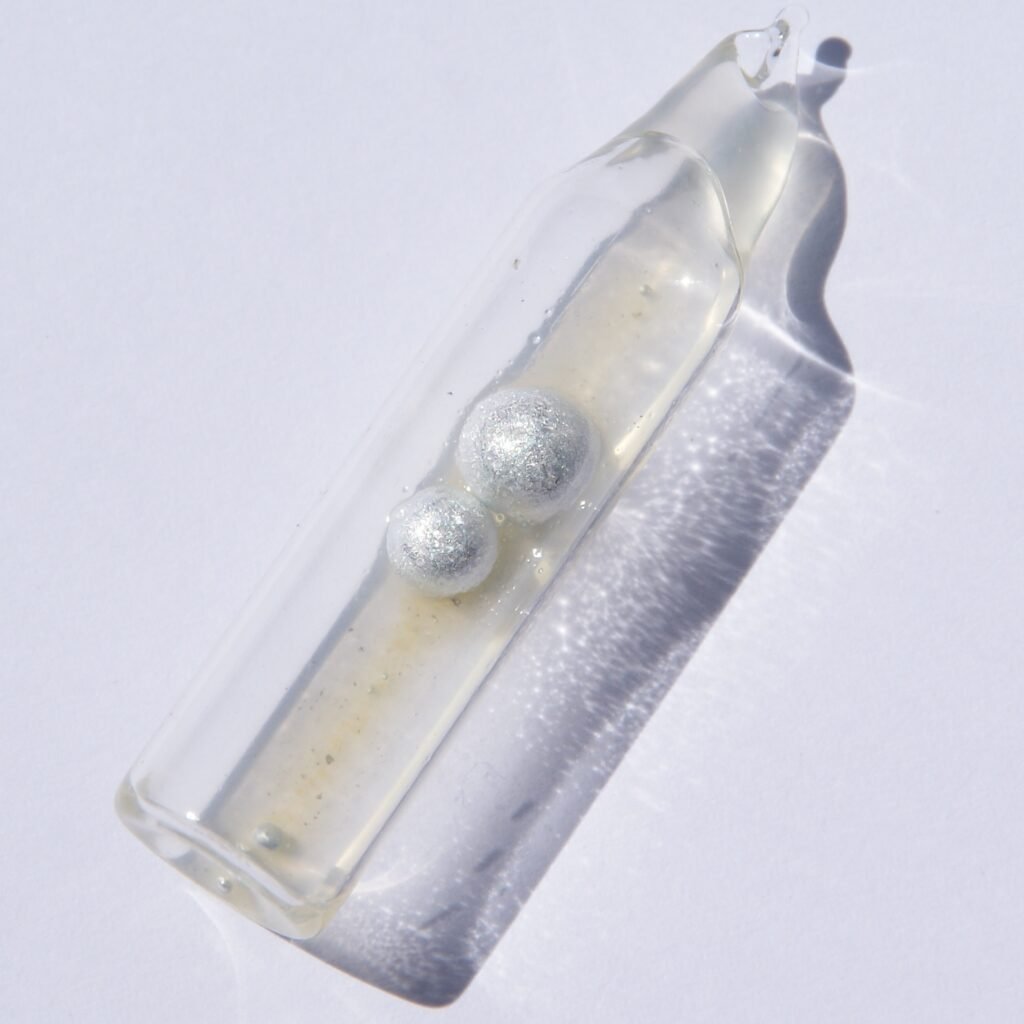
Potassium is the chemical element with atomic number 19 and the symbol K. It is a soft, silvery alkali metal in group 1 of the periodic table that tarnishes within minutes in air and reacts violently with water. Potassium compounds are essential to living cells and are the main ingredient of many fertilizers.
History of potassium
Potassium compounds were familiar for centuries before the metal itself was isolated. Saltpeter, or potassium nitrate, was used in gunpowder. Alum, which contains potassium, was used in dyeing. Potash, which is mostly potassium carbonate, was collected as wood ash and used to make soap and glass. The name of the element comes from the English word potash, while the symbol K comes from kalium, the Latin form of an Arabic word for alkali.
Early chemists could not break these salts down. Antoine Lavoisier classified potash as an earth, a category of substances thought to be impossible to decompose. In 1807 Humphry Davy passed an electric current through moist potash and observed small metallic globules form, which were the new metal. He saw that when the globules were dropped in water they skimmed across the surface and burned with a lavender flame.
Davy isolated sodium by a similar method just days later. These were the first two metals obtained by electrolysis, a technique that went on to reveal several other elements.
Properties of potassium
Potassium has a standard atomic weight of about 39.098 and an electron configuration of [Ar] 4s1. It has a single outer electron that it gives up very easily, so it is one of the most reactive metals. PubChem lists an electronegativity of 0.82 and a first ionization energy of 4.341 electronvolts, both low.
The metal is so soft that it can be cut with a knife. A freshly cut surface is shiny, but it dulls within minutes as the metal reacts with oxygen and moisture in the air. Potassium melts at about 63.5 degrees Celsius, boils at about 759 degrees Celsius and has a density of 0.89 grams per cubic centimeter, which is less than that of water.
Potassium reacts with water to release hydrogen gas and heat, often enough to ignite the hydrogen. Laboratories store it under oil, which keeps out air and moisture. Compounds of potassium show a lilac color when heated in a flame, and chemists use this flame test to detect the element. Its chemistry is close to that of sodium, the element above it in group 1, but potassium is more reactive.
Occurrence and production of potassium
Potassium makes up about 2.4 percent of the Earth’s crust by mass, and the Royal Society of Chemistry ranks it as the seventh most abundant metal there. Most potassium minerals in igneous rocks are sparingly soluble, so the metal is difficult to extract from them. The practical sources are salt deposits left behind when ancient seas and lakes evaporated.
These deposits contain sylvite, which is potassium chloride, sylvinite, a mixture of potassium and sodium chlorides, and carnallite, a potassium magnesium chloride. There are billions of tonnes of potassium chloride in deposits around the world, and mining extracts about 35 million tonnes a year. Seawater also holds potassium, but in smaller amounts than sodium.
The metal itself has relatively few uses, so little is made. It can be produced by reacting molten potassium chloride with sodium metal, or by electrolysis. Nearly all mined potassium is used in the form of salts.
Uses of potassium
The largest demand for potassium compounds comes from agriculture. Plants need potassium, and farmland from which harvests are taken every year needs it replaced with potassium-based fertilizers, usually potash. The three main fertilizer nutrients are potassium, phosphorus and nitrogen, and fertilizer labels list them.
Many other salts are important. Potassium carbonate is used in making glass, and potassium hydroxide is used in detergents and liquid soap. Potassium chloride is used in pharmaceuticals and in saline drips, and it also appears in some salt substitutes. Potassium nitrate remains an ingredient in fireworks and some explosives, and potassium permanganate is used as an oxidizing agent. Potassium cyanide, bromide and sulfate have specialized industrial uses.
Isotopes of potassium
Potassium has three naturally occurring isotopes. Potassium-39 makes up about 93.3 percent, potassium-41 about 6.7 percent and potassium-40 about 0.012 percent. Potassium-40 is radioactive, with a half-life of about 1.25 billion years, which is long enough that a share of what formed with the Earth still remains.
Most potassium-40 decays into calcium-40, and a small share becomes argon-40. This second path is used in dating rocks, as described in the entry on argon. Potassium-40 is also a significant source of the natural radioactivity inside the human body and the Earth. The Royal Society of Chemistry notes that this radioactivity is mild but may be one natural cause of genetic mutation. For background on terms, see isotope and half-life.
Potassium in life and the environment
Potassium is essential to life. Potassium ions are found inside every cell, where they help to keep fluid and electrolyte balance and are central to the electrical signals in nerves and muscles. Plant cells are particularly rich in potassium, which they take from the soil.
The average person eats up to 7 grams of potassium a day and holds about 140 grams in body cells. A normal healthy diet contains enough, according to the Royal Society of Chemistry, though foods such as instant coffee, sardines, nuts, raisins, potatoes and chocolate contain more than average. This entry is general background rather than dietary or medical advice.
Potassium metal is hazardous because of its violent reaction with water. In the environment, potassium is rarely a problem, although runoff of potassium fertilizers can contribute to nutrient pollution in the same way as other fertilizers.
Key facts
- Potassium has atomic number 19 and the symbol K, and sits in group 1 (the alkali metals) and period 4 of the periodic table.1
- Potassium melts at about 63.5 degrees Celsius and has a density of 0.89 grams per cubic centimeter, less than water.1
- Humphry Davy isolated potassium in 1807 by passing an electric current through moist potash.1
- Potassium makes up about 2.4 percent of the Earth's crust by mass.1
- Potassium has three natural isotopes, including radioactive potassium-40, and a standard atomic weight of about 39.098.2
Related concepts
In the news
Quick checkWho discovered potassium?Show answer
Humphry Davy isolated potassium in 1807 by passing an electric current through moist potash.
Sources
- Royal Society of Chemistry, Periodic Table: Potassium, https://periodic-table.rsc.org/element/19/potassium
- National Center for Biotechnology Information, PubChem Periodic Table: Potassium (element 19, including IUPAC-sourced atomic weight and isotope data), https://pubchem.ncbi.nlm.nih.gov/element/19
Editorially reviewed by Specialty Digest Editorial TeamLast reviewed November 4, 2026Researched and drafted with AI assistanceReport an issue