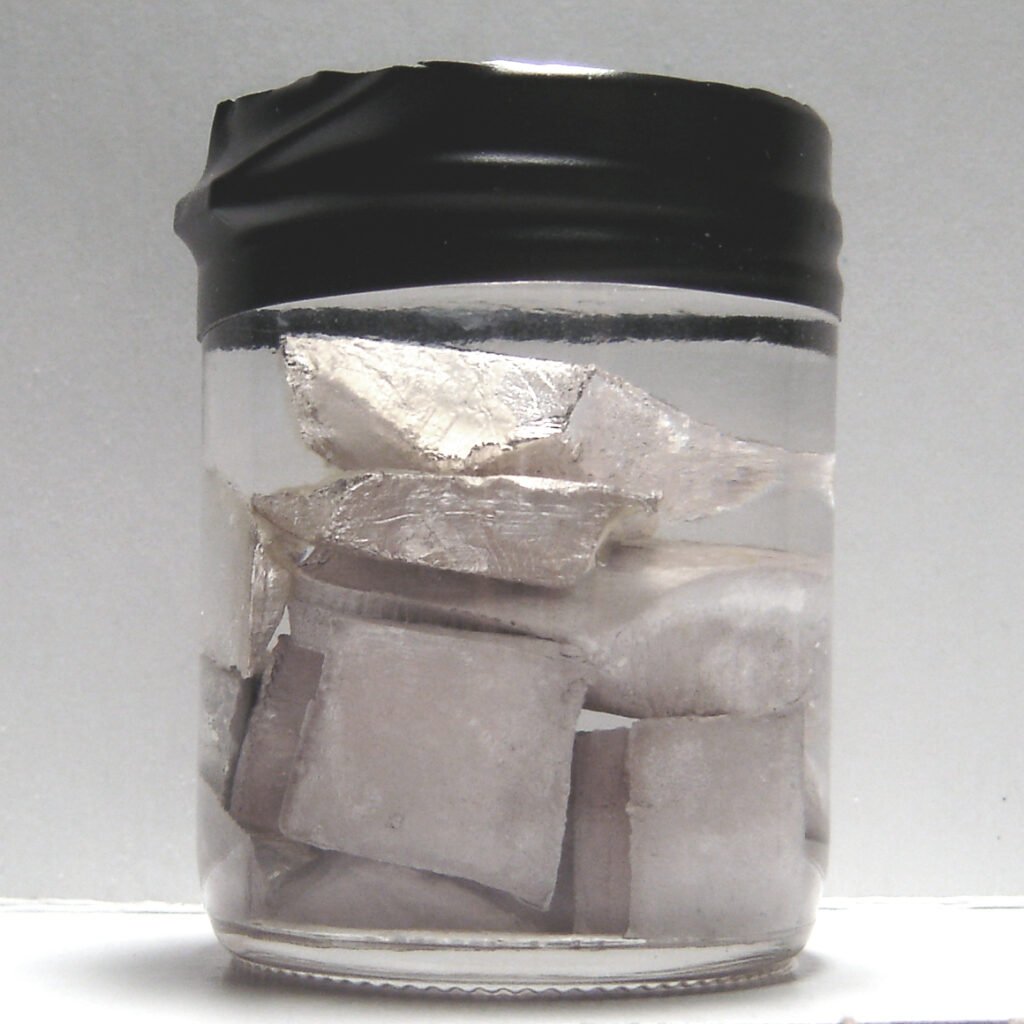
Sodium is the chemical element with atomic number 11 and the symbol Na. It is a soft, silvery alkali metal in group 1 of the periodic table that reacts vigorously with water and tarnishes within seconds in air. The metal itself has limited uses, but its compounds, above all common salt, are among the most familiar and widely used chemicals in the world.
History of sodium
Salt, which is sodium chloride, and soda, which is sodium carbonate, were known in prehistoric times. Salt came from seawater and was used as a flavoring and a preservative. Soda came from the Natron Valley in Egypt or from the ash of certain plants, and it was used to make glass. Early chemists argued about what these substances contained.
The answer came in October 1807 at the Royal Institution in London, where Humphry Davy passed an electric current through caustic soda, which is sodium hydroxide, and obtained small globules of sodium metal. He had done the same for potassium shortly before, but sodium needed a stronger current. The following year the French chemists Louis-Joseph Gay-Lussac and Louis-Jacques Thénard made sodium by heating a mixture of caustic soda and iron filings to red heat. The name comes from the English word soda.
Properties of sodium
Sodium has a standard atomic weight of about 22.990 and the electron configuration [Ne] 3s1, a single outer electron beyond a neon-like core. It is a soft metal with a density of 0.97 grams per cubic centimeter, slightly less than water, so a lump of sodium floats. It melts at about 97.8 degrees Celsius and boils at about 883 degrees Celsius.
That lone outer electron is easily lost, which makes sodium highly reactive. PubChem lists a low first ionization energy of 5.139 electronvolts. The metal reacts vigorously with water, releasing hydrogen and heat, and it forms compounds in which it carries a charge of plus one. Because of this reactivity it is never found as a metal in nature and is stored away from air and moisture.
Occurrence and production of sodium
Sodium makes up about 2.6 percent of the Earth’s crust, according to the Royal Society of Chemistry. The most common compound is sodium chloride, a highly soluble salt that has been carried into the oceans over the life of the planet and is dissolved in seawater at a concentration near 10,800 milligrams per liter. Where ancient seas have evaporated, salt beds and salt lakes are found on land.
Sodium also occurs in many minerals, including cryolite, zeolite and sodalite. Sodium metal is produced by the electrolysis of molten sodium chloride, in which an electric current separates the metal from the chlorine.
Uses of sodium
Sodium metal is used as a heat exchanger, a fluid that carries heat away, in some nuclear reactors. It also serves as a reagent in the chemical industry, including in the production of titanium, sodium cyanide, sodium peroxide and sodium hydride. Sodium vapor lamps produce a brilliant yellow-orange light and have lit many streets, which is the origin of the orange glow familiar from older street lighting.
Sodium compounds have far more uses than the metal. Sodium chloride is added to food and used to de-ice roads in winter, and it is a feedstock for the chemical industry. Sodium carbonate, known as washing soda or soda ash, softens water. Sodium bicarbonate, or baking soda, is used in cooking and cleaning. Sodium hydroxide, or caustic soda, is a strong base used in many industrial processes, and Chile saltpeter and borax are other familiar sodium compounds.
Isotopes of sodium
Sodium has only one stable isotope, sodium-23, so natural sodium is a single isotope. Its atomic weight is therefore known very precisely, at 22.98976928 according to IUPAC data. Several radioactive isotopes of sodium exist, but they decay quickly and are made in laboratories or reactors rather than found in everyday materials.
Common compounds of sodium
Nearly everything people encounter as sodium is a compound, because the metal reacts with air, water and most nonmetals. Sodium chloride forms when sodium burns in chlorine, and it is the dominant salt of seawater and of the human diet. Sodium hydroxide is made industrially from brine and is used to make paper, soap and aluminum. Sodium carbonate and sodium bicarbonate are produced in large quantities for glassmaking, cleaning and baking.
Sodium compounds are also recognizable by their color in a flame. Even a trace of sodium turns a flame an intense yellow, with a characteristic emission near 589 nanometers, which is why sodium is so easy to detect in a flame test and why it often contaminates other spectroscopic measurements. Nearly all sodium salts dissolve readily in water, which is why sodium is the most abundant metal ion in the oceans.
Health and environmental effects of sodium
Sodium is essential to all living things, and people have known this since prehistoric times. The human body contains about 100 grams. It helps cells transmit nerve signals and regulates water levels in tissues and blood, and because the body constantly loses sodium, it has to be replaced from food. We can obtain all the sodium we need from our food without adding any extra.
The Royal Society of Chemistry notes that the average person eats about 10 grams of salt a day, whereas only about 3 grams is needed, and that extra sodium may contribute to high blood pressure. Dietary guidance on sodium varies by country and is set by health authorities, so this entry is general background and not advice. Elemental sodium is a hazard because it reacts violently with water and can start fires, and the spread of road salt can harm freshwater ecosystems.
Key facts
- Array
This entry explains a medical term. It is not medical advice. If you are concerned about your health, speak with a qualified health professional.
In the news
Quick checkWhy is sodium never found as a pure metal in nature?Show answer
Sodium has one outer electron that it loses very easily, so it reacts quickly with water and air. In nature it occurs only in compounds such as sodium chloride and in minerals like cryolite, zeolite and sodalite.
Sources
- Array
Editorially reviewed by Specialty Digest Editorial TeamLast reviewed November 4, 2026Researched and drafted with AI assistanceReport an issue