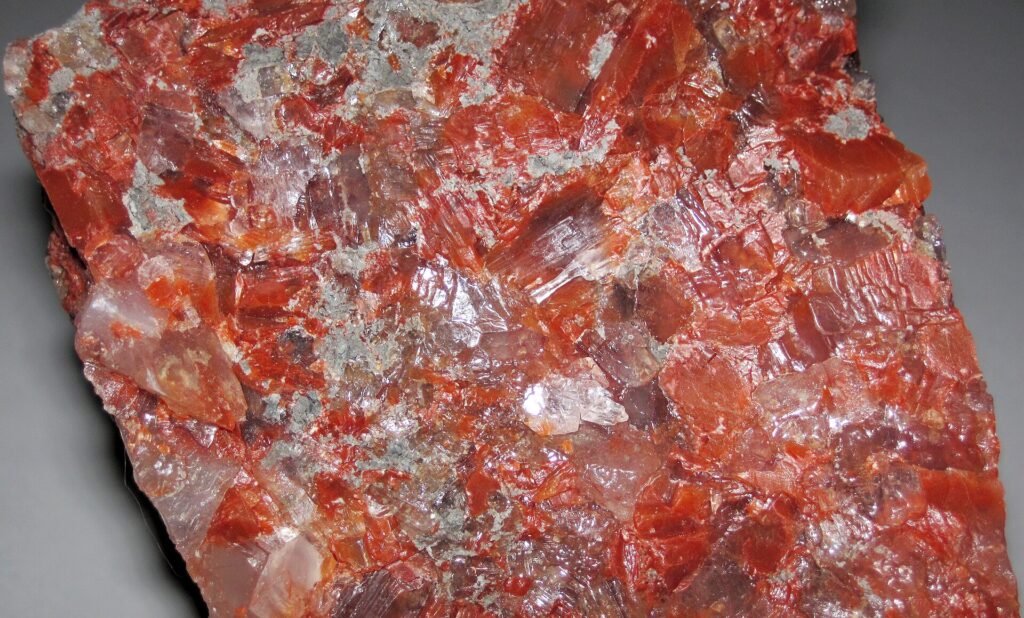
Potash in 2025 was produced at an estimated 49 million metric tons of K2O equivalent worldwide, up from 46.7 million in 2024, according to the U.S. Geological Survey’s Mineral Commodity Summaries 2026. Canada and Russia together supplied about half. The United States imports most of the potash it uses, mainly from Canada. This article summarizes the USGS potash chapter, explains the main numbers and flags what the chapter does not say.
Who produces potash?
The USGS lists estimated 2025 mine production, in thousand metric tons of K2O equivalent:
- Canada: 15,000
- Russia: 10,000
- China: 6,300
- Belarus: 6,000
- Germany: 3,000
- Laos: 2,400
- Israel: 2,000
- Jordan: 1,800
- Chile: 600
- United States: 500
- Spain: 450
- Brazil: 300
By our own arithmetic, Canada mines about 31% of the world total and Canada plus Russia about 51%. The U.S. share is about 1%. Belarus rose from an estimated 5,000 to 6,000, and Germany from an estimated 2,500 to 3,000. The USGS says estimates are rounded, and the country lines do not add exactly to the world figure.
What is potash used for?
The USGS says the fertilizer industry took about 85% of U.S. potash sales, with chemical and industrial uses taking the rest. Potassium is a plant nutrient, and the chapter says nothing substitutes for it as a plant or animal nutrient. Manure and a mineral called glauconite are low-potassium alternatives with limited transport range. Our report on the cost of a healthy diet shows why fertilizer matters to food systems.
How much potash does the United States make?
Marketable U.S. production rose to an estimated 500 thousand tons in 2025 from 410 in 2024, a rise of about 22% by our own arithmetic. Sales by producers were 460 thousand tons, and the USGS puts the value of 2025 sales at $550 million, up 13%. More than 60% of production was potassium sulfate and potassium magnesium sulfate, which suit crops sensitive to chloride. The remainder was muriate of potash, the most common fertilizer form.
How dependent is the United States on imports?
Net import reliance was an estimated 92% of apparent consumption in 2025, against 94% in 2024 and 93% in 2021. Imports fell from 5,970 thousand tons to 5,600, and apparent consumption from 6,200 to 5,900. For 2021 to 2024, Canada supplied 79% of imports, Russia 12% and Israel 3%. Potash enters the United States duty free under every listed tariff line as of December 31, 2025.
How did prices move?
The average price for all products was $1,200 per ton of K2O in 2025, up from $1,150. The price for muriate of potash fell from $690 to $600, about 13% lower by our arithmetic. Both figures sit well below the 2022 peak of $1,790 for all products and $980 for muriate. The two series moved in opposite directions, and the copy of the chapter we read does not explain the difference, so we do not guess at one.
What is the global outlook in the chapter?
World fertilizer potash consumption was estimated at 41.6 million tons of K2O in 2025, up from 40.6 million, and is projected to reach 45.3 million by 2029. World production capacity was 66.1 million tons in 2025 and is projected to rise to 77.4 million by 2029. By our arithmetic, projected capacity growth of about 17% outpaces projected consumption growth of about 9%. The chapter does not draw conclusions from that gap, and projections are not facts.
What new U.S. supply does the chapter mention?
In January 2025, the Department of Energy made a conditional commitment of a $1.26 billion loan for a potash and salt mine in Michigan, planned at 800,000 tons of muriate of potash and 1 million tons of salt per year. The commitment was subject to conditions that had to be met within one year. U.S. potash resources are about 7 billion tons, mostly 1,800 to 3,100 meters deep in Montana and North Dakota. The USGS puts world resources at about 250 billion tons.
Is potash a critical mineral?
Yes, under the U.S. list. The final 2025 critical minerals list, published November 7, 2025, added potash, along with copper, lead, rhenium, silicon and silver. Readers can see our report on copper in 2025 for another addition.
How did U.S. trade change?
Exports of U.S. potash were 170 thousand tons in 2025, against 150 in 2024 and 267 in 2022. They are small next to imports, which were about 33 times larger in 2025 by our own arithmetic. The USGS also reports employment at the one group of mines and mills at 900 people in every year from 2021 to 2025, a sign of a small and stable domestic industry. Domestic production rose in 2025 while imports and consumption both fell, so the import share dipped only two points.
How to read the numbers
Potash output is measured as K2O equivalent so that different salts can be compared. Reserve columns in the table lacked clear units in the copy we read, so we do not report them. Estimates for 2025 are first reads that the USGS may revise.
How does potash connect to other coverage?
Potash links farming, trade and food prices. See our reports on the FAO Food Price Index, hunger and diet costs and the USGS summary of U.S. mineral production.
What should readers watch for next?
Readers can watch the Michigan project, Canadian and Russian exports and the next USGS edition, which replaces estimates with reported data.
Related reading: Soda Ash in 2025: USGS Shows the U.S. Exports More Than Half of Its Output.
Glossary
- Potash: a group of potassium salts, mainly used as fertilizer
- K2O equivalent: a standard way of counting potassium content
- Muriate of potash: potassium chloride fertilizer
- Net import reliance: imports minus exports, as a share of apparent consumption
- Reserves: resources that can be mined economically today
These definitions are general explanations and are not quoted from the USGS.
What is not covered here?
We omit the reserve columns, the tariff schedule and any price forecast.
Key facts at a glance
- World production, 2025: about 49 million tons of K2O
- Canada: 15 million tons, about 31%
- U.S. net import reliance: 92%
- Fertilizer: about 85% of U.S. sales
- World resources: about 250 billion tons
Frequently asked questions
Which country produces the most potash?
Canada, at an estimated 15 million tons in 2025.
What is potash used for?
Mostly fertilizer, about 85% of U.S. sales.
Does the United States import potash?
Yes. The USGS puts net import reliance at about 92%.
More in Business
- Phosphate Rock in 2025: USGS Shows China Mines 44 Percent and Morocco Holds 68 Percent
- Titanium Minerals in 2025: USGS Shows China Mines a Third of Ilmenite
- Magnesium Compounds in 2025: USGS Shows China Mines 60 Percent of Magnesite
- Antimony in 2025: USGS Shows a $25 Price as U.S. Import Reliance Hits 91 Percent