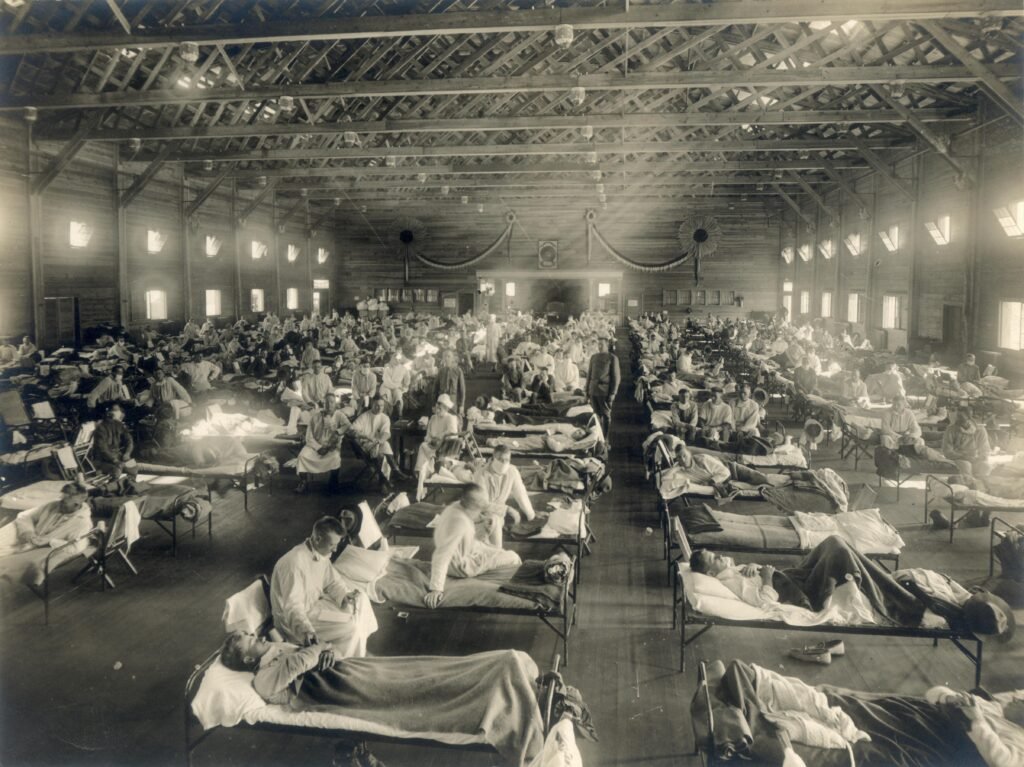
The 1918 influenza pandemic was a worldwide outbreak of influenza A (H1N1) that lasted from 1918 into 1919 and is often called the Spanish flu. The Centers for Disease Control and Prevention (CDC) estimates that about 500 million people, roughly one third of the world’s population, were infected, and that at least 50 million died, including about 675,000 in the United States. It was the most severe pandemic in recent history, and it struck an unusual number of healthy young adults.
Background of the 1918 influenza pandemic
The virus behind the pandemic was a new H1N1 influenza virus with genes of avian origin. Researchers writing in the CDC journal Emerging Infectious Diseases found that the genes for its two surface proteins, hemagglutinin and neuraminidase, probably came from a bird-like influenza virus shortly before the outbreak began. Because almost no one had immunity to this combination, it spread easily. Humans and swine appear to have been infected at nearly the same time, and the virus’s exact route from animals to people is still unclear. Diseases that cross between species in this way are known as zoonotic diseases.
Where the pandemic began is also unresolved. The CDC notes there is no universal agreement on its origin. Before 1918 and afterward, most flu pandemics started in Asia, but this one appeared in Europe, Asia and North America at about the same time, and genetic analysis of the virus does not point to a place. In the United States it was first identified in military personnel in spring 1918.
The world also had few defenses. There was no influenza vaccine and no antibiotics to treat the bacterial infections that often followed flu. Doctors did not yet know that a virus caused influenza, because the first flu viruses were not isolated until the 1930s, first from pigs and soon after from people.
What happened during the 1918 influenza pandemic
The pandemic came in three waves. The first began in March 1918 and spread unevenly through the United States, Europe and possibly Asia over about six months. Many people fell ill, but death rates in most places were not much above normal. The second wave, from September to November 1918, spread globally and was far deadlier. In many countries a third wave followed in early 1919. Three waves of influenza in a single year, with almost no quiet period between them, had never been recorded before.
The disease often moved quickly from ordinary flu symptoms to fatal pneumonia. Researchers estimate that fewer than 0.1 percent of flu cases died in other pandemics, compared with more than 2.5 percent in 1918 and 1919. The overall toll is an estimate, and published figures vary. A widely cited analysis in Emerging Infectious Diseases put deaths at about 50 million, and noted that some estimates run as high as 100 million. These differences exist because many countries did not track influenza deaths reliably at the time.
The age pattern was unusual. Seasonal flu normally kills the very young and the very old, which produces a U-shaped curve on a graph of deaths by age. In 1918 the curve was W-shaped, with a third peak among adults aged about 20 to 40. Nearly half of the influenza deaths in the pandemic were in that age group. The CDC also reports high mortality in children under 5 and adults 65 and older. Scientists still do not fully understand why healthy young adults were hit so hard.
With no vaccine or antibiotics, authorities relied on non-pharmaceutical measures: isolating the sick, quarantine, good personal hygiene, disinfectants and limits on public gatherings. The CDC says these were applied unevenly from place to place.
Aftermath and significance of the 1918 influenza pandemic
By the early 1920s influenza had settled into a pattern of yearly seasonal epidemics with much lower death rates. The 1918 virus did not simply disappear, though. Its descendants continued to circulate in people and pigs. When a new H2N2 virus caused the 1957 pandemic, the direct human descendants of the 1918 strain vanished from circulation until H1N1 viruses reappeared in 1977. According to the Emerging Infectious Diseases review, all influenza A pandemics since 1918, and nearly all cases of influenza A worldwide, have been caused by descendants of the 1918 virus. That is why it is sometimes called the mother of all pandemics.
The pandemic also drove scientific progress. In 1995, researchers began piecing together the virus’s genetic code from preserved autopsy tissue collected in autumn 1918. They later reconstructed the virus in a highly secure laboratory at the CDC to study how it worked. Even so, the CDC states that the properties that made it so devastating are not well understood. The work shapes today’s epidemiology and preparedness planning, including how health agencies build vaccine programs and decide on healthcare policy for a future pandemic.
Conditions today differ from those of 1918, since antibiotics can treat many of the secondary infections that killed people then. The pandemic remains a reference point, however, because it shows how quickly a new influenza virus can spread across the globe.
FAQs
How many people died in the 1918 influenza pandemic? No exact figure exists. The CDC estimates at least 50 million deaths worldwide, and some scientific analyses suggest the number could have been as high as 100 million.
What caused the 1918 flu? It was caused by an H1N1 influenza A virus with genes of avian origin.
Why was the 1918 flu deadly for young adults? Nearly half of deaths were in adults aged 20 to 40, an unusual pattern. Scientists have proposed several explanations, but none is settled.
Did the 1918 pandemic start in Spain? The place where it began is not known. The CDC says there is no universal consensus on its origin.
How did the 1918 pandemic end? Cases declined after the third wave in 1919 as the population gained immunity and the virus settled into seasonal patterns.
More in Infectious Diseases
Key facts
- The CDC estimates about 500 million people were infected and at least 50 million died worldwide, including about 675,000 in the United States.1
- The pandemic came in three waves: spring 1918, a far deadlier wave from September to November 1918, and a third in early 1919.2
- Nearly half of influenza deaths were in adults aged 20 to 40, an age pattern not seen in other pandemics.2
- There was no vaccine and no antibiotics for secondary bacterial infections, so control relied on isolation, quarantine, hygiene and limits on gatherings.1
- The place where the virus first emerged is still unresolved, and all later influenza A pandemics descend from the 1918 virus.12
This entry explains a medical term. It is not medical advice. If you are concerned about your health, speak with a qualified health professional.
Related concepts
Quick checkWhich age group accounted for nearly half of the 1918 pandemic influenza deaths?Show answer
Adults aged about 20 to 40. This was unusual because seasonal flu usually kills mainly the very young and the very old.
Sources
- Centers for Disease Control and Prevention, 1918 Pandemic (H1N1 virus), https://archive.cdc.gov/www_cdc_gov/flu/pandemic-resources/1918-pandemic-h1n1.html
- Taubenberger and Morens, 1918 Influenza: the Mother of All Pandemics, CDC Emerging Infectious Diseases 2006, https://wwwnc.cdc.gov/eid/article/12/1/05-0979_article
Editorially reviewed by Specialty Digest Editorial TeamLast reviewed November 4, 2026Researched and drafted with AI assistanceReport an issue