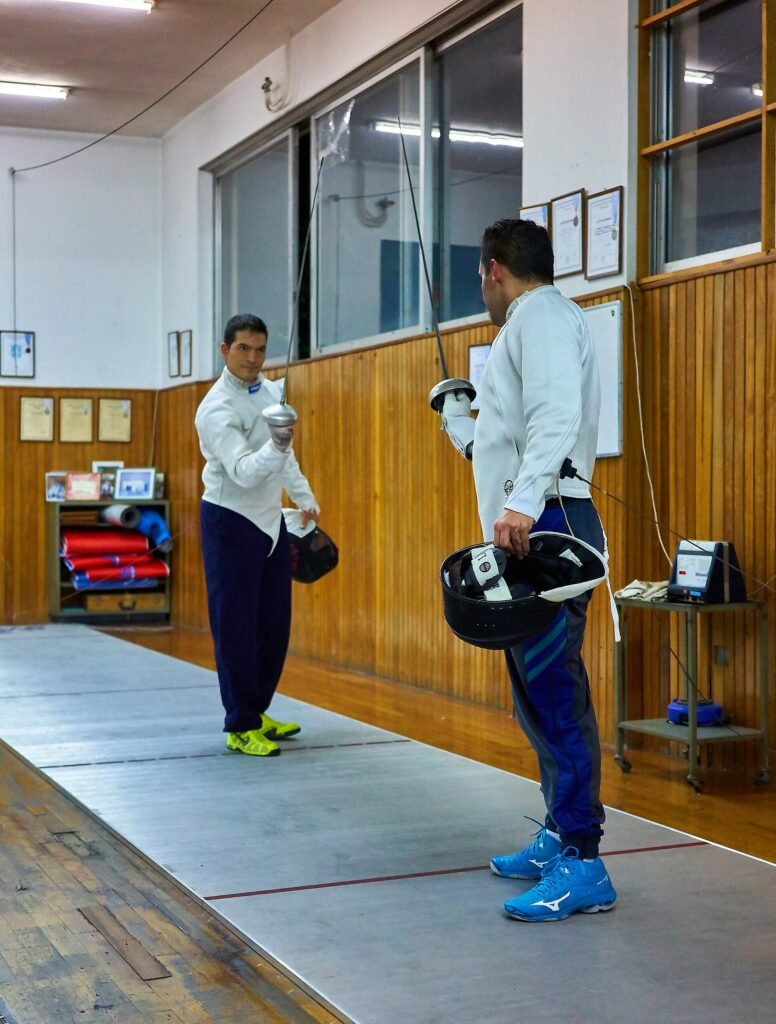
Fencing is a combat sport in which two competitors score hits on each other with a blade, using one of three weapons: the foil, the épée or the sabre. Modern bouts are scored electrically on a narrow metal strip, and an Olympic-style bout is won by the first fencer to reach 15 touches. Men’s fencing has been part of the Olympic Games since the first modern edition in 1896.
History of fencing
The rules of modern competitive fencing were first collected in the 1880s by Camille Prévost, a French fencing master. National bodies followed over the next two decades: the Amateur Fencers League of America in 1891, the Amateur Fencing Association of Great Britain in 1902 and a French national federation in 1906. Intercollegiate fencing matches began in the United States in 1894.
Disagreements over equipment shaped the early Olympic years. At the 1912 Games, France withdrew its foil team over a dispute about the foil target area, and Italy refused to fence the épée events after its request to lengthen the épée blade was rejected. The Fédération Internationale d’Escrime, known as the FIE, was founded in 1913 and became the governing body of international amateur fencing.
The biggest technical change was electrical scoring, which reduced the need for human judges watching for hits. Sources agree that foil was scored electrically at the 1956 Olympics, but they give different dates for the other two weapons. One reference dates electrical épée to 1933 and electrical sabre to 1988, while another gives 1936 for épée and 1992 for sabre.
Rules and how fencing is played
Each weapon has its own target area and its own way of deciding a point. In foil, only the point of the blade scores, and the target is the torso. In épée, only the point scores, but the whole body is the target. In sabre, the blade can both cut and thrust, and the target is the upper body, including the mask and neck.
Foil and sabre use a convention called right of way, in which the referee decides which fencer had priority when both land a hit at nearly the same moment. Épée has no right of way, so both fencers can score on the same exchange, although a double touch at 14 to 14 is void.
The scoring machine also applies a lockout time, which is the short window after one hit in which the opponent can still register a hit. The window is about 300 milliseconds in foil, 40 milliseconds in épée and 170 milliseconds in sabre. A foil hit on a non-target area is called off-target and does not score, while épée has no off-target hits because the entire body counts.
An Olympic-style bout is fought in three periods of three minutes, with one-minute breaks, and the first fencer to 15 touches wins. If time runs out first, the fencer with the higher score wins. A fencer who leaves the strip through the rear boundary gives the opponent a point.
Equipment and venues
Fencing is held on a strip called a piste, which is 14 meters long and between 1.5 and 2 meters wide. Fencers start in the en garde position about 4 meters apart. The surface is metal or another conductive material, and because it is grounded, an épée point that touches it does not register as a hit on an opponent.
Cables run from a spool at each end of the piste to the fencer’s body cord and then to the weapon, with a scoring box that lights up and sounds when a valid hit lands. At the highest levels of competition, wireless systems replace the spools. A referee stands opposite the piste, facing the scoring box.
Foil and sabre may weigh up to 500 grams, and the épée up to 775 grams. Foil and sabre fencers wear a conductive jacket called a lamé over their protective jacket, along with a mask cord, so that valid hits complete the electrical circuit.
Safety standards are strict. FIE-approved masks are stainless steel and must pass a 12-kilogram punch test, and they are mandatory at the World Championships and the Olympics. Neck bibs must resist 1,600 newtons, and other protective clothing must resist 800 newtons. Chest protectors are mandatory for women.
Governing bodies and major competitions
The FIE sets the rules that international competitions must follow and oversees how they are carried out. It also publishes technical documents on approved equipment, and its recognized suppliers must meet international safety and quality standards. The FIE assists the International Olympic Committee in organizing the Olympic fencing events.
The Olympic Games are the main stage for the sport. Men’s fencing has been there since 1896, and épée was added as an individual event in 1900 at Paris, after foil and sabre were already on the program. Team foil arrived in 1904, and team sabre and team épée in 1908.
Women’s events entered later. Individual foil for women was added in 1924, and team foil followed in 1960. Women’s épée, both individual and team, was first held at the 1996 Games, and women’s individual sabre was added in 2004, followed by team sabre in 2008. Because the IOC did not increase the number of fencing medals, two team events were dropped from the Olympic program between 2004 and 2016 to make room for the new women’s events.
Records and notable moments
Sabre is the only weapon contested at every modern Olympic Games. Épée made its Olympic debut at Paris in 1900, so its Olympic history is slightly shorter than that of the other two weapons. Women had only individual foil from 1924 until 1960, and by 2008 they had competed in individual and team events with all three weapons.
Global reach
Fencing is organized through national federations that follow FIE rules, and its Olympic program is open to men and women in all three weapons. Standardized equipment, scoring boxes and strip dimensions mean that a bout looks the same wherever it is held. The sport also has a long university tradition in the United States, where intercollegiate matches have been held since the 1890s.
More in Sports Coaching and Performance
Key facts
- The International Fencing Federation, the FIE, was founded in 1913 and governs international amateur fencing.1
- An Olympic-style bout is won by the first fencer to reach 15 touches, within three periods of three minutes.2
- Foil and sabre weigh at most 500 grams and the épée at most 775 grams.2
- The fencing strip, called a piste, is 14 meters long and 1.5 to 2 meters wide.3
- Sabre is the only weapon contested at every Olympic Games.2
Related concepts
Quick checkHow many touches win an Olympic fencing bout?Show answer
The first fencer to reach 15 touches wins, or the fencer with the higher score when three periods of three minutes run out.
Sources
- Encyclopaedia Britannica, Fencing: Organized sport, https://www.britannica.com/sports/fencing/Organized-sport
- Olympics.com, Everything you need to know about fencing: the equipment, the weapons, the athletes, https://olympics.com/en/news/everything-you-need-to-know-about-fencing-the-equipment-the-weapons-the-athletes
- Encyclopaedia Britannica, Fencing: Fencing area, https://www.britannica.com/sports/fencing/Fencing-area
- International Fencing Federation, New to fencing, https://fie.org/new-to-fencing
Editorially reviewed by Specialty Digest Editorial TeamLast reviewed November 4, 2026Researched and drafted with AI assistanceReport an issue