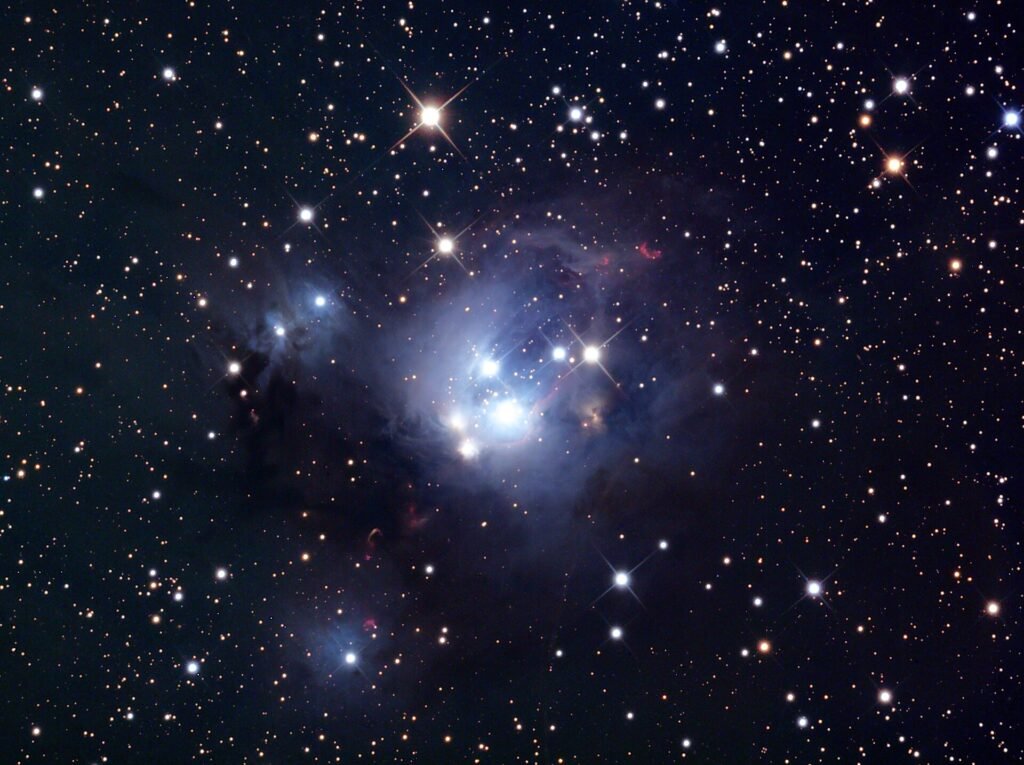
NGC 7129 is a stellar nursery about 3,300 light-years from Earth, and a NASA release dated October 6, 2026 shows it in a new near-infrared image from the James Webb Space Telescope. The image reveals jets, winds and shocked gas from young stars. This article summarizes the NASA release, explains what the colors and features mean and flags what the release does not measure.
What did Webb capture?
Webb imaged NGC 7129 in near-infrared light with its NIRCam instrument. Near-infrared light can pass through dust that blocks many other telescopes, so it shows stars and gas that are hidden at visible wavelengths. NASA’s description calls the region a cauldron of cosmic creation. In the image, hot atomic hydrogen is shown in gold and cooler, shocked molecular hydrogen in red. These are false colors that stand for gas types and do not match natural color.
What is at the center?
The central star is LkH-alpha 234, a pre-main-sequence star that the release puts at roughly 5 to 8 times the mass of the Sun. It is still contracting under gravity and will eventually fuse hydrogen like the Sun. A gold cavity to the left of the star spans about 3.5 light-years. Outflows from an earlier stage of the star carved it out of the surrounding molecular cloud. Some gas is blown away, and some is compressed, which could trigger more star formation.
What do the stellar winds do?
Several stars inside the cavity are also pre-main-sequence and emit stellar winds. These winds form small bow shocks and cavities of their own, like the wake in front of a boat. Light from the stars also creates a hot boundary at the top of the cavity, called a photodissociation region, where molecular hydrogen breaks apart into atoms. The release says this helps show how such clouds may erode over millions of years.
Where are the youngest stars?
The red region on the right holds younger protostars that are still gaining mass. Their superheated outflows shock the surrounding gas and produce the textured red glow. Overlapping outflows from several stars create the chaotic look that gives the release its title. A protostar in the blue nebula at the upper left is surrounded by a donut-shaped disk that casts a shadow, similar to a feature that Hubble observed, called the Bat Shadow.
How does this compare with earlier views?
NASA’s retired Spitzer Space Telescope previously observed NGC 7129. Webb’s higher resolution reveals more detailed gas and dust filaments and many background galaxies. The release gives no numeric resolution figures, so we cannot say by how much the detail improved. The comparison is qualitative.
What can this teach us?
A single image shows stars at several stages at once, from protostars that are still gaining mass to pre-main-sequence stars that are nearly formed. That makes it a snapshot of a sequence that takes millions of years. The release says astronomers will continue studying the data. These are early descriptions, not final conclusions about how the stars shape their surroundings.
Why use infrared light for a nursery?
Young stars form inside clouds of gas and dust. Visible light is scattered and absorbed by that dust, so a visible-light image of a nursery often shows dark patches where stars are hiding. Near-infrared light passes through more of the dust, which is why Webb can show the protostars, jets and shocked gas in this region. In general terms, this is the reason telescopes that observe in the infrared are used to study star birth. This explanation is general and is not quoted from NASA.
What does the Bat Shadow tell us?
The release describes a donut-shaped disk around a protostar in the blue nebula that casts a shadow, like one that Hubble saw earlier. A disk of gas and dust around a young star is the material from which planets can later form. The release does not say whether any planets are forming here, and it gives no size or mass for the disk, so readers should take the shadow only as evidence that such a disk is present.
How to read the image
Colors here mark gas types, so a red patch means shocked molecular hydrogen and a gold patch means hot atomic hydrogen. They do not show how the region would look to the eye. Sizes such as 3.5 light-years are given as about values. By our own arithmetic, 3,300 light-years is roughly 31 quadrillion kilometers, but the release states only the light-year figure, and the distance is approximate.
Who produced the release?
The article is by the NASA Webb Mission Team at the Goddard Space Flight Center. Image processing was by Alyssa Pagan of the Space Telescope Science Institute. The credit line is NASA, ESA, CSA and STScI, because Webb is an international program led by NASA with the European Space Agency and the Canadian Space Agency. The release cites no peer-reviewed paper, so it is a press description and not a research result.
How does this connect to other coverage?
Webb and Hubble have imaged other nebulae. See our reports on the Cat’s Eye Nebula in Hubble and Webb images, the James Webb Space Telescope and Hubble and missing oxygen in dwarf galaxies.
What should readers watch for next?
Readers can watch for papers that measure the outflow speeds and star counts in NGC 7129, which the release does not give.
Glossary
- Stellar nursery: a cloud of gas and dust where stars form
- Protostar: a very young star still gathering mass
- Pre-main-sequence star: a star that has formed but has not yet started steady hydrogen fusion
- Bow shock: a curved shock wave formed where a fast wind meets slower gas
- Near-infrared: light just beyond the red end of the visible spectrum
These definitions are general explanations and are not quoted from NASA.
What is not covered here?
The release gives no observation dates, exposure details or measurements of outflow speed, so we report none.
Key facts at a glance
- Target: NGC 7129, about 3,300 light-years away
- Central star: LkH-alpha 234, about 5 to 8 solar masses
- Cavity: about 3.5 light-years across
- Instrument: Webb NIRCam
- Released: October 6, 2026
Frequently asked questions
What is NGC 7129?
A stellar nursery about 3,300 light-years from Earth.
What do the colors in the Webb image mean?
Gold marks hot atomic hydrogen and red marks cooler, shocked molecular hydrogen.
Is this a research paper?
No. It is a NASA press release with no cited paper.
More in Science
- Trans-Neptunian Objects: Hubble and Webb Find 27 New Ones as Small as 3 Miles Across
- Yardangs on Mars: Curiosity Photographs Wind-Carved Cliffs at Dawn
- Artemis II Preliminary Lunar Science Report: Impact Flashes, Colors and an Eclipse
- Why the Next Breakthrough in Battery Chemistry Might Come From Studying How Trees Store Energy