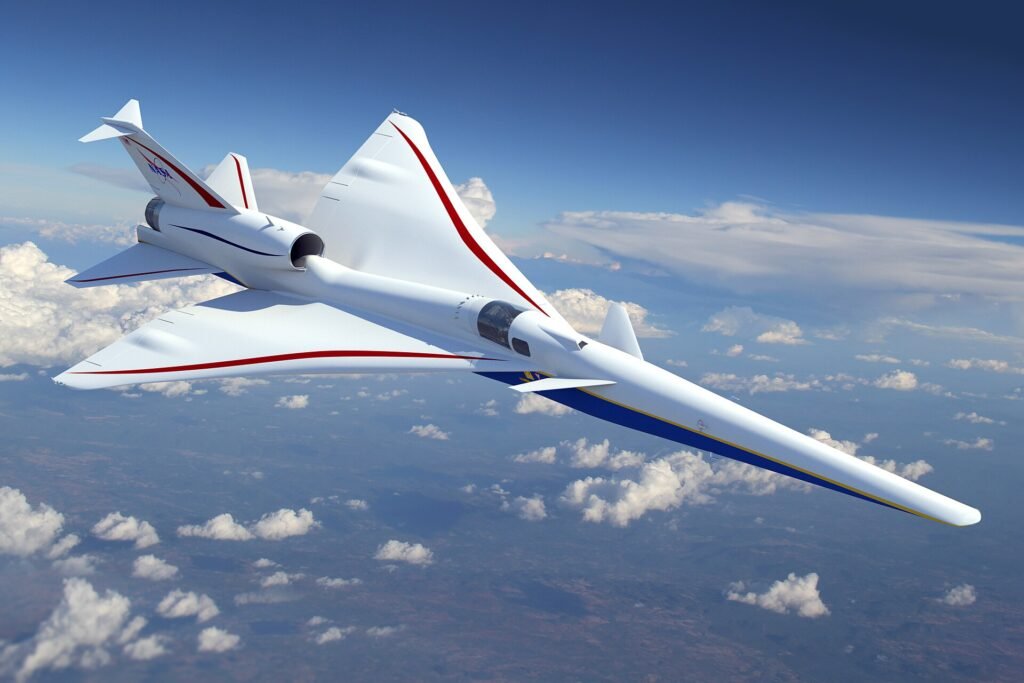
The NASA X-59 quiet supersonic research aircraft flew six times in one week in September 2026, a record for the program. The agency’s Quesst blog, dated October 2, 2026, says the plane also reached its fastest speed so far. This article summarizes that post, explains what the X-59 is for and lists what the post does not report.
What did the X-59 do in one week?
During the week of September 21, 2026, the X-59 flew six times: two flights on September 22, two on September 24 and two on September 25. NASA says that beat the program’s previous record for flights in a week by two. The program has now logged 38 test flights in total. By our own arithmetic, the earlier weekly record was therefore four flights.
How fast did it fly?
On one flight the aircraft reached Mach 1.53, about 1,010 miles per hour, its fastest speed so far. The blog says the figure is supported by a screen capture from the aircraft’s external vision system. Its typical cruise speed is Mach 1.4. Mach 1 is the speed of sound, so Mach 1.53 means about one and a half times that speed. The post gives no altitude for the flight.
What is flight envelope expansion?
Flight envelope expansion is the step-by-step widening of the speeds, altitudes and maneuvers that a test aircraft has been cleared to fly. Each flight checks that the airplane behaves as engineers predicted before the next, harder step. The record week is part of this process. It does not show that the airplane has completed it, and the blog does not state how much of the planned envelope remains.
Why build a quiet supersonic plane?
The Quesst mission aims to show that an aircraft can fly faster than sound without producing a loud sonic boom. NASA then plans to study how the public responds to the quieter sound, which it describes as a thump, and to share its findings with regulators. Regulators can use such data when deciding whether to allow supersonic flight over land. The blog does not describe any regulatory change, and it does not report public response data.
What happens after the record week?
The post says about three weeks of scheduled maintenance followed the flights. Maintenance is routine for a test aircraft. The post gives no date for the next flight, so readers should not assume a schedule.
What does this not show?
The post does not give any measurement of the noise the aircraft makes. Quiet flight is the entire goal of the aircraft, but speed records do not prove it has been reached. Boom measurements and community studies are separate steps that are still ahead. This is NASA reporting on its own program, and no outside review is cited.
How do flight counts help a test program?
In general terms, more flights in a short period give engineers more data on how the airplane behaves in different conditions and show that the ground crew can turn the airplane around quickly. The blog does not say how many tests were completed in the record week or what they covered. This general explanation is not quoted from NASA.
What is the X-59 built to do?
The X-59 is an experimental aircraft that NASA built for the Quesst mission. Its purpose is to test whether a supersonic aircraft can be shaped so that the shock waves that cause a sonic boom do not merge into one loud sound at the ground. The blog describes the sound it hopes to produce as a quieter thump. It is flown as a research tool.
Why does the speed record matter less than the sound?
A higher speed shows that the airplane can be flown safely across a wider range of conditions. It does not show that the sound on the ground is quiet. Because the mission is about sound, the later measurements are the key results, and the blog does not report any. Readers should keep that in mind when headlines focus on speed.
Who benefits from the findings?
NASA says it will share its findings with regulators. In general terms, rules on supersonic flight over land were written when nobody could fly fast without a loud boom, and data on quieter designs is the kind of evidence a regulator would need to review them. The blog does not say whether any rule will change or when. This general explanation is not quoted from NASA.
How to read the numbers
Mach number depends on air temperature, so a given Mach number corresponds to different miles per hour at different altitudes. The post gives about 1,010 miles per hour for Mach 1.53, and we repeat that as an approximate value. The count of 38 flights is a total for the program, not for the record week.
How does this connect to other coverage?
NASA research reports on this site include the Mars helicopter blade, plume surface interaction tests, science aboard the International Space Station in 2025 and the CASALS lidar project.
What should readers watch for next?
Readers can watch for the return to flight after maintenance and for the first measurements of the sound the aircraft produces.
Glossary
- Mach number: speed expressed as a multiple of the speed of sound
- Sonic boom: the loud sound from a shock wave made by a supersonic aircraft
- Supersonic: faster than the speed of sound
- Flight envelope: the range of speeds and altitudes an aircraft may fly
- Quesst: NASA’s mission to study quiet supersonic flight
These definitions are general explanations and are not quoted from NASA.
What is not covered here?
The post has no altitude, noise or public response data, so we report none.
Key facts at a glance
- Flights in the week of September 21, 2026: six
- Total test flights: 38
- Top speed so far: Mach 1.53, about 1,010 mph
- Typical cruise: Mach 1.4
- Next: about three weeks of maintenance
Frequently asked questions
What is the X-59?
A NASA research aircraft built to test supersonic flight with a quieter sound.
How fast has it flown?
Mach 1.53, or about 1,010 miles per hour, on one flight.
Has it shown that it is quiet?
Not yet. The blog reports no noise measurements.
More in Technology