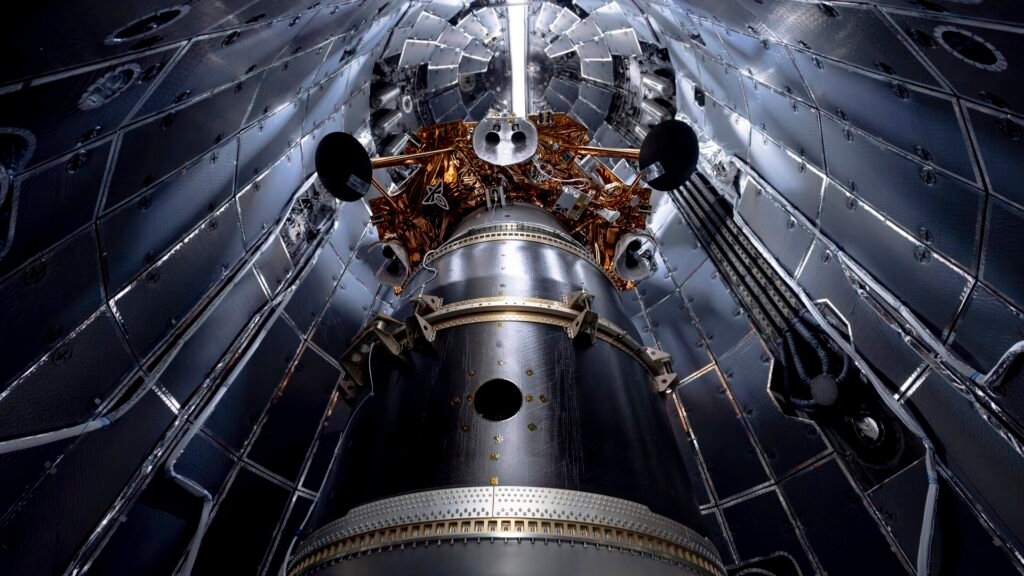
NASA has begun a series of tests at its Langley Research Center to study what happens when a lunar lander’s engine blows dust, soil and rocks across the surface of the Moon. The tests use a 60-foot spherical vacuum chamber and a bin of lunar soil simulant. This article on plume-surface tests summarizes NASA’s description of the setup, what the cameras measure and why the data matters for landing astronauts near a planned Moon Base.
What is NASA testing?
NASA calls the topic plume-surface interaction. A lander’s engine produces a plume of hot gas, and when the lander is close to the ground, that plume can blast dust, soil and rocks outward. NASA says the tests study the hazards of that effect, and the data will improve predictive models and inform spacecraft design. The agency ties the work to returning astronauts to the Moon starting with Artemis IV in 2028 and to building a Moon Base.
Where are the tests?
The tests take place at NASA Langley Research Center in Hampton, Virginia, inside a 60-foot spherical vacuum chamber. A vacuum chamber removes the air so that a plume behaves more like it would on the Moon, where there is almost no atmosphere. That reasoning is general and is not a NASA quotation. NASA does not give the chamber’s pressure in the text we used.
How is the first round set up?
Round one uses an ethane system designed by NASA’s Stennis Space Center and built by Purdue University. A correction in NASA’s article notes that Langley operates the system. It produces a maximum of about 100 pounds of thrust, and NASA says it heats but does not burn. The target is a bin about 6.5 feet in diameter and one foot deep, filled with a lunar regolith simulant called Black Point-1. Each firing lasts about six seconds.
What comes in round two?
Later in 2026, NASA plans a second round with a 14-inch, 3D-printed hybrid rocket motor developed at Utah State University and tested at NASA’s Marshall Space Flight Center in Huntsville, Alabama. It produces about 35 pounds of thrust by burning solid propellant with gaseous oxygen. NASA says both systems will be tested at various heights above the bin.
What do the instruments measure?
Instruments, including a version of the SCALPSS cameras that imaged Firefly’s Blue Ghost Mission-1 landing in 2025, track:
- Crater formation
- The angle and height of the ejecta sheet
- The spatial distribution of solid ejecta
- The speed of regolith particles leaving the bin
Ejecta means material thrown out of a crater. Regolith is the loose dust and broken rock that covers the Moon’s surface. Those two definitions are general.
How to read the numbers
By our own arithmetic, 6.5 feet is about 2 meters, and a cylinder 6.5 feet wide and one foot deep holds roughly 33 cubic feet, or about 0.9 cubic meter of simulant. The first system’s 100 pounds of thrust is nearly three times the second system’s 35 pounds. A thrust of 100 pounds-force is about 445 newtons. These calculations are ours and are not NASA statements. They show that the tests use small engines and a small bin, which is a scale model of a real landing.
Why is scale a concern?
A real lander engine is far more powerful than either test engine, so the results must be scaled up with models. NASA says the data will improve those predictive models, which suggests the tests are meant to check and tune the models and not to reproduce a full landing. The page does not explain the scaling method, so we describe the logic only in general terms. Sound models matter because the dust a plume throws can damage nearby hardware or limit visibility.
Why does the setup stay flexible?
NASA says the setup is modular. The lunar simulant can be swapped for a sand-like Mars simulant, and the chamber can be set to Mars-like pressure. That means the same facility could support research for missions to Mars, although NASA’s article focuses on the Moon.
How does it connect to other coverage?
Dust is a recurring theme in exploration. Our article on Perseverance and Martian dust covers what a rover learned about the planet’s dust, and our report on the three new Moon Base science investigations includes one that will study how the surface responds to rocket exhaust. Our summary of Artemis III covers a 2027 test of lunar landers, and the article on the lunar 5G contract covers a network for surface operations. Each addresses a piece of working on the Moon.
Related reading: NASA X-59 Flies Six Times in One Week and Reaches Mach 1.53.
Glossary
- Plume-surface interaction: the effect of an engine’s exhaust on the ground beneath a lander
- Regolith simulant: an Earth-made material that imitates lunar or Martian soil
- Ejecta: material thrown outward by an impact or blast
- Thrust: the push an engine produces
- Hybrid rocket: a rocket that uses a solid fuel and a gas or liquid oxidizer
These definitions are general explanations and are not quoted from NASA.
What is not covered here?
NASA’s page does not report results from the tests, the chamber pressure or the exact heights used. It also notes several revisions: the story was first published in December, revised on August 26, 2026 and corrected on September 2, 2026. We have not added any findings.
Key facts at a glance
- Facility: 60-foot spherical vacuum chamber at NASA Langley
- Round one: ethane system, about 100 pounds of thrust, six-second firings
- Round two: 3D-printed hybrid motor, about 35 pounds of thrust, later in 2026
- Bin: about 6.5 feet wide, one foot deep, Black Point-1 simulant
- Goal: better models for landings starting with Artemis IV in 2028
Frequently asked questions
Why does a plume matter?
It can throw dust and rocks that could harm a lander or nearby equipment.
Are there results yet?
NASA’s page describes the setup but reports no findings.
Can it test Mars conditions?
Yes in principle. NASA says the simulant and chamber pressure can be changed.
More in Technology
- New Mars Helicopter Blade Design Targets Flights of Nearly 19 Kilometers, NASA Says
- NASA's CASALS Lidar Fills Gaps in 3D Maps of Earth's Surface
- Starliner Update: NASA and Boeing Plan an Uncrewed Flight and Crew Return by 2028
- IEA Energy Innovation Report 2026: 320 New Start-Ups and a Shift to Security