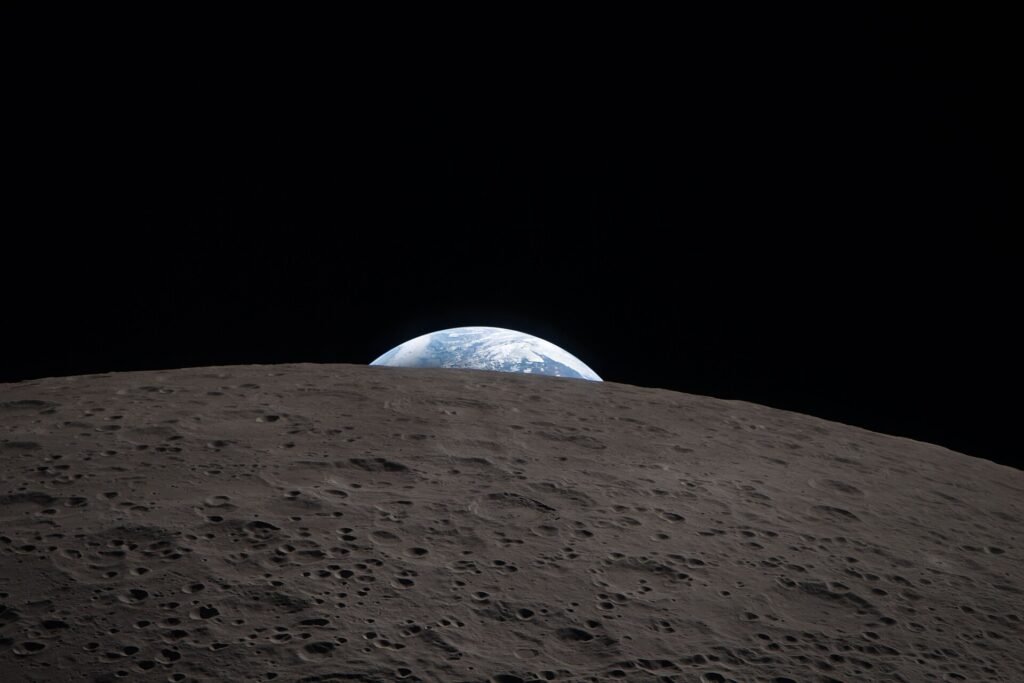
The Artemis II preliminary lunar science report is NASA’s first account of what the four astronauts saw during their April 6, 2026 flyby of the Moon. NASA released it on October 7, 2026 and updated the page on October 29. It describes faint impact flashes, surface colors, an eclipse seen from the far side and images of Earth. This article summarizes the report and flags where it is only an estimate.
Who flew and what did they do?
The crew was Reid Wiseman, Victor Glover, Christina Koch and Jeremy Hansen of the Canadian Space Agency. They flew past the Moon on April 6, 2026, and the report says their closest approach was 4,067 miles. They spent about seven hours at the windows making observations. The report is labeled preliminary, which means the findings may change as the team analyzes the data.
What impact flashes did they see?
The crew saw five extremely faint flashes of light on the Moon’s surface, which NASA interprets as meteoroids hitting it. Orion was about 46,000 miles from the Moon when they were seen. The impactors are estimated to be no more than a couple of inches wide. NASA says these are likely the faintest flashes ever seen by the unaided eye. The size of the impactors is an estimate and not a measurement.
What do the surface colors mean?
The crew described subtle colors across the lunar surface. The report says blues suggest titanium-rich volcanic rock, browns suggest iron and greens suggest glass. These are interpretations of what the astronauts saw, and they are not laboratory analyses. Samples or instrument data would be needed to confirm the composition.
What did they see near the terminator?
The terminator is the line between day and night on the Moon. Low sunlight there makes craters and ridges stand out. The report highlights views of the terminator and describes the crater Carnot, about 80 miles wide. The report does not give a depth for the crater.
What happened during the eclipse?
From the far side, the crew watched the Sun pass behind the Moon for about 54 minutes. During this time they could see the planets Mars and Saturn, a glow called zodiacal light and a pulsating streamer of the Sun’s outer atmosphere, the corona. The report presents these as visual observations by the crew.
Which Earth images did the crew take?
On April 2, the crew took an image called Hello, World from about 6,000 miles away. NASA says it shows auroras, a plume of Saharan dust, lightning over the Congo basin and city lights. A Milky Way image followed on April 7.
What does the Orientale Basin data show?
The crew’s observations of the Orientale Basin were combined with data from NASA’s Lunar Reconnaissance Orbiter. The report gives elevations from minus 8.71 to 9.43 kilometers, roughness up to 18.06 meters and rock abundance up to 1.33 percent. By our own arithmetic, the elevation range spans about 18.14 kilometers from lowest to highest. The report does not state the area these values cover.
Why does a crewed flyby add to orbiter data?
Orbiters measure the Moon with instruments, while people see color, brightness and context with their eyes. In general terms, human observation can point scientists to features worth studying with instruments. This general explanation is not quoted from NASA, and the report does not say which observations led to new instrument work.
Why is the report called preliminary?
A preliminary report gives early findings before the full analysis is finished. The page was updated on October 29, after its October 7 release, which shows the text can change. The report does not list which findings are most likely to be revised, so readers should treat every figure as provisional.
How reliable are eyewitness observations?
The flashes, colors and eclipse details come from what the astronauts saw and described, supported by images. Human eyes are good at noticing faint changes, but they cannot measure the energy of a flash or the exact makeup of a rock. In general terms, scientists treat such reports as leads that instruments and later analysis must confirm. This general explanation is not quoted from NASA. The report itself notes that the impactor size is an estimate, which is consistent with that caution.
What does the Hello, World image add?
The image taken from about 6,000 miles away shows Earth as the crew saw it, with auroras, dust, lightning and city lights in one view. The report presents it as an observation of Earth from deep space. It does not give measurements of the aurora, the dust plume or the lightning, so the image is best read as a record of what was visible and not as data.
How to read the numbers
Distances such as 46,000 miles and 4,067 miles are distances from the Moon at different times in the trip. The eclipse duration of 54 minutes is approximate. The roughness and rock abundance values are maximums from combined data and not averages.
How does this connect to other coverage?
See also the Artemis II data release, the Artemis II mission, the Artemis III plans and the Moon Base PRISM project.
What should readers watch for next?
Readers can watch for the final science report and for peer-reviewed analysis of the impact flashes.
Glossary
- Terminator: the boundary between lunar day and night
- Zodiacal light: a faint glow caused by sunlight scattering off dust in the solar system
- Corona: the Sun’s outer atmosphere
- Orientale Basin: a large impact basin on the Moon
- Preliminary: early and subject to revision
These definitions are general explanations and are not quoted from NASA.
What is not covered here?
The report gives no spectral data for the colors and no peer review of the flash estimates, so we report none.
Key facts at a glance
- Flyby: April 6, 2026
- Closest approach: 4,067 miles
- Impact flashes: five, impactors no more than a couple of inches wide
- Eclipse: about 54 minutes
- Released: October 7, 2026
Frequently asked questions
What is in the Artemis II science report?
Observations of impact flashes, surface colors, an eclipse and Earth images by the crew.
Is the report final?
No. NASA calls it preliminary.
Who flew on Artemis II?
Reid Wiseman, Victor Glover, Christina Koch and Jeremy Hansen.
More in Science