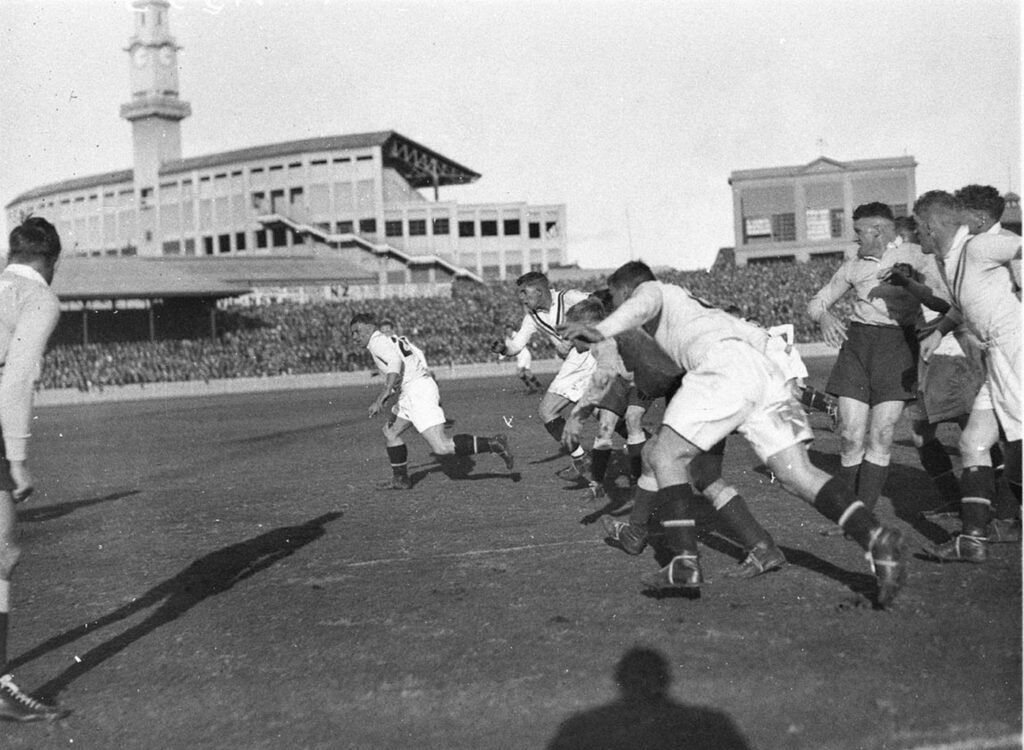
Rugby league is a team sport for two sides of 13 players, which split from rugby union in 1895 when northern English clubs broke away over payments to players. A match normally lasts 80 minutes, and a try is worth four points. The sport is governed worldwide by International Rugby League (IRL).
History of rugby league
On August 29, 1895, northern English clubs broke away from the Rugby Football Union (RFU) because they wanted to pay players, which the union then banned. They formed the Northern Rugby Football Union, usually called the Northern Union. The Rugby Football League gives the number of clubs as 21, while Britannica says 22 clubs left at a meeting in Huddersfield.
The Challenge Cup began in 1897, when Batley beat St Helens 10 to 3 at Headingley on April 24. That year the line-out was removed, and conversions, penalties and drop goals were all worth two points.
In 1906 the sport moved to 13 players a side and introduced the play-the-ball, and all 31 professional clubs merged into one league. The Northern Union was renamed the Rugby Football League in 1922. In 1996 Super League began, and the sport moved to a summer season.
The game spread quickly overseas. The New South Wales Rugby League was formed in 1907, its first clubs formed in 1908, and the first premiership games were played that year. After the 1909 Wallabies tour, more than half of the touring squad accepted offers to join rugby league, and the so-called rugby war in Australia was over by 1910. France formed its own rugby league federation in 1934.
Rules and how rugby league is played
Under IRL’s 2024 Laws of the Game, a team may have up to 13 players on the field at a time, and a match normally lasts 80 minutes. Each team names 17 players and may make up to eight interchanges, and a team must have at least nine players on the field. The extract of the laws that was read for this entry also notes that an 18th player can be activated in certain head-injury or foul-play cases.
A try is worth four points, a conversion goal two, a penalty goal two and a drop goal one. Britannica contrasts this with rugby union, where a try is worth five and a drop goal three.
The central difference is how possession works. Each league team gets a limited set of tackles before the ball goes to the opponents, and Britannica puts the number at six, with teams usually kicking after the fifth unless they are near scoring range. The IRL laws describe it as a handover after the fifth tackle if the team is tackled a sixth time.
After a tackle, the tackled player must regain their feet without delay, face the opponents’ goal line and place the ball on the ground, then heel it backward to put it back in play. This is the play-the-ball. Defenders must retire 10 meters. League also abolished the ruck and the line-out by 1907, and its scrum has a 3-2-1 formation, compared with 3-4-1 in union.
Rugby league vs. rugby union
Rugby league has 13 players a side, and rugby union has 15. A try is worth four points in league and five in union, and a drop goal is worth one point in league and three in union. League dispensed with the line-out and the ruck by 1907, and a league team gets a limited set of tackles, while a union team can keep the ball as long as it is controlled and not lost forward.
The two codes also differ in the scrum. League uses a 3-2-1 formation, and union uses 3-4-1, according to Britannica. Both codes share one kicking rule: from inside the defensive 22-meter line the ball may be kicked into touch in the air, but outside the 22 it must bounce in the field of play first.
Equipment and venues
The IRL laws say the ball’s dimensions are those approved by the IRL Board, so this entry gives no ball measurements. The field of play is a rectangular pitch with goal posts, but the extract of the laws that was readable did not state the pitch dimensions clearly, so they are not given here.
Some venues carry the sport’s history. Headingley hosted the first Challenge Cup final in 1897. Lang Park in Brisbane staged the first State of Origin game in 1980.
Governing bodies and major competitions
IRL calls itself the global governing body of rugby league. It took its current form in 2019, when the Rugby League International Federation, founded in 1998, transformed itself into International Rugby League. An earlier Rugby League International Board was set up in 1948.
IRL has 19 full members, 16 affiliate members and 19 observer members. It is based in London, has been responsible for the Laws of Rugby League since 1998, and sanctions Test matches and the global rankings. It also presents the Golden Boot Award each year to the best male, female and wheelchair players.
The Rugby League World Cup is held every four years and has men’s, women’s and wheelchair competitions. Domestic competitions include England’s Challenge Cup and Super League, and Australia’s National Rugby League (NRL), which was formed in 1998.
Notable moments in rugby league history
The first Rugby League World Cup was held in France in 1954, and Great Britain beat France 16 to 12 in the final. New Zealand beat Australia 34 to 20 in Brisbane to win in 2008, and Australia beat New Zealand 34 to 2 in 2013.
State of Origin began in 1980 at Lang Park, where Queensland won the first game 20 to 10. Australia first hosted the World Cup in 1957.
Rugby league around the world
The sport grew in northern England and in New South Wales, and IRL now counts 54 members in its three categories, each belonging to a regional confederation. Its World Cup has been played at irregular intervals since 1954, and IRL describes it today as a four-year event with men’s, women’s and wheelchair competitions.
Overseas growth took different routes. In Australia the New South Wales league was formed in 1907 and the first premiership games were played in 1908, while in France a rugby league federation was formed in 1934. The NRL says Australia first hosted the World Cup in 1957, three years after the first tournament in France.
More in Sports Coaching and Performance
Key facts
- Rugby league began on August 29, 1895, when northern English clubs left the Rugby Football Union over payments to players.1
- The sport moved to 13 players a side and introduced the play-the-ball in 1906.1
- A try is worth four points, a conversion two, a penalty goal two and a drop goal one.4
- The first Rugby League World Cup was held in France in 1954, and Great Britain beat France 16 to 12.3
- International Rugby League has 19 full members and has been responsible for the Laws of Rugby League since 1998.5
Related concepts
Quick checkWhen and why did rugby league split from rugby union?Show answer
On August 29, 1895, northern English clubs broke away from the Rugby Football Union because they wanted to pay players, which the union banned.
Sources
- Rugby Football League, History and Heritage, https://www.rugby-league.com/governance/about-the-rfl/history-&-heritage
- National Rugby League, History of Rugby League Australia and the NRL, https://www.nrl.com/operations/history-of-rugby-league/
- Britannica, Rugby League World Cup, https://www.britannica.com/sports/Rugby-League-World-Cup
- International Rugby League, Laws of the Game 2024 with Notes on the Laws, https://www.intrl.sport/uploads/docs/international-rugby-league-laws-of-the-game-2022%20(3).pdf
- International Rugby League, About the IRL, https://www.intrl.sport/about/about-the-irl
- Britannica, Rugby: The growth of the game, https://www.britannica.com/sports/rugby/The-growth-of-the-game
- Britannica, Rugby: Principles of play, https://www.britannica.com/sports/rugby/Principles-of-play
Editorially reviewed by Specialty Digest Editorial TeamLast reviewed November 4, 2026Researched and drafted with AI assistanceReport an issue