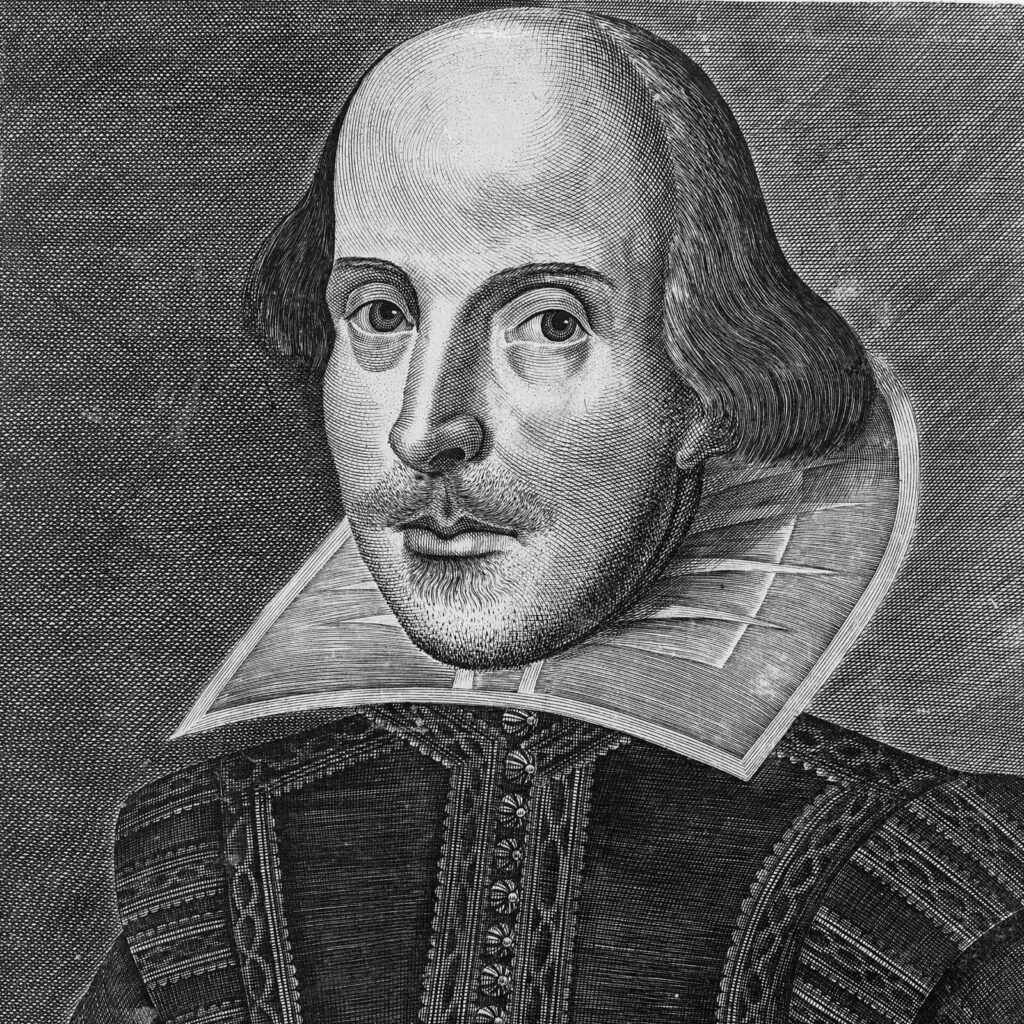
William Shakespeare (baptized April 26, 1564; died April 23, 1616) was an English playwright, poet and actor, widely regarded as the greatest writer in the English language. Working in London during the late Elizabethan and early Jacobean years, he wrote comedies, histories, tragedies and poems, and he was also a shareholder in a leading acting company. Many records from his lifetime are lost, so parts of his biography remain uncertain, and this entry says so where it matters.
Early life of William Shakespeare
Shakespeare was baptized in Stratford-upon-Avon, about 100 miles northwest of London. His exact birthdate is unknown, but tradition gives April 23. He was the oldest surviving child of John Shakespeare, a leatherworker who specialized in the soft white leather used for gloves, and Mary Arden, who came from a prominent local family. John rose through town offices to become bailiff, an office much like mayor, when William was about five. He later withdrew from public life for reasons nobody knows.
As the son of a leading citizen, William almost certainly attended Stratford’s grammar school, the King’s New School, which was free to boys of the borough. Its curriculum centered on Latin. Pupils read authors such as Terence, Virgil and Horace, and they even performed Latin plays. Shakespeare probably left at about 14 or 15, and no record shows that he ever attended a university.
In late 1582 he married Anne Hathaway, who was 26 to his 18 and already expecting their first child. Susanna was baptized in May 1583, and the twins Judith and Hamnet followed in February 1585. Hamnet died in 1596 at age 11. Anne and the children stayed in Stratford while Shakespeare worked in London, though no one knows exactly when he moved. Between 1585 and 1592 almost nothing about him is documented, a gap biographers often call the lost years.
The first definite mention of Shakespeare in London comes in 1592. A rival writer mocked him as a “Shake-scene” and alluded to Henry VI, Part 3, which means that play had already been performed. By then he was an established actor and playwright.
Major contributions of William Shakespeare
For more than two decades Shakespeare worked as an actor, a playwright and, in time, a business partner in the Lord Chamberlain’s Men, an acting company renamed the King’s Men in 1603. In 1593 he published Venus and Adonis, a long narrative poem, and the first quarto editions of his early plays appeared in 1594. A quarto is a small book made by folding each printed sheet twice. His name was missing from the first quartos, but it later became a regular feature of title pages, a sign that it helped sell copies.
His plays fall into groups that the Folger Shakespeare Library lists as comedies, histories, tragedies and romances, along with his sonnets and other poems. The comedies include As You Like It and Twelfth Night, and the histories include the Henry VI plays. Among the tragedies are Hamlet, Macbeth, Othello and Julius Caesar, and The Tempest is usually counted among the late romances. This range, from slapstick farce to political drama, is a large part of why theaters and classrooms still return to him.
Shakespeare also wrote with partners. Among his last plays was The Two Noble Kinsmen, which he wrote with his frequent collaborator John Fletcher, most likely in 1613. Collaboration was common in the commercial theater of the period, so a play’s title page does not always tell the whole story of who wrote it.
The theater made him prosperous. He invested in Stratford real estate and in 1597 bought New Place, the second-largest house in town. His father was granted a coat of arms in 1596, a mark of family standing that a heraldic official challenged in 1602 without success. These details matter because they show a working professional who treated writing as a livelihood, not only as an art.
Shakespeare died on April 23, 1616, the traditional date of his birthday. The cause of death is unknown. His brother-in-law had died a week earlier, which might point to an infectious illness, but his health may also have declined over a longer period. In his will, dated March 25, 1616, he left his wife his second-best bed. That was not necessarily a slight, since the best bed was usually treated as an heirloom for the heir, and the second-best was probably the one the couple shared.
Legacy of William Shakespeare
Shakespeare’s original manuscripts have been gone for centuries, so early printed books are the closest surviving evidence of what he wrote. The most important is the First Folio of 1623, the first collected edition of his plays, assembled seven years after his death by John Heminge and Henry Condell, two of his fellow actors in the King’s Men. It contains 36 plays, and 18 of them, including Macbeth, The Tempest and Twelfth Night, had never been printed before. Without the book, those plays might have been lost. It also sorted the plays into comedies, histories and tragedies for the first time. The book depended on the printing press, which made it possible to preserve and spread the plays widely.
The First Folio carries an engraved portrait of Shakespeare by Martin Droeshout. It is one of two likenesses scholars consider authentic, because people who knew him approved it. The other is the memorial bust in Holy Trinity Church in Stratford, where he is buried. The Folger Shakespeare Library in Washington holds 82 copies of the First Folio, the largest collection in the world.
Shakespeare’s own family line ended. His daughter Susanna had one child, Elizabeth, who had no children, and Judith’s sons died without marrying. Descendants of his sister Joan, who married William Hart, are alive today. His influence on Renaissance and later writing is far wider than his bloodline, and his stories are still staged, filmed, taught and translated around the world.
FAQs
When was William Shakespeare born? He was baptized on April 26, 1564, so he was probably born a few days earlier. April 23 is the traditional date.
How many children did Shakespeare have? Three: Susanna, and the twins Judith and Hamnet. Hamnet died at age 11.
What is the First Folio? It is the 1623 collection of 36 of his plays, and it preserved half of them for the first time in print.
Did Shakespeare go to university? No record shows that he did. He most likely studied Latin at the grammar school in Stratford.
More in Literature
Key facts
- Shakespeare was baptized in Stratford-upon-Avon on April 26, 1564, and tradition gives April 23 as his birthday.1
- He married Anne Hathaway in late 1582 and had three children: Susanna and the twins Judith and Hamnet.1
- He was a partner in the Lord Chamberlain's Men, renamed the King's Men in 1603.1
- He died on April 23, 1616, and the cause of death is unknown.1
- The First Folio of 1623 collected 36 plays, 18 of them printed for the first time.3
- He most likely attended the Stratford grammar school, and no record shows he attended a university.2
Related concepts
In the news
Quick checkWhat was the First Folio?Show answer
It was the 1623 collection of 36 of Shakespeare's plays, published seven years after his death.
Sources
- Folger Shakespeare Library, Shakespeare's life, https://www.folger.edu/explore/shakespeares-life/
- Shakespeare Birthplace Trust, Shakespeare's School, https://www.shakespeare.org.uk/explore-shakespeare/shakespedia/william-shakespeare/shakespeares-school/
- Folger Shakespeare Library, The Shakespeare First Folio, https://www.folger.edu/explore/shakespeare-in-print/first-folio/
- Folger Shakespeare Library, Shakespeare's works, https://www.folger.edu/explore/shakespeares-works/
Editorially reviewed by Specialty Digest Editorial TeamLast reviewed November 4, 2026Researched and drafted with AI assistanceReport an issue