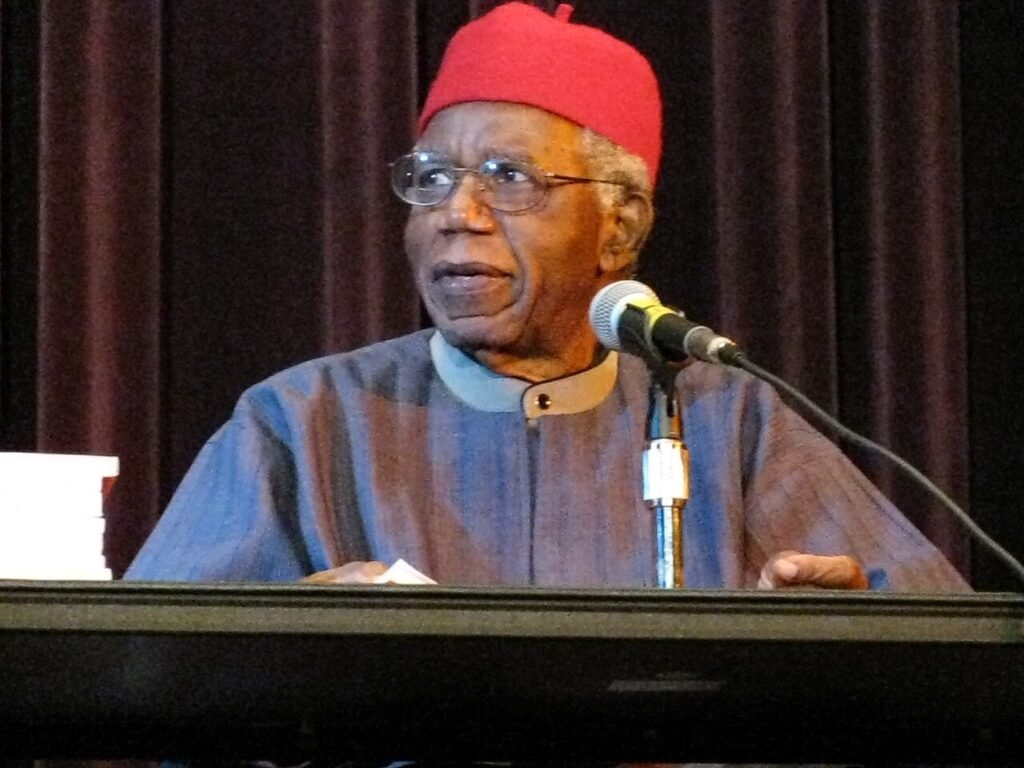
Chinua Achebe (1930 to 2013) was a Nigerian novelist, poet and essayist, widely regarded as a founding figure of modern African literature. His first novel, Things Fall Apart, published in 1958, tells the story of Igbo society before and during the arrival of European rule, and it remains the most studied African novel. He died in Boston, United States, on 21 March 2013.
Early life of Chinua Achebe
Chinua Achebe was born Albert Chinualumogu Achebe on 16 November 1930 in the village of Ogidi in eastern Nigeria. His father worked for the Church Missionary Society, and Achebe received his early education through the society’s schools. He began to learn English at the age of eight. His parents were Christians, but the family kept a respect for traditional Igbo customs, and the meeting of these two worlds became a central theme in his fiction.
At 14 he was one of a few boys chosen to attend the government college at Umuahia, one of the best schools in West Africa. In 1948 he enrolled at the newly founded University College, Ibadan, a college affiliated with the University of London. He first planned to study medicine but soon switched to English literary studies, and he wrote stories, essays and sketches for the student paper, the University Herald. After graduating in 1953 he decided to make writing his life’s work.
His chosen goal was to tell the stories of African people, especially the Igbo, with realism and care. He spent his first year after college teaching and then began a career at the Nigerian Broadcasting Corporation, where he stayed for twelve years and became director of the external service, the Voice of Nigeria.
Career and major works
In 1957 Achebe went to London to attend the British Broadcasting Corporation’s staff school. One of his teachers, the novelist and critic Gilbert Phelps, read his manuscript and recommended it for publication. Things Fall Apart appeared a year later in 1958. It gives an account of colonial history from the point of view of the colonized, centered on the Igbo farmer and wrestler Okonkwo, and the Poetry Foundation reports that it has been translated into 45 languages.
To write it, Achebe studied his own culture by interviewing older people and by reading the accounts of colonial administrators and missionaries. He followed with No Longer at Ease in 1960 and Arrow of God in 1964. Together with Things Fall Apart, these novels span the period from precolonial Africa through colonial rule to the years just before Nigeria’s independence from Britain. His satirical novel A Man of the People appeared in 1966.
In 1967 civil war broke out in Nigeria when the eastern region declared itself the independent state of Biafra. Over the next thirty months Achebe traveled to Europe and North America on Biafran affairs. During this time he turned from the long novel to poetry and short stories, including the story Civil Peace. After the war he helped found the literary journal Okike and worked with the publisher Heinemann on its African Writers Series, which brought the work of many African authors to wider readers.
His later books include Anthills of the Savannah in 1987, a satire of political corruption set in the fictional West African nation of Kangan, and several essay collections such as Hopes and Impediments, Home and Exile and There Was a Country, a personal history of Biafra published in 2012.
Ideas and contributions
Achebe argued that Africans had to tell their own stories rather than leave them to outsiders. The Booker Prize Foundation observes that he drew on the Igbo traditions he grew up with to take his fiction beyond the colonial concerns of most earlier writing about Africa. His prose mixes English with Igbo proverbs and speech patterns, giving the novels the rhythm of oral storytelling.
He also wrote about the responsibilities of writers. His essays concerned the role of the African writer in society, and his poetry, including the collection Beware, Soul-Brother, which won the Commonwealth Poetry Prize in 1972, reflected on war and politics. Nelson Mandela cited reading Achebe in prison as an inspiration.
Death of Achebe
Achebe died in Boston on 21 March 2013, aged 82. In the early 1990s he had moved to the United States, where he taught at Bard College in New York and later at Brown University. The Poetry Foundation says he left Nigeria to escape a repressive regime that had threatened to jail him, and other biographies also stress a car crash in 1990 that left him partly paralyzed.
Legacy of Chinua Achebe
Anthills of the Savannah was shortlisted for the Booker Prize in 1987, and in 2007 Achebe won the Man Booker International Prize for his body of work. Other honors include the German Booksellers Peace Prize and honorary degrees from more than twenty American universities. In 1999 he was named a goodwill ambassador by the United Nations Population Fund.
Things Fall Apart is taught in schools and universities around the world, and Achebe’s work opened the way for later generations of African authors writing in English. The Booker Prizes also notes that in 2007 the judges honored him for his whole literary career, not for a single book, and that he was by then regarded as the most significant literary figure on the African continent.
Controversies and criticism
In a 1975 lecture titled An Image of Africa, Achebe criticized Joseph Conrad’s novella Heart of Darkness, arguing that it presents Africa as a place without humanity and that Conrad was a thoroughgoing racist. The lecture became a landmark of postcolonial criticism, although many scholars still defend Conrad’s work as a critique of European colonialism. The debate remains a standard part of university courses on the novel.
More in Literature
Key facts
- Achebe was born on 16 November 1930 in Ogidi, eastern Nigeria, and died in Boston on 21 March 2013.1
- Things Fall Apart was published in 1958 and has been translated into 45 languages.1
- He won the Man Booker International Prize in 2007 for his body of work.2
- Anthills of the Savannah was shortlisted for the Booker Prize in 1987.2
- He worked for the Nigerian Broadcasting Corporation for twelve years and became director of the Voice of Nigeria.1
Related concepts
Quick checkWhat is Chinua Achebe best known for?Show answer
His 1958 novel Things Fall Apart, which tells the story of Igbo society and the arrival of colonial rule from an African point of view. It is the most studied African novel.
Sources
- Poetry Foundation, Chinua Achebe, biography, https://www.poetryfoundation.org/poets/chinua-achebe
- The Booker Prizes, Chinua Achebe, author profile, https://www.thebookerprizes.com/the-booker-library/authors/chinua-achebe
Editorially reviewed by Specialty Digest Editorial TeamLast reviewed November 4, 2026Researched and drafted with AI assistanceReport an issue