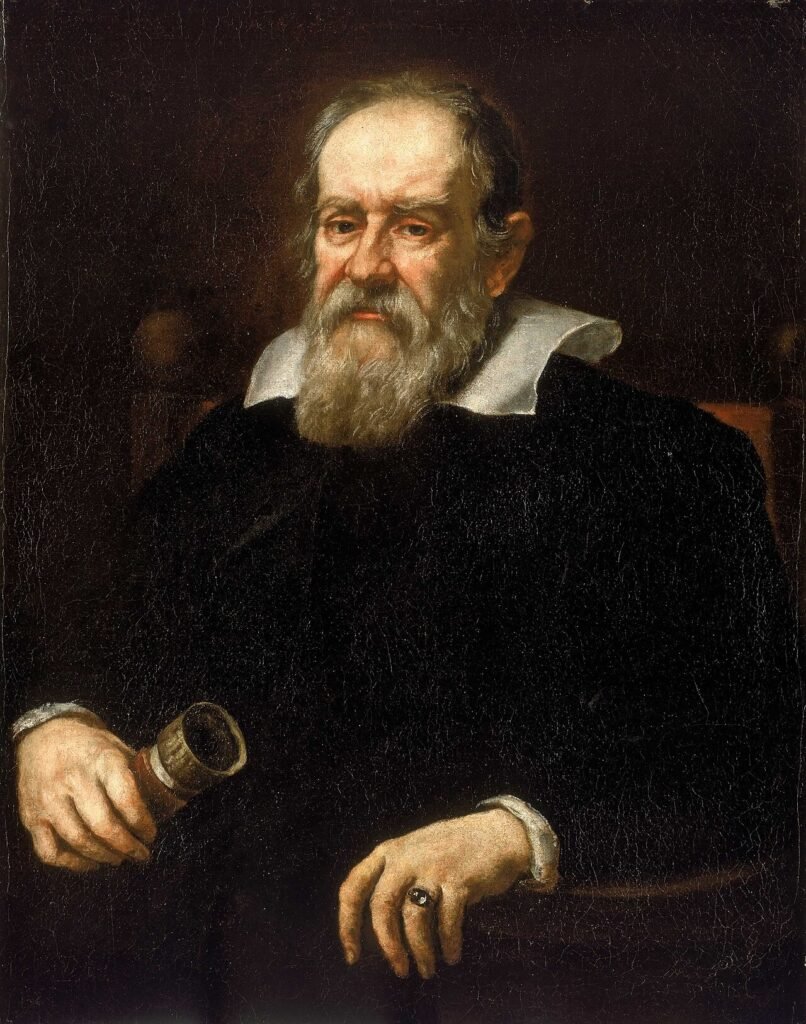
Galileo Galilei (1564 to 1642) was an Italian mathematician, astronomer and natural philosopher. He used an improved telescope to gather evidence that not everything in the sky circles the Earth, and he described how falling bodies move. In 1633 the Roman Inquisition convicted him of vehement suspicion of heresy, and he lived under house arrest for the rest of his life.
Early life of Galileo
Galileo was born in Pisa on February 15, 1564, the first child of Vincenzo Galilei, a music scholar and lute player, and Giulia Ammannati. The family returned to Florence in 1572, and Galileo later studied at a monastery school at Vallombrosa before coming back to Florence.
His father wanted him to become a physician, so Galileo enrolled in medicine at the University of Pisa in 1581. He cared more about mathematics and natural philosophy, and he read Euclid and Archimedes with the help of a Tuscan court mathematician, Ostilio Ricci. By 1585 he had left Pisa without a degree.
He then taught mathematics privately and at Siena. In 1586 he wrote his first scientific work, a short book on the hydrostatic balance, which described how Archimedes compared the densities of substances by weighing them in water. He was appointed to teach mathematics at Pisa in 1589, and in 1592 he moved to a better-paid chair at the University of Padua in the Venetian Republic.
Career and major work of Galileo
At Padua, Galileo studied mechanics and built practical instruments. The Museo Galileo in Florence lists a thermoscope, a geometric and military compass and a water-lifting machine that he patented in 1594. He also earned extra income by tutoring and by selling instruments made in a workshop at his house.
In 1609 he heard about the recently invented spyglass and built better versions of it. With these telescopes he studied the Moon, found four moons circling Jupiter, and reported his findings in the Starry Messenger, which appeared in March 1610. The book made him famous across Europe.
Later in 1610 he left Padua to become mathematician and philosopher to the Grand Duke of Tuscany. In 1611 he visited Rome, joined the scientific Accademia dei Lincei and observed sunspots. His Letters on Sunspots of 1613 was the first work in which he openly supported the Copernican system, which places the Sun at the center.
In 1623 he published The Assayer, a polemic about the nature of comets that also contains his well-known claim that the book of nature is written in the language of mathematics. In 1632 he printed the Dialogue Concerning the Two Chief World Systems in Florence. His last major work, the Discourses on Two New Sciences, was smuggled out of Italy and published in Holland in 1638, when he was almost completely blind.
Ideas and contributions of Galileo
Galileo’s telescope observations gave concrete evidence against the older picture in which every heavenly body revolved around the Earth. The moons of Jupiter were the clearest example, because they showed a center of motion other than the Earth. Later observations, such as the changing phases of Venus, fit the Copernican arrangement more naturally.
His second major contribution was in the study of motion. MacTutor credits him with formulating the basic law of falling bodies and checking it with careful measurements. In the Two New Sciences he treated both motion and the strength of materials, and he showed how mathematics could describe each.
Galileo also challenged parts of the physics taught from the works of Aristotle. Rather than argue only from first principles, he paired mathematical reasoning with experiments and instruments. Historians still disagree about how best to describe his method, and they have called him an Archimedean mathematician, an experimentalist and an heir to craft traditions of engineering.
Galileo and the Church
Support for a moving Earth was controversial in Galileo’s time because it seemed to conflict with some readings of scripture. In 1614 a Dominican preacher, Tommaso Caccini, denounced Copernican opinions from a Florence pulpit. In March 1616 Copernicus’s book was suspended pending correction, and Galileo was warned by Cardinal Robert Bellarmine not to teach or defend the theory. Historians still dispute the exact details of that meeting.
After his friend Maffeo Barberini became Pope Urban VIII in 1623, Galileo felt able to write the Dialogue. Printing was finished in early 1632, but the Inquisition soon banned its sale and ordered him to Rome. In June 1633 he was convicted of vehement suspicion of heresy, and a prison sentence was immediately commuted to perpetual house arrest.
He was held for a time in Siena and in December 1633 was allowed to retire to his villa at Arcetri. His eldest daughter, Sister Maria Celeste, died there in 1634. The Inquisition trial remains one of the best-known clashes between scientific inquiry and church authority.
Legacy of Galileo
Galileo died at Arcetri on January 8, 1642. Because he had been condemned, his burial place was obscure until his remains were reburied in 1737. The Museo Galileo in Florence now preserves many of the instruments of his era and presents his career to the public.
His mathematical treatment of motion paved the way for Isaac Newton, whose laws of motion drew on this tradition. His telescope work helped open a new period of observational astronomy, and he stands among the leading figures of the scientific revolution that followed the Renaissance.
The Dialogue and the Two New Sciences are still read today, both for their physics and for their vivid prose. The Dialogue was written in Italian rather than Latin, which let educated readers outside the universities follow the argument. His name is also attached to modern spacecraft and instruments, a sign of how closely he is linked with the exploration of the sky.
More in Physics
Key facts
- Galileo was born in Pisa on February 15, 1564, and died at Arcetri near Florence on January 8, 1642.1
- He held the mathematics chair at the University of Padua from 1592 to 1610, then became mathematician and philosopher to the Grand Duke of Tuscany.1
- His Starry Messenger (Sidereus Nuncius) appeared in March 1610 and reported his telescope discoveries.2
- In June 1633 he was convicted of vehement suspicion of heresy, and a sentence of imprisonment was commuted to perpetual house arrest.2
- His last book, on two new sciences of motion and material strength, was published in Holland in 1638.2
Related concepts
In the news
Quick checkWhy was Galileo put on trial in 1633?Show answer
His Dialogue Concerning the Two Chief World Systems, printed in 1632, favored the Copernican view that the Earth moves around the Sun. The Roman Inquisition convicted him of vehement suspicion of heresy and he spent the rest of his life under house arrest.
Sources
- Museo Galileo, Galileo Galilei biography, https://catalogue.museogalileo.it/biography/GalileoGalilei.html
- Stanford Encyclopedia of Philosophy, Galileo Galilei, https://plato.stanford.edu/entries/galileo/
- MacTutor History of Mathematics, University of St Andrews, Galileo Galilei, https://mathshistory.st-andrews.ac.uk/Biographies/Galileo/
Editorially reviewed by Specialty Digest Editorial TeamLast reviewed November 4, 2026Researched and drafted with AI assistanceReport an issue