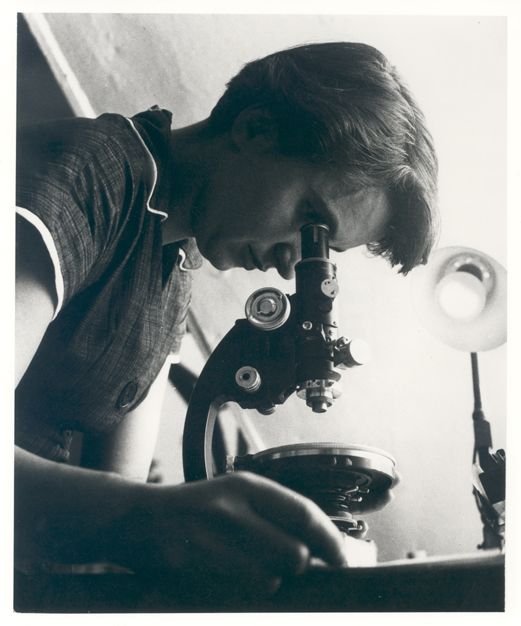
Rosalind Franklin (1920 to 1958) was an English chemist and X-ray crystallographer. Her X-ray diffraction work at King’s College London produced key evidence for the double helix structure of DNA, and she also made important studies of coal, graphite and the tobacco mosaic virus. She died of cancer at age 37.
Early life of Rosalind Franklin
Franklin was born in London in 1920. She studied physical chemistry at Newnham College, Cambridge, although as a woman she was not allowed to receive a degree there at the time. She received her PhD in 1945 for research on the small-scale structures of coal and carbons, which she carried out during the Second World War.
Her coal and graphite research was done at the British Coal Utilization Research Association. She then moved to a state chemistry laboratory in Paris, the Laboratoire Central des Services Chimiques de l’Etat. There she learned X-ray diffraction and used it to study the structure of carbon samples after heating.
Career and major work of Rosalind Franklin
X-ray diffraction is a technique in which a beam of X-rays passes through a crystal or fiber and forms a pattern of spots on film. The pattern reveals how the atoms are arranged, and the method is described further in the entry on crystal structure. Franklin became one of the leading experts in the method. At King’s, several researchers, including Wilkins, were trying to find the structure of DNA, and her skill with diffraction made her central to that effort.
She joined the laboratory of John Randall at King’s College London around 1950 to 1951, and she worked there until 1953. By controlling the water content of her DNA samples, she showed that the molecule could exist in two forms, called A and B. She and her PhD student Raymond Gosling described the shift between the two forms in detail.
In May 1952 Franklin and Gosling captured an image of the B form that became known as Photograph 51. It gave clear evidence that DNA has a helical structure. In 1953 she and Gosling published two papers reporting X-ray evidence for the helical structure of both forms.
In 1953 she moved to Birkbeck College in London, where the crystallographer J. D. Bernal invited her to work on the tobacco mosaic virus. In 1955 she published a paper in the journal Nature on the structure of that virus. She was diagnosed with ovarian cancer in 1956 and died in 1958.
Ideas and contributions of Rosalind Franklin
Franklin’s most famous contribution concerns the shape of DNA. Photograph 51 showed a pattern that pointed to a helix,. Her discovery that DNA exists in a drier A form and a wetter B form was essential, because water content changes how the molecule packs.
In an X-ray image of a helical molecule, a cross-shaped arrangement of spots is a sign of the helix. Photograph 51 shows that pattern very clearly, which is why it is regarded as a landmark image. Interpreting it still required careful measurement and mathematics, which is the part of the work that Franklin carried out.
Her information reached James Watson and Francis Crick at the Cavendish Laboratory in Cambridge. They used it to build their model of the DNA double helix in March 1953. King’s College London says that her X-ray work made the discovery possible, and that her paper with Gosling and one by Maurice Wilkins and colleagues accompanied Watson and Crick’s announcement in Nature.
Her other work was also significant. Her studies of coal and graphite improved scientific understanding of how carbon-based materials are built at the atomic scale. Her work on the tobacco mosaic virus revealed the structure of a virus particle, and models of it are held in the Science Museum Group collection with her colleague Aaron Klug.
Credit and controversy
The question of how much credit Franklin received is one of the best-known disputes in the history of science. According to the American Crystallographic Association, Photograph 51 was shown by Wilkins to Watson and Crick without Franklin’s knowledge or permission. The photograph provided unmistakable evidence of the helical structure of B-DNA and led directly to the model they proposed.
The 1962 Nobel Prize in Physiology or Medicine was awarded to Crick, Watson and Wilkins. Franklin had died four years earlier, and Nobel Prizes are not given posthumously. Historians still discuss how her contribution was described in early popular accounts, and many now give her work a much larger place in the story than earlier tellings did.
It is important to separate this credit question from the science. Watson and Crick built the model, and Franklin and Gosling supplied the experimental evidence that showed a helix. Both parts were needed for the discovery, and the accounts agree that her data were central.
Legacy of Rosalind Franklin
Franklin died of cancer before the 1962 Nobel Prize was awarded for the structure of DNA. She had helped to uncover the story of life and to lay the foundations of structural molecular biology, as King’s College London puts it. Her coauthored papers and images remain central to the history of molecular biology. Her colleague Aaron Klug continued the virus research after her death, and models in the Science Museum Group collection illustrate the work of both scientists.
Today her name is carried by institutions, lectures and awards, and her story is widely taught. She is often cited as an example of the importance of fair recognition for scientists, particularly women. The structure she helped reveal explains how genes can be stored and copied, which is why her images appear in textbooks on heredity.
More in Chemistry
Key facts
- Rosalind Franklin was born in London in 1920 and died of cancer in 1958 at age 37.1
- She received her PhD from Cambridge in 1945 for research on the structure of coal and carbons.1
- In May 1952 she and student Raymond Gosling captured the X-ray image of the B form of DNA now known as Photo 51.2
- She moved to Birkbeck College in 1953 to work on the tobacco mosaic virus.3
- The 1962 Nobel Prize in Physiology or Medicine for the structure of DNA went to Francis Crick, James Watson and Maurice Wilkins.4
Related concepts
In the news
Quick checkWhat did Rosalind Franklin contribute to the discovery of DNA's structure?Show answer
Franklin and her student Raymond Gosling produced X-ray diffraction images of DNA, including Photo 51, that showed its helical structure. Her data and report were shared with Watson and Crick without her knowledge, and they used the information to build their model in 1953.
Sources
- Science Museum Group, Rosalind Franklin 1920-1958, https://collection.sciencemuseumgroup.org.uk/people/cp37285/rosalind-franklin
- King's College London, The structure of DNA: How Dr Rosalind Franklin contributed to the story of life, https://www.kcl.ac.uk/the-structure-of-dna-how-dr-rosalind-franklin-contributed-to-the-story-of-life-2
- American Crystallographic Association, Rosalind E. Franklin (1920-1958), https://history.amercrystalassn.org/rosalind-franklin
- Nobel Prize Outreach, The Nobel Prize in Physiology or Medicine 1962, https://www.nobelprize.org/prizes/medicine/1962/summary/
Editorially reviewed by Specialty Digest Editorial TeamLast reviewed November 4, 2026Researched and drafted with AI assistanceReport an issue