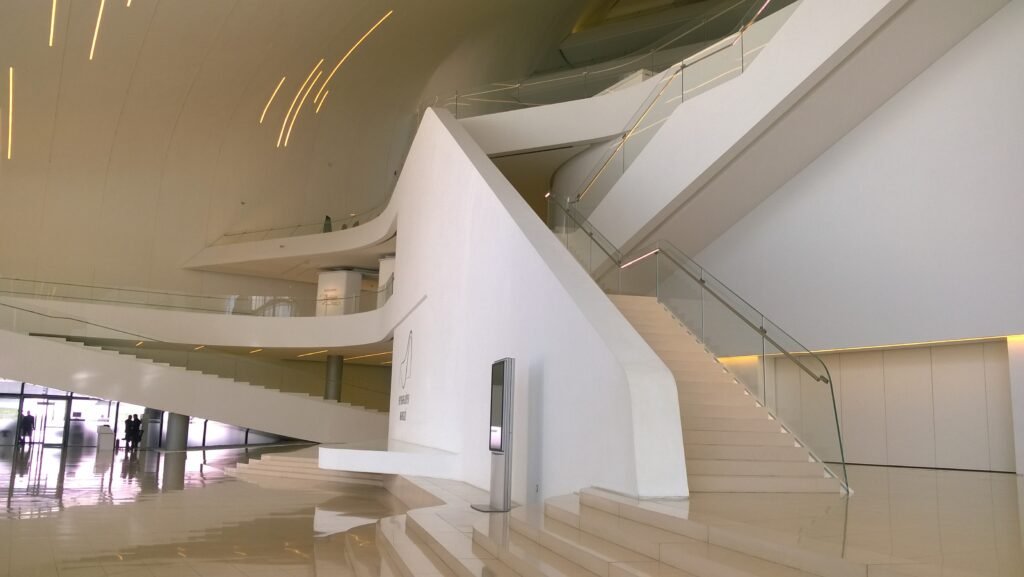
Parametric architecture is a design approach in which buildings and components are generated through algorithms that link design variables, or parameters, to geometric outcomes, allowing architects to explore and manipulate complex forms by adjusting underlying rules rather than drawing shapes directly by hand. Changing a single parameter, such as a curve’s tension or a facade panel’s rotation, can automatically propagate adjustments across an entire structure.
Enabled by advances in computer-aided design software over the past several decades, parametric architecture has moved from a specialized experimental practice into a mainstream tool used across firms of many sizes, particularly for projects involving complex curved surfaces, repetitive but varied components, or performance-driven design optimization.
How Parametric Design Software Works
Parametric design relies on software platforms that represent a building’s geometry not as fixed shapes but as a network of relationships between variables, often visualized through node-based scripting interfaces that let designers wire inputs and outputs together to define how a form responds to changing conditions.
Popular tools in this space include visual scripting plugins that integrate with mainstream three-dimensional modeling software, allowing architects to iterate rapidly through many design variations by adjusting sliders or input values rather than manually redrawing each version from scratch.
Historical Origins and Early Pioneers
While computational design tools matured mainly from the 1990s onward, the conceptual roots of parametric thinking trace back to earlier architects who explored rule-based and mathematical approaches to form, including work on structural optimization using physical models and hanging-chain experiments long before digital computing existed.
The widespread adoption of personal computing and increasingly powerful three-dimensional modeling software during the 1990s and 2000s allowed these earlier conceptual approaches to be realized at a scale and complexity previously impractical, giving rise to the parametric architecture movement as commonly understood today.
Structural Optimization and Performance-Driven Design
One of parametric design’s most significant practical applications lies in structural optimization, where algorithms can generate forms that distribute material efficiently based on load paths, reducing the amount of material needed while maintaining structural integrity, an approach sometimes informed by biological growth patterns found in nature.
Beyond structure, parametric tools are also used to optimize building performance factors such as daylight penetration, solar heat gain, and wind flow around a structure, allowing architects to test many design variations against performance criteria before committing to a final form.
Notable Buildings and Architectural Examples
Parametric design has produced some of the most visually distinctive buildings of recent decades, characterized by flowing, non-rectilinear forms that would be extraordinarily difficult to design and document using traditional drafting methods, often associated with architects who have become closely identified with this computational design philosophy.
Beyond standalone iconic buildings, parametric methods have also been applied to large-scale facade systems composed of thousands of individually varied panels, each generated algorithmically to respond to factors such as solar exposure or structural load while maintaining overall design coherence.
Fabrication and Construction Challenges
Translating complex parametric designs into buildable construction documents and ultimately physical structures has historically posed significant challenges, since conventional construction methods are often ill-suited to producing the highly varied, non-standard components that parametric design can generate.
Advances in digital fabrication, including computer-controlled milling and increasingly large-scale three-dimensional printing, have helped bridge this gap, allowing complex parametric forms to be manufactured with a precision and consistency that would be difficult or prohibitively expensive using traditional craft-based construction techniques.
Criticisms and Limitations
Critics of parametric architecture have argued that an overreliance on algorithmic form generation can prioritize visual spectacle over practical considerations such as cost, maintainability, and contextual fit within a surrounding urban fabric, producing buildings that showcase technical virtuosity without necessarily serving occupants or neighborhoods well.
Some architects have also raised concerns that parametric design can obscure the decision-making process behind a final form, since the underlying algorithm‘s logic may not be immediately legible to clients, builders, or the public in the way a more traditional design rationale might be.
Current Trends and Future Directions
Parametric architecture increasingly intersects with artificial intelligence and generative design tools, which can explore vastly larger design spaces than a human designer manually adjusting parameters, suggesting optimized solutions that architects then evaluate, refine, and select from rather than generating entirely by hand.
As computational tools become more accessible and integrated into standard architectural practice, many observers expect parametric techniques to become less a distinct specialized niche and more simply one set of tools within a broader, increasingly digital design workflow.
Architecture schools have steadily expanded coursework in computational design and scripting languages, reflecting a broader professional expectation that graduates arrive with at least a working familiarity with parametric tools alongside traditional drafting and model-making skills.
Interdisciplinary collaboration between architects, structural engineers, and computational specialists has become increasingly common on complex parametric projects, since realizing an algorithmically generated form often requires expertise spanning several traditionally separate professional disciplines.
FAQ
What makes a building parametric rather than just computer-designed?
Parametric architecture specifically uses algorithms linking variables to geometric outcomes, so that adjusting a parameter automatically propagates changes across the design, distinguishing it from simply drafting shapes digitally without underlying rule-based relationships.
Is parametric architecture only used for unusual-looking buildings?
No, while it is often associated with striking curved forms, parametric methods are also widely used for structural optimization, performance analysis, and facade systems in buildings that may not appear unconventional at first glance.
What software is commonly used for parametric design?
Architects typically use visual scripting plugins that integrate with three-dimensional modeling software, allowing them to define relationships between design variables and generate geometry through node-based interfaces rather than manual drafting.
More in Architecture
Editorially reviewed by Specialty Digest Editorial TeamLast reviewed November 4, 2026Researched and drafted with AI assistanceReport an issue