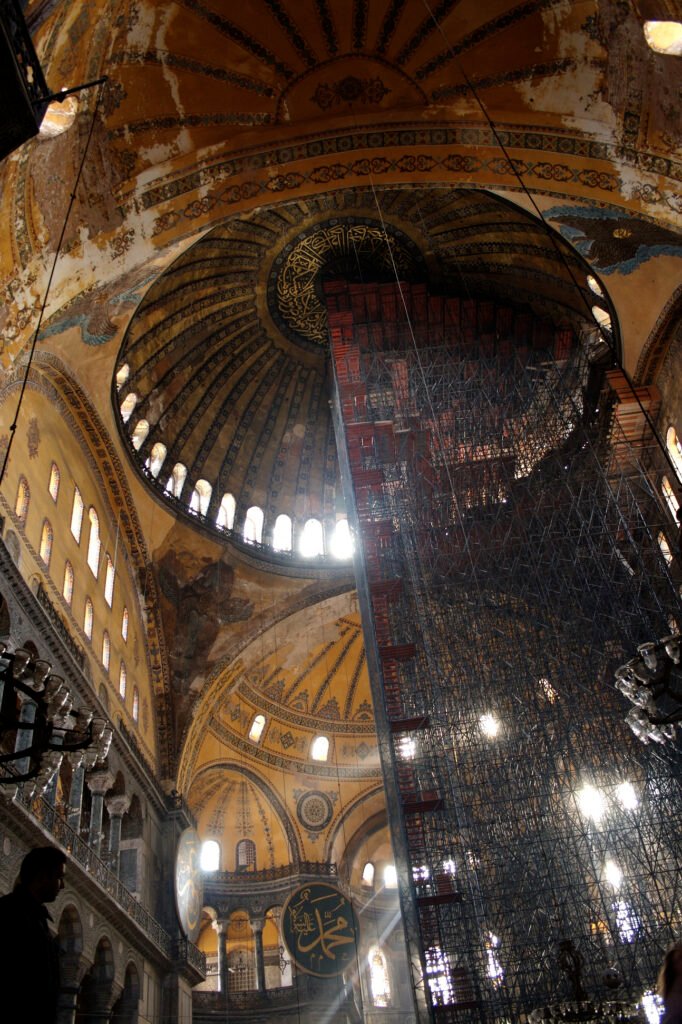
Byzantine architecture refers to the building traditions that developed in the Eastern Roman, or Byzantine, Empire from the fourth century onward, centered on the imperial capital of Constantinople and extending across the empire’s territories around the eastern Mediterranean. The style is distinguished above all by its masterful use of domes, rich interior decoration, and an architectural language that fused earlier Roman engineering with new aesthetic and liturgical priorities.
Byzantine architecture served primarily religious and imperial functions, with church design in particular evolving to support Orthodox Christian liturgical practice, creating interior spaces intended to evoke a sense of heavenly transcendence through light, scale, and elaborate surface decoration rather than the structural clarity emphasized in some later Western traditions.
The Dome as Central Architectural Element
The dome stands as Byzantine architecture’s signature achievement, with engineers developing techniques to support a circular dome atop a square or polygonal base using pendentives, curved triangular sections of masonry that smoothly transition the geometry from one shape to the other, solving a structural challenge that had limited earlier builders.
This innovation allowed Byzantine architects to create vast, uninterrupted interior spaces beneath soaring domes, producing an interior experience often compared to a vision of heaven brought down to earth, with light entering through ring of windows at the dome’s base appearing to make the structure float above the space below.
Hagia Sophia and Imperial Patronage
The Hagia Sophia in Constantinople, completed in the sixth century under Emperor Justinian I, stands as the preeminent example of Byzantine architectural achievement, its massive dome and vast interior remaining structurally and symbolically influential for centuries after its construction across both Christian and later Islamic architectural traditions.
Imperial patronage played a crucial role in Byzantine architecture more broadly, since emperors used monumental church construction to demonstrate religious devotion, political legitimacy, and imperial grandeur simultaneously, making architecture an explicit instrument of statecraft rather than a purely aesthetic or functional pursuit.
Interior Decoration and Mosaic Art
Byzantine church interiors are renowned for elaborate mosaic decoration, typically featuring gold backgrounds and stylized religious imagery that covered walls, domes, and apses, creating a shimmering, otherworldly visual effect that reinforced the spiritual function of the architectural space surrounding worshippers.
This emphasis on surface decoration extended to marble veneers, carved capitals, and elaborate iconography, with the overall effect of a Byzantine church interior designed to overwhelm visitors with sensory richness that communicated the sacred significance of the liturgical events taking place within.
Regional Variations Across the Empire
While Constantinople remained the empire’s architectural center, Byzantine building traditions spread and adapted across diverse regions including the Balkans, Russia, and parts of Italy, producing distinctive regional variations such as the multi-domed churches characteristic of medieval Russian Orthodox architecture.
These regional adaptations often combined core Byzantine structural and decorative principles with local materials and building traditions, demonstrating how the style functioned less as a single rigid formula and more as an adaptable architectural language that could be reinterpreted across very different geographic and cultural contexts.
Church Plan Types and Spatial Organization
Byzantine churches commonly employed a cross-in-square plan, in which a central dome rises above the intersection of a cross-shaped layout inscribed within a square overall footprint, a configuration that became highly influential for Orthodox church design across many centuries and regions.
This plan type balanced structural practicality with symbolic meaning, since the cross shape held obvious religious significance while the centralized dome created a unified processional and visual focus appropriate to Orthodox liturgical practice, distinct from the elongated basilica plans more common in some Western church traditions.
Influence on Later Islamic and Western Architecture
Byzantine architectural innovations, particularly dome construction techniques, significantly influenced subsequent Islamic architecture in regions that came under Muslim rule following the Byzantine Empire’s territorial contraction, with several prominent mosques directly adapting Byzantine structural and spatial solutions.
Byzantine influence also reached Western European architecture at various points, particularly in regions with close trade or political ties to Constantinople, contributing structural and decorative ideas that fed into the broader development of medieval European church architecture alongside more locally rooted traditions.
Decline and Enduring Legacy
Byzantine architectural production gradually diminished alongside the empire’s political and territorial decline, particularly following the loss of Constantinople in 1453, though the architectural tradition’s core innovations, especially dome engineering and centralized church planning, continued to shape building practice well beyond the empire’s political existence.
Today, surviving Byzantine monuments remain significant pilgrimage and tourism destinations and continue to be studied as foundational achievements in the history of structural engineering and sacred architectural design across both Christian and Islamic building traditions.
Modern structural engineers and architectural historians continue to study surviving Byzantine domes using contemporary analytical methods, finding that many of the empirical techniques developed by Byzantine builders anticipated structural principles that were not formally codified in engineering theory until many centuries later.
FAQ
What is the most famous example of Byzantine architecture?
The Hagia Sophia in Constantinople, completed in the sixth century under Emperor Justinian I, is the most renowned example, celebrated for its massive dome and influence on both later Christian and Islamic architecture.
How did Byzantine architects support a round dome on a square building?
Byzantine engineers developed pendentives, curved triangular sections of masonry that smoothly transition the geometry from a square base to a circular dome, solving a structural challenge that had limited earlier builders.
Did Byzantine architecture influence Islamic architecture?
Yes, Byzantine dome construction techniques and spatial solutions significantly influenced later Islamic architecture in regions that came under Muslim rule, with several prominent mosques directly adapting Byzantine structural ideas.
More in Architecture
Editorially reviewed by Specialty Digest Editorial TeamLast reviewed November 4, 2026Researched and drafted with AI assistanceReport an issue