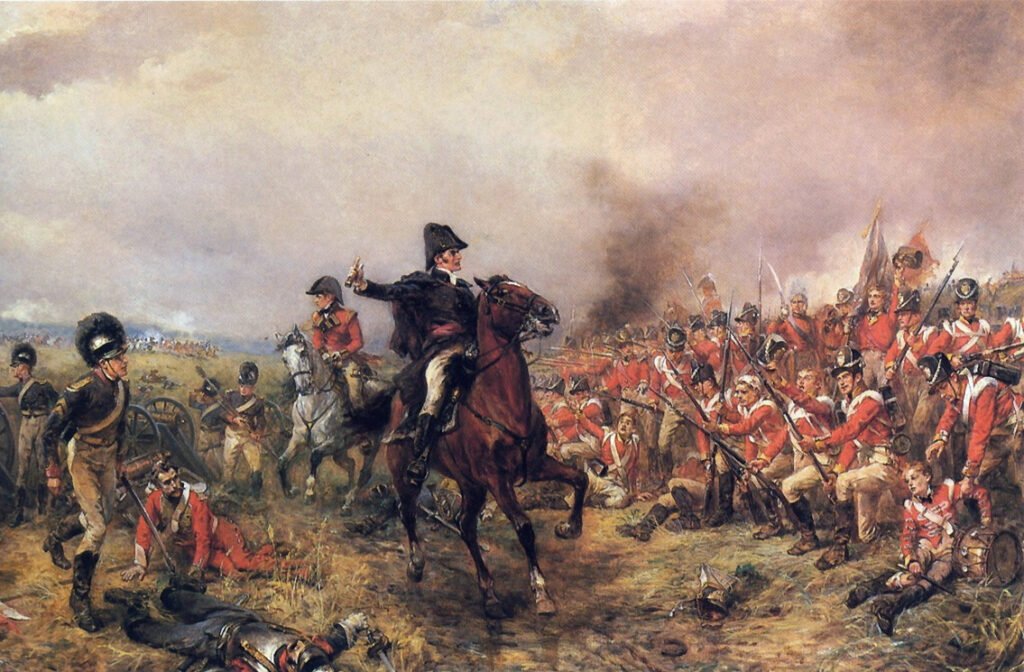
The Battle of Waterloo was fought on 18 June 1815 near the village of Waterloo, in present-day Belgium, between the French army of Napoleon Bonaparte and two allied armies led by the Duke of Wellington and Field Marshal Gebhard von Blucher. The allied victory ended Napoleon’s attempt to regain power in Europe. The National Army Museum in London calls it the decisive battle of its age, because it concluded a war that had lasted 23 years.
Background of the Battle of Waterloo
Napoleon had escaped from exile on the island of Elba in March 1815 and returned to power in France. The other European powers formed a coalition against him. Two armies gathered in the Netherlands to fight him: a Prussian force under Blucher and a multinational Anglo-allied force under Wellington. Together they outnumbered the French, so Napoleon’s best chance was to attack first and defeat each army separately before they could unite.
He crossed the River Sambre into what is now Belgium on 15 June, according to the National Army Museum, although another summary gives 16 June. On 16 June, the main French force defeated the Prussians at Ligny, where the Prussians lost more than 20,000 men and the French about half that number. On the same day, Wellington beat off a separate French attack at the crossroads of Quatre Bras, but the Prussian defeat forced him to retreat or risk being outflanked. A French corps marched back and forth between the two battlefields without fighting at either, which weakened the French pursuit.
The defeated Prussians retreated north and stayed in contact with Wellington. Their General Staff reorganized the army and moved it to Waterloo within 48 hours of the defeat at Ligny. Encouraged by the promise of reinforcements, Wellington decided to stand and fight on 18 June until the Prussians could arrive.
Course of the Battle of Waterloo
After detaching 33,000 men to follow the Prussians, Napoleon had about 72,000 men and 246 guns. Wellington had about 68,000 men and 156 guns, a mix of inexperienced troops and veterans of the Peninsular War. Because of this, Wellington could not take the offensive. He placed most of his army behind the ridge of Mont-Saint-Jean, out of sight of the French and sheltered from artillery fire, and he garrisoned three outposts in front of it: the chateau of Hougoumont, the farm of La Haye Sainte, and the hamlet of Papelotte.
Heavy rain fell the night before the battle. The sodden ground slowed the French advance, which gave Blucher’s Prussians time to reach the field. At about 11:30 in the morning, Napoleon began with an artillery bombardment and a diversionary attack on Hougoumont. The French cleared the wood in front of the chateau, but they could not take it, and the chateau remained in British hands all day.
Two hours later, the French attacked the allied left centre and drove back the Dutch-Belgian troops. At the crest of the ridge, they were stopped by British infantry and then hit by a counter-attack from British heavy cavalry. The cavalry routed the French infantry but carried its charge too far and was cut to pieces by French cavalry. Marshal Michel Ney later led a series of massed cavalry charges against the allied infantry, which formed squares and held firm despite artillery fire.
By mid-afternoon, news of the Prussians’ arrival forced Napoleon to form a defensive line on his right. At about 6:00 in the evening, the French captured La Haye Sainte, which seriously weakened Wellington’s center. Napoleon chose to send troops to retake the village of Plancenoit from the Prussians before supporting Ney, and that delay gave Wellington time to strengthen his line.
At about 7:00 in the evening, Napoleon made a last attempt, sending in the Imperial Guard, his finest troops. They advanced up the ridge at a point where Wellington was strongest and came under fierce fire from British guardsmen and light infantry. The Guard halted, wavered and broke. Their defeat sent the rest of the French army into panic, and the retreat continued through the night while Prussian cavalry pursued.
Casualties and aftermath
Sources give different casualty totals, and none is exact. The National Army Museum says Napoleon lost nearly 40,000 men killed, wounded or captured, and that the allies suffered about 22,000 casualties. A research summary from EBSCO lists about 25,000 French killed and wounded and 9,000 captured, about 15,000 casualties in Wellington’s army, and about 8,000 among the Prussians.
Napoleon spoke of fighting on but was forced to abdicate for a second time, and the allies entered Paris on 7 July. He surrendered to the British and spent the rest of his life in exile on the island of St Helena in the South Atlantic. Wellington, who grieved over the loss of so many of his soldiers, received a hero’s welcome in Britain. He later became prime minister in 1828 and again in 1834.
Significance and legacy of the Battle of Waterloo
Waterloo ended the wars that had shaken Europe since the French Revolution began in 1789. It also ended French attempts, whether under Louis XIV or Napoleon, to dominate the continent. The museum notes that it opened a general European peace that, apart from the brief Crimean War of 1854 to 1856, lasted until 1914. EBSCO adds that it left Great Britain the leading power in Europe.
The outcome depended on cooperation. Wellington held the ridge, but the Prussian advance on the French right was what turned a hard-fought defense into a decisive victory. Both sources treat Waterloo as a joint allied victory rather than the triumph of a single commander.
The battle also left a physical mark on the landscape. Tours of the battlefield began immediately after the campaign and continue today. The Lion’s Mound, built in 1820 by King William I of the Netherlands on the spot where he believed his son, the Prince of Orange, had been wounded, is one of the best-known landmarks.
More in History
Key facts
- The Battle of Waterloo was fought on 18 June 1815 near Waterloo in present-day Belgium.12
- Wellington commanded an Anglo-allied army of about 68,000 and Napoleon about 72,000 men on the day.1
- The Prussian army under Blucher joined the battle in the afternoon and helped turn the result.12
- French losses are estimated at roughly 34,000 to 40,000 men and allied losses at roughly 22,000 to 23,000.12
- Napoleon abdicated for a second time and was exiled to St Helena after the allies entered Paris on 7 July 1815.1
Related concepts
Quick checkWhich part of the French army failed in the final attack at Waterloo?Show answer
The Imperial Guard, Napoleon's finest troops, was repulsed at about 7:00 in the evening, which led to the collapse of the French army.
Sources
- National Army Museum, Battle of Waterloo, https://www.nam.ac.uk/explore/battle-waterloo
- EBSCO Research Starters, Battle of Waterloo, https://www.ebsco.com/research-starters/history/battle-waterloo
- National Army Museum, Dawn of Waterloo, https://www.nam.ac.uk/explore/dawn-waterloo
Editorially reviewed by Specialty Digest Editorial TeamLast reviewed November 4, 2026Researched and drafted with AI assistanceReport an issue