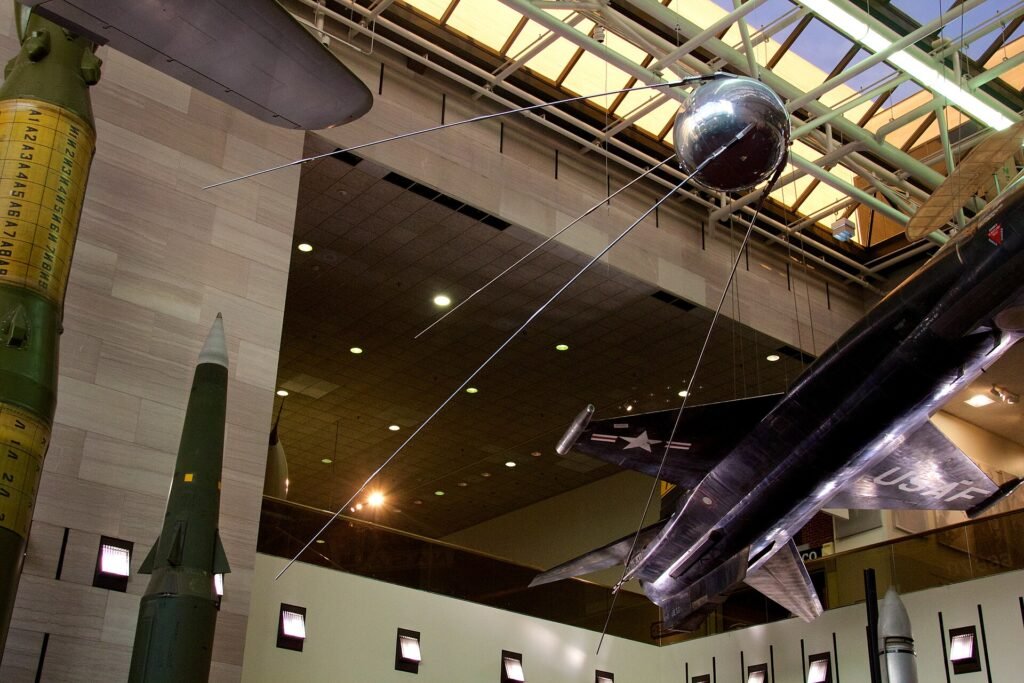
The Sputnik launch took place on 4 October 1957, when the Soviet Union sent Sputnik 1, the world’s first artificial Earth satellite, into orbit. The small metal sphere carried only a radio beacon, yet its success shocked the United States, intensified the Cold War and opened what became known as the Space Age.
Background to the Sputnik launch
The race to orbit grew out of a scientific project. In 1952 an international science council known as CSAGI began planning the International Geophysical Year, a period of coordinated research running from 1 July 1957 to 31 December 1958. In October 1954 the council adopted a resolution calling for the launch of artificial satellites during that period, according to a history of the launch by Roger Launius for NASA. The Soviet Union quickly announced that it would orbit a satellite, and the United States responded with its own program, Project Vanguard.
Both countries were also developing long-range missiles. The U.S. Department of State’s Office of the Historian notes that German scientists had aided research in both countries after the Second World War. The same rocket technology that could lift a satellite could also carry a warhead, which is why the launch carried military meaning as well as scientific meaning. In the United States, tests of rockets and missiles had repeatedly failed, and few Americans expected the Soviets to succeed first.
Course of events
Sputnik 1 was launched from the Soviet Union’s rocket testing facility near Tyuratam in the Kazakh Republic. NASA describes it as an aluminum sphere about 22 inches across, trailing four spring-loaded whip antennas. It weighed about 183 pounds (83.6 kilograms in NASA’s chronology) and followed an elliptical orbit that took it around Earth every 96 minutes. The State Department summary gives the orbital period as about 90 minutes, so sources differ on that detail. A small radio transmitter beeped at regular intervals.
News reached Washington during a reception at the Soviet embassy for delegates of a scientific conference. A little before 6 p.m., a New York Times reporter learned that the Soviet news agency Tass had announced the launch. The American delegate Lloyd Berkner then told the room that a Russian satellite was in orbit and congratulated Soviet colleagues on the achievement. NASA calls the night of 4 and 5 October 1957 Sputnik Night. Scientists went to the embassy roof to look for the satellite, but it was not visible to the naked eye.
The next morning, the Soviet delegate Anatoli Blagonravov explained details of the launch and the spacecraft to the conference, which officially congratulated the Soviet Union. NASA adds that Sputnik 1 had passed within easy detection range of the United States twice before anyone there knew it existed. Many Americans also understood that the Soviet Union had won a major propaganda victory and could now claim leadership in a leading field of technology.
The satellite fell from orbit on 4 January 1958, three months after launch. Before then the Soviet Union had struck again. On 3 November 1957 it launched Sputnik 2, which weighed about 508 kilograms and carried a dog named Laika. A third satellite, Sputnik 3, reached orbit on 15 May 1958 with a mass of about 1,327 kilograms and a large set of scientific instruments, although its tape recorder failed.
Aftermath
Launius writes that the reaction in the United States can only be described as hysteria. The phrases pre-Sputnik and post-Sputnik entered everyday speech, and so did the term Space Age. The launch had what he calls a Pearl Harbor effect on public opinion. President Dwight Eisenhower and other officials congratulated the Soviets and tried to downplay the event, but they misjudged the public mood.
The Soviet success created an impression of a technology gap. Sputnik 1 weighed nearly 200 pounds, while the first Vanguard satellite had been planned at only 3.5 pounds. The State Department’s historians add that the launch fed fears that the U.S. military had fallen behind and that it led American policymakers to speed up space and weapons programs.
The American response was at first embarrassing. A publicly witnessed test of the Vanguard rocket on 6 December 1957 failed when the rocket rose about three feet and disintegrated in flames. The Army then flew its own satellite plan, and Explorer 1 reached orbit on 31 January 1958. NASA’s chronology lists its mass as 14 kilograms, and an instrument built by James Van Allen on board discovered the radiation zones now called the Van Allen belts. Vanguard 1 finally reached orbit on 17 March 1958.
Significance and legacy
The launch changed government as well as technology. NASA’s history says the Space Age and a rise in spending on aerospace work, technical and scientific education programs, and new federal agencies followed directly from the shock of Sputnik. Eisenhower worked with Congress on legislation to create a permanent civilian space agency, which became the National Aeronautics and Space Administration, or NASA, built from the older National Advisory Committee for Aeronautics.
The launch also deepened the arms race. The State Department’s historians record that the Soviet Union tested the first intercontinental ballistic missile in the same year, and that talk of a treaty to ban nuclear testing faded for several years. Fear of a missile gap became a political issue in the 1960 U.S. presidential election. The Cuban Missile Crisis of 1962 later reminded both sides of the dangers of the weapons they were building.
Not every claim made at the time held up. Some American Cold War hawks suggested that the beeping satellite was meant to gather targeting data for Soviet missiles, but NASA’s historian says that does not appear to have been the case.
Satellites later became everyday infrastructure, including systems for satellite communication. For historians, Sputnik remains the clearest example of a technical demonstration that changed politics, education and national priorities almost overnight.
More in Astronomy & Space
Key facts
- The Soviet Union launched Sputnik 1, the first artificial Earth satellite, on 4 October 1957.12
- Sputnik 1 was an aluminum sphere about 22 inches across that weighed about 183 pounds (83.6 kilograms).13
- It orbited Earth about every 96 minutes (NASA) and fell from orbit on 4 January 1958.1
- Sputnik 2, carrying the dog Laika, followed on 3 November 1957.3
- The first U.S. satellite, Explorer 1, launched on 31 January 1958 and discovered the Van Allen radiation belts.13
- The shock of Sputnik led to a permanent U.S. civilian space agency, NASA.1
Related concepts
In the news
Quick checkWhat was Sputnik 1?Show answer
It was the first artificial Earth satellite, launched by the Soviet Union on 4 October 1957. It carried a radio beacon and stayed in orbit about three months.
Sources
- NASA History Office, Sputnik and the Origins of the Space Age (Roger D. Launius), https://history.nasa.gov/sputnik/sputorig.html
- U.S. Department of State, Office of the Historian, Milestones: Sputnik, 1957, https://history.state.gov/milestones/1953-1960/sputnik
- NASA History Office, Chronology of Sputnik/Vanguard/Explorer Events 1957-58, https://history.nasa.gov/sputnik/chronology.html
Editorially reviewed by Specialty Digest Editorial TeamLast reviewed November 4, 2026Researched and drafted with AI assistanceReport an issue