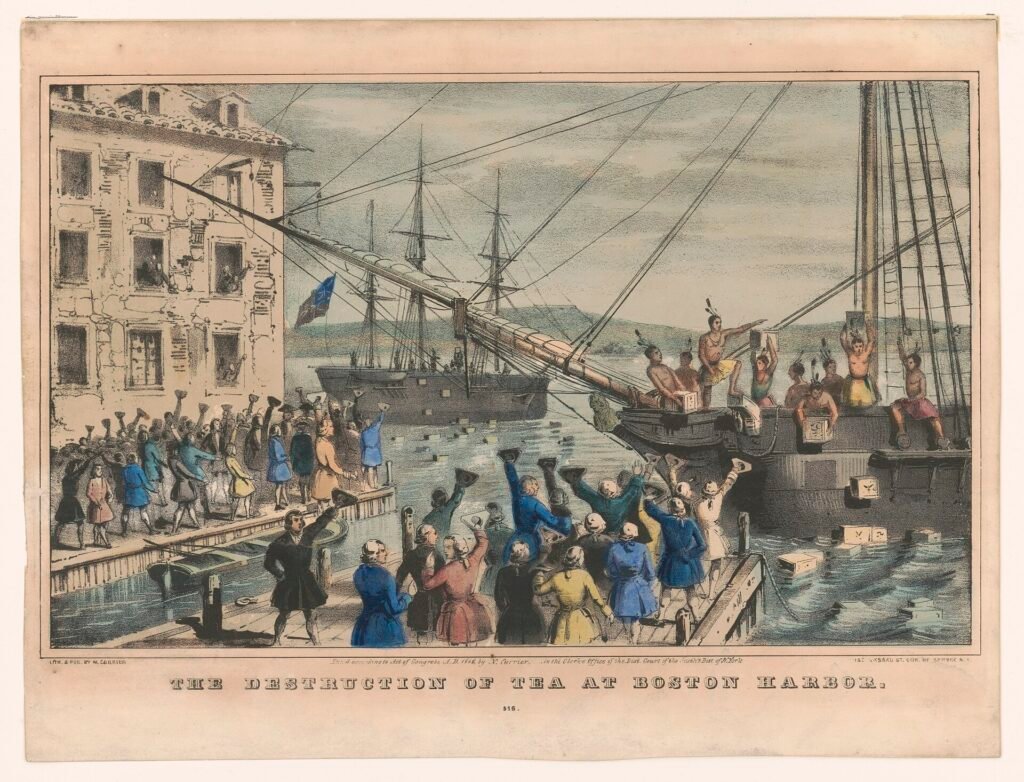
The Boston Tea Party was a protest on the night of 16 December 1773 in which colonists in Boston, Massachusetts, boarded three ships and threw their cargoes of East India Company tea into the harbor. It was a direct challenge to the Tea Act of 1773 and to British rule, and the harsh British response helped push the colonies toward revolution.
Background to the Boston Tea Party
The dispute grew out of years of conflict over taxes. The Massachusetts Historical Society (MHS) traces it through a timeline that runs from the Stamp Act of 1765 to the Townshend Acts of 1767, which taxed glass, paper, lead and tea. Colonists responded with agreements not to import British goods, and British troops landed in Boston in 1768 to restore order. The Boston Massacre followed on 5 March 1770, and on 12 April 1770 Parliament repealed the Townshend duties except for the tax on tea.
The Tea Act, passed on 10 May 1773, was meant to rescue the East India Company from bankruptcy. It allowed the company to sell a half million pounds of tea directly to the colonies without paying the usual duties and tariffs. That meant the company could undersell every other seller, including the smugglers whose tea colonists had been drinking almost exclusively since 1767. Parliament expected colonists to buy the cheaper tea and so rescue the company. Instead, the act revived the old argument over taxation without representation. The colonies were by then governed within the wider structure of British colonial rule, which is why the dispute carried so much political weight.
Course of events
Tension built through the autumn of 1773. On 3 November the Sons of Liberty demanded that the men who had agreed to receive the tea resign. On 5 November a meeting at Faneuil Hall resolved to prevent the sale of tea. The ship Dartmouth arrived in Boston on 28 November with 114 chests of tea, which prompted a mass meeting of thousands the next day. The Eleanor arrived on 3 December and the Beaver on 7 December. A fourth tea ship, the William, was wrecked in a winter storm on Cape Cod on 10 December.
Colonists blocked the unloading and demanded that the tea be returned to England. Governor Thomas Hutchinson refused to let the ships leave without discharging their cargoes. On 16 December a mass meeting at the Old South Church drew thousands of people from Boston and surrounding towns. After a day of heated speeches, Samuel Adams rose and announced that he did not see what more the inhabitants could do to save their country. According to the MHS, war whoops then filled the hall, and between 30 and 60 disguised men hurried toward Griffin’s Wharf and its three tea ships.
The men were dressed as Native Americans and boarded the Dartmouth, Eleanor and Beaver. That night they dumped 340 large wooden chests holding about 90,000 pounds of tea into Boston Harbor, the MHS reports. A Library of Congress blog gives the number of chests as 342, so the exact count varies by source. The MHS holds a small glass bottle of tea leaves that were gathered on the shore at Dorchester Neck on the morning of 17 December 1773.
Aftermath of the Boston Tea Party
Tea was also destroyed elsewhere in the colonies, but Parliament singled out Boston for punishment. It passed what Americans called the Intolerable Acts and the British called the Coercive Acts. The Library of Congress lists four: the Boston Port Act, which closed the harbor until the destroyed tea was paid for; the Massachusetts Government Act, which replaced elected local government with an appointed one; the Act for the Impartial Administration of Justice, which let the governor move trials to another colony or to Great Britain; and the Quartering Act, which required colonists to house British troops in unoccupied buildings at their own expense. The MHS adds that the port was closed and the town was garrisoned with thousands of soldiers.
These measures were meant to restore strict control. The Library of Congress says they had the opposite effect. The MHS agrees that the extreme reaction of the British government galvanized public opinion across the colonies. Its account of the Revolution lists the Coercive Acts, the First Continental Congress and the fighting at Lexington and Concord as the steps that followed in turn.
Significance and legacy
The event is remembered as a turning point on the road to American independence. It showed that colonists were willing to take direct action rather than petition, and it prompted a response that united many people who had not previously been involved in the dispute. A few years later, the French Revolution began in France with events such as the storming of the Bastille.
The name Boston Tea Party is a later invention, as the MHS notes in saying that the event was only afterward given that label. Participants and witnesses described it at the time in plainer terms. John Rowe wrote in his diary that the tea was flung overboard, and a letter from John Andrews written on 18 December 1773 gives another contemporary account. A German engraving made soon after the event, which the MHS calls imaginative though not wholly accurate, shows how quickly the story spread beyond Boston.
Accounts differ in detail. The MHS puts the number of disguised men at between 30 and 60, and the chest count varies from source to source. Objects held in Massachusetts, including broadsides, diary entries and a porcelain punch bowl from which participants are said to have drunk before heading to the wharf, give a physical link to the protest. The Library of Congress marked the 250th anniversary in December 2023, noting that Boston commemorated it with reenactments throughout the day.
More in History
Key facts
- On 16 December 1773 disguised colonists boarded three ships at Griffin's Wharf and destroyed about 340 chests of East India Company tea.1
- The protest followed the Tea Act of 10 May 1773, which let the company sell tea directly to the colonies without the usual duties.1
- The three ships were the Dartmouth, Eleanor and Beaver, and about 90,000 pounds of tea were dumped into the harbor.1
- Parliament responded with the Coercive Acts, called the Intolerable Acts in America, which closed the port of Boston.12
- The Library of Congress counts 342 chests, while the Massachusetts Historical Society counts 340.12
Related concepts
Quick checkWhat triggered the Boston Tea Party?Show answer
The Tea Act of 1773 let the East India Company sell tea directly to the colonies without the usual duties, reviving colonists' objection to taxation without representation.
Sources
- Massachusetts Historical Society, Collections Relating to the Boston Tea Party, https://www.masshist.org/features/boston-tea-party
- Library of Congress, In Custodia Legis, The 250th Anniversary of the Boston Tea Party, https://blogs.loc.gov/law/2023/12/the-250th-anniversary-of-the-boston-tea-party/
Editorially reviewed by Specialty Digest Editorial TeamLast reviewed November 4, 2026Researched and drafted with AI assistanceReport an issue