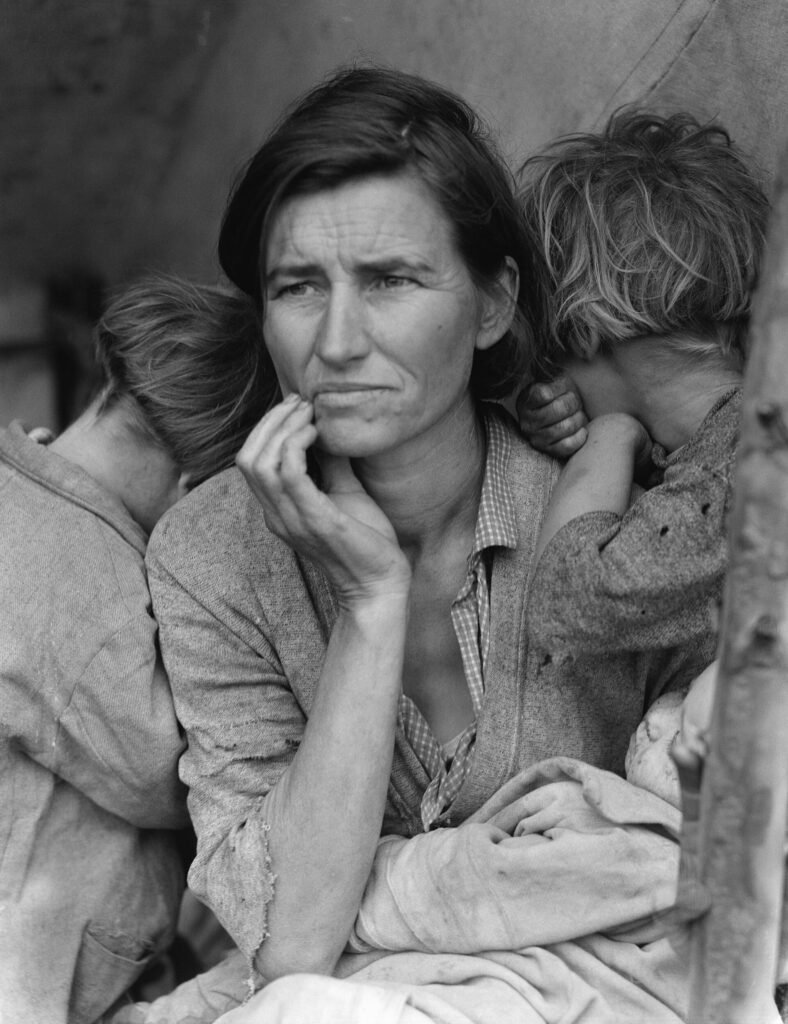
The Great Depression was the longest and deepest economic downturn in the history of the United States and the modern industrial world. It began in 1929, spread across the globe through the 1930s and ended only during the Second World War. Industrial production collapsed, unemployment soared, and banks failed in large numbers.
Background to the Great Depression
The decade before the Depression, the Roaring Twenties, was a period of rapid growth, new consumer technologies and rising share prices. The Federal Reserve History project dates the start of the downturn to August 1929, when this expansion ended. The Wall Street Crash of 1929 followed in October, but the sources treat it as one event within a longer chain rather than the sole cause.
Policy decisions made before the crash also mattered. In 1928 and 1929 the Federal Reserve raised interest rates to limit stock speculation. Because the international gold standard linked the monetary policies of participating countries, those increases pushed other economies into recession as well. The Fed repeated the mistake in the fall of 1931 when it responded to an international financial crisis by raising rates again.
Course of the Great Depression
The Federal Reserve History project describes a series of financial crises. These included the 1929 crash, a series of regional banking panics in 1930 and 1931, and national and international crises from 1931 through 1933. The downturn bottomed out in March 1933, when the commercial banking system collapsed and President Franklin Roosevelt declared a national banking holiday.
The Franklin D. Roosevelt Presidential Library says that by the time Roosevelt took office on 4 March 1933, the banking system had collapsed, nearly one quarter of the labor force was unemployed, and prices and output had fallen to about a third of their 1929 levels. At the height of the Depression in 1933, 24.9 percent of the workforce, or 12,830,000 people, had no job. Farmers were not counted in that figure, yet falling crop prices cost many of them their land and homes.
The money supply shrank sharply. From the fall of 1930 through the winter of 1933 it fell by nearly 30 percent, and prices fell by about the same amount. This deflation made debts harder to repay, reduced spending and pushed banks, firms and households into bankruptcy. The Federal Reserve History project argues that the Fed could have prevented the deflation by preventing the collapse of the banking system or by expanding the money supply, but it did not, partly because its leaders disagreed about how to respond.
The Fed’s structure made coordination hard. At the start of the Depression each Federal Reserve district had a governor who set policy for the district, and the Board in Washington lacked the authority and tools to act alone. When the governors disagreed, districts sometimes pursued separate and even contradictory courses.
The Depression was not confined to the United States. The Federal Reserve History project says the contraction began in the United States and spread around the globe, largely because the gold standard tied the monetary policies of many countries together. Families felt the strain in other ways as well, and the same source notes that marriage rates fell during the period.
Daily life changed for millions. Families lost homes to foreclosure, and shantytowns nicknamed Hoovervilles appeared across the country. On the Great Plains, drought and dust storms compounded the economic damage, and many families left their farms and headed for California. Young people whose families could no longer support them traveled the railroads in search of work.
Policy responses and the New Deal
Under President Herbert Hoover, Congress passed the Reconstruction Finance Corporation Act and the Banking Act of 1932. After the election of 1932 Roosevelt promised a New Deal for the American people. At 1:00 a.m. on 6 March 1933, two days after his inauguration, he issued Proclamation 2039, which suspended all banking transactions for a week to stop runs on banks.
During his first hundred days in office Roosevelt pushed through a package of laws. The Emergency Banking Act of 1933 and the Banking Act of 1933, usually called Glass-Steagall, followed, along with the Gold Reserve Act of 1934 and the Banking Act of 1935. New agencies included the Agricultural Adjustment Administration, the Civilian Conservation Corps, the Tennessee Valley Authority, the Works Progress Administration and the Federal Deposit Insurance Corporation.
The programs aided recovery but did not end the Depression. The Roosevelt Library notes that they rested on differing and not always consistent theories, and that no sustained macroeconomic theory guided them. A new recession struck in 1937. The economist John Maynard Keynes had published his General Theory in 1936, and Roosevelt afterward adopted the idea of using deficit spending, a form of fiscal policy, to raise demand. Full recovery came only with the very large public spending of the Second World War.
Aftermath and legacy of the Great Depression
The Depression transformed American finance. The reforms of the 1930s shifted some of the Federal Reserve’s duties to the Treasury and to new agencies such as the Federal Deposit Insurance Corporation, and the changes across the following decades turned the Fed into a modern central bank. Deposit insurance and separate rules for banks and securities markets became lasting features of the financial system.
The Depression also changed how people think about the role of government. Public expectations of federal action on unemployment, relief and banking grew sharply, and the New Deal agencies created a precedent for active government involvement in the economy.
Economists still debate the causes. Bernanke told an audience honoring Milton Friedman in 2002 that the Federal Reserve was partly responsible for the downturn and that it would not repeat the mistake. The Federal Reserve History project says that policy mistakes by the Fed contributed, along with the gold standard and the structure of the banking system, though it also stresses that experts at the time disagreed about the correct course of action. These questions returned to the foreground during the financial crisis of 2008, when central banks acted far more aggressively than in the 1930s.
More in Economics
Key facts
- The Federal Reserve History project dates the start of the Great Depression to August 1929 and its end to the Second World War.1
- The downturn bottomed out in March 1933, when the commercial banking system collapsed and President Roosevelt declared a banking holiday.1
- Unemployment reached 24.9 percent of the workforce, or 12,830,000 people, in 1933.2
- From the fall of 1930 through the winter of 1933 the money supply fell by nearly 30 percent.1
- Roosevelt suspended all banking transactions for a week from 6 March 1933 under Proclamation 2039.3
- A new recession in 1937 interrupted the recovery, which was completed during the Second World War.2
Related concepts
In the news
Quick checkWhat caused the Great Depression?Show answer
There were several causes, including the end of the 1920s boom, the 1929 stock crash, banking panics, a fall in the money supply and the gold standard, and economists still debate their relative weight.
Sources
- Federal Reserve History, The Great Depression, https://www.federalreservehistory.org/essays/great-depression
- Franklin D. Roosevelt Presidential Library and Museum, Great Depression Facts, https://www.fdrlibrary.org/great-depression-facts
- Federal Reserve History, Bank Holiday of 1933, https://www.federalreservehistory.org/essays/bank-holiday-of-1933
- Federal Reserve History, Stock Market Crash of 1929, https://www.federalreservehistory.org/essays/stock-market-crash-of-1929
Editorially reviewed by Specialty Digest Editorial TeamLast reviewed November 4, 2026Researched and drafted with AI assistanceReport an issue