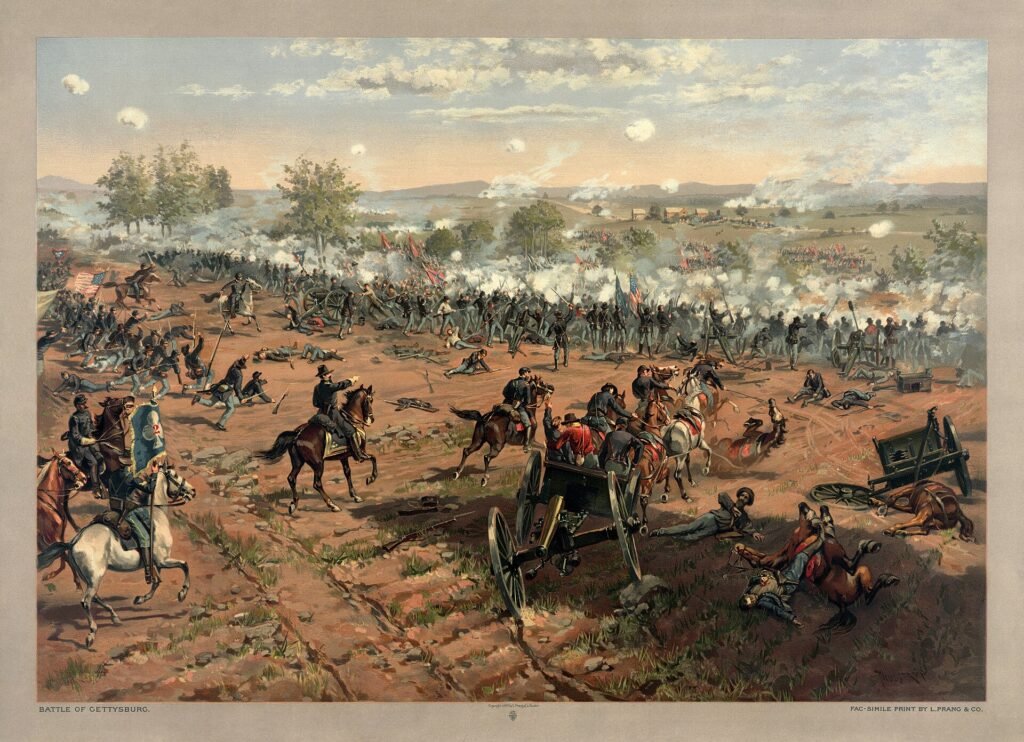
The Battle of Gettysburg was fought from 1 to 3 July 1863 around the town of Gettysburg, Pennsylvania, between the Union Army of the Potomac and the Confederate Army of Northern Virginia. It was the largest battle of the American Civil War and, by most estimates, the bloodiest, with more than 50,000 casualties. The Union victory ended General Robert E. Lee’s second invasion of the North and is widely regarded as a turning point in the war.
Background of the Battle of Gettysburg
The American Civil War began on 12 April 1861, when Confederate forces fired on Fort Sumter in South Carolina. The National Park Service (NPS) explains that, although disputes over federal and state power ran back to the founding of the country, by the 1850s the main cause of discontent was slavery. After the election of President Abraham Lincoln in November 1860, eleven Southern states left the Union and formed the Confederate States of America.
By the spring of 1863, Union forces seemed to be winning on most fronts. Major General Ulysses S. Grant was besieging Vicksburg, Mississippi, a city whose loss would cut the Confederacy in two, and the Union navy was blockading Southern ports. Only in the Eastern Theater did the Confederates appear to be winning, thanks to Lee’s army. After a victory at Chancellorsville, Virginia, in May 1863, Lee decided to invade the North to revive Confederate morale and to relieve pressure on Vicksburg.
Lee began moving north on 3 June 1863, using the mountains of the Shenandoah Valley to screen his advance. The Army of the Potomac followed, staying between Lee and the capital, Washington, D.C. On 28 June, Major General George Gordon Meade was named its new commander. By 30 June, a Confederate division was about nine miles west of Gettysburg, while Union cavalry under Brigadier General John Buford approached from the south. The time and place of the battle were set.
Course of the Battle of Gettysburg
The battle opened on the morning of 1 July, when Confederates attacked Union troops on McPherson Ridge, west of town. The Union forces were outnumbered but held until the afternoon, when they were overpowered and driven back through the streets to Cemetery Hill, south of town. During the night, the main body of the Union army arrived and took up strong positions.
On 2 July, the two armies faced each other on parallel ridges about a mile apart, with Union forces on Cemetery Ridge and Confederates on Seminary Ridge. Lee ordered attacks on both Union flanks. Lieutenant General James Longstreet’s assault on the Union left produced savage fighting around Little Round Top, the Wheatfield, Devil’s Den and the Peach Orchard. On the Union right, Lieutenant General Richard Ewell’s evening attack on East Cemetery Hill and Culp’s Hill was momentarily successful but could not be exploited. By nightfall, the Union army still held Little Round Top.
On the morning of 3 July, Confederate infantry were driven from their last foothold on Culp’s Hill. That afternoon, Lee’s artillery opened a two-hour bombardment of the Union lines, and then some 12,000 Confederate soldiers advanced across open fields toward the Union center in the assault known as Pickett’s Charge. The American Battlefield Trust puts the number at 12,500. The attack briefly broke the Union line before it was driven back with severe losses, and the NPS says Lee lost more than 5,000 soldiers in about an hour.
On 4 July, Lee began a retreat toward the Potomac River at Williamsport. His wagon train of wounded stretched more than fourteen miles. The American Battlefield Trust notes that Meade did not pursue vigorously, which gave up a chance to trap Lee’s army.
Casualties and aftermath
Casualty and strength figures vary by source. The NPS Civil War battle database lists about 158,000 men engaged, of whom 83,289 were Union and 75,054 Confederate, with an estimated 51,000 casualties in total, about 23,000 Union and 28,000 Confederate. The American Battlefield Trust gives a slightly larger force of about 165,600 and describes the casualties as more than 50,000. These totals include killed, wounded, captured and missing men, and they are estimates.
The local community was devastated. When the armies left, they left behind a town in shambles, with wounded and dying soldiers crowded into nearly every building and graves in many fields. To meet the need, Camp Letterman General Hospital was set up east of town. Union surgeons, with help from the U.S. Sanitary Commission and the Christian Commission, treated over 20,000 wounded Union and Confederate soldiers there, and the last patients had left by January 1864.
On 19 November 1863, Lincoln traveled to Gettysburg for the dedication of the Soldiers’ National Cemetery. His brief speech, the Gettysburg Address, gave meaning to the sacrifices made there and expressed his belief that the war would bring a “new birth of freedom” for the nation.
Significance and legacy of the Battle of Gettysburg
Gettysburg did not end the war. The NPS stresses that the fighting continued for another eighteen months, through battles such as Chickamauga, the siege of Atlanta, the Wilderness and the siege of Petersburg. Lee surrendered to Grant at Appomattox Court House, Virginia, on 9 April 1865, and all remaining Confederate forces surrendered by May of that year. The country then faced Reconstruction, the difficult process of bringing the Southern states back into the Union.
Even so, Gettysburg ended Lee’s attempt to carry the war into Union territory. The American Battlefield Trust calls the battle the turning point of the Civil War, although the NPS reminds readers that the fighting went on for many months afterward.
The battle remains a subject of debate and memory. The NPS notes that people still argue about the war’s causes and about the meaning of Lincoln’s address, including the phrases “a new birth of freedom” and “the unfinished work.” It also says that slavery caused the war, while descendants of both sides still argue over their ancestors’ personal motivations, and that the debate has extended to Southern monuments. Gettysburg National Military Park preserves the battlefield today.
Key facts
- The Battle of Gettysburg was fought from 1 to 3 July 1863 in and around Gettysburg, Pennsylvania.123
- The Union Army of the Potomac under Major General George Meade defeated Robert E. Lee's Army of Northern Virginia.12
- Estimated casualties exceeded 50,000, with the NPS giving about 23,000 Union and 28,000 Confederate.23
- Pickett's Charge on 3 July cost Lee more than 5,000 soldiers in about an hour.1
- President Lincoln delivered the Gettysburg Address at the cemetery dedication on 19 November 1863.1
Related concepts
Quick checkHow many days did the Battle of Gettysburg last?Show answer
Three days, from 1 to 3 July 1863, followed by Lee's retreat on 4 July.
Sources
- National Park Service, Gettysburg Overview, Gettysburg National Military Park, https://www.nps.gov/gett/learn/historyculture/gettysburg-overview.htm
- National Park Service, The Civil War: Battle Detail, Gettysburg, https://www.nps.gov/civilwar/search-battles-detail.htm?battleCode=pa002
- American Battlefield Trust, Gettysburg Battle Facts and Summary, https://www.battlefields.org/learn/civil-war/battles/gettysburg
Editorially reviewed by Specialty Digest Editorial TeamLast reviewed November 4, 2026Researched and drafted with AI assistanceReport an issue