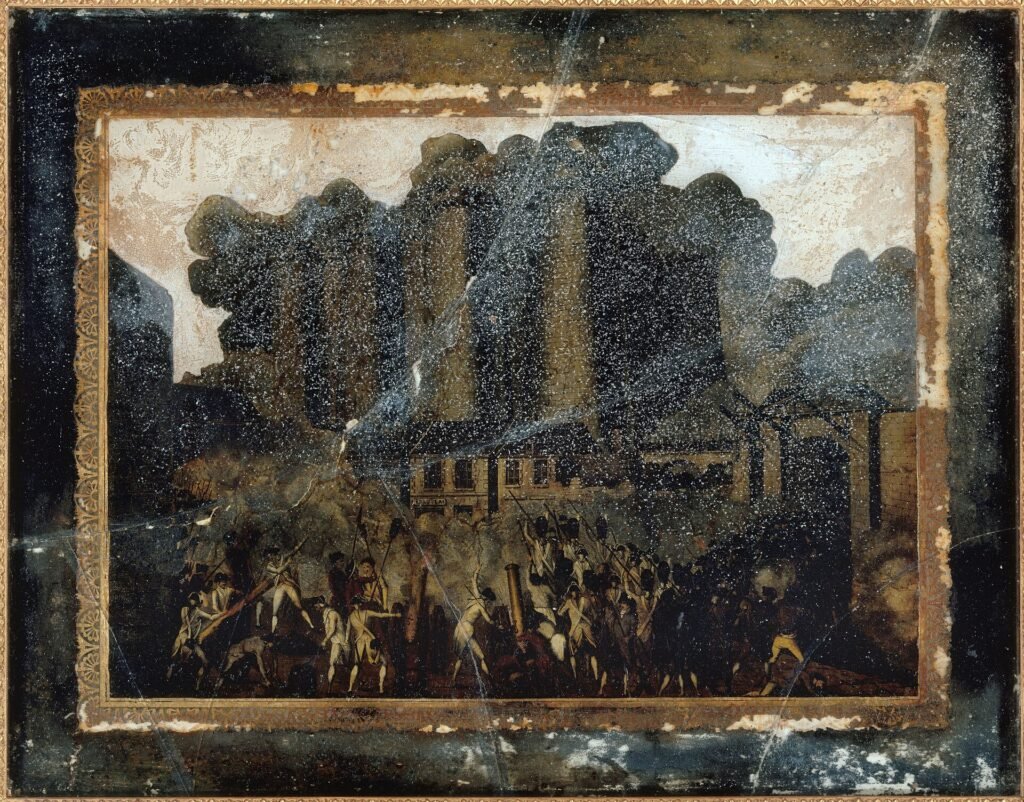
The storming of the Bastille took place in Paris on 14 July 1789, when a crowd attacked the Bastille, a royal fortress and state prison, seized its gunpowder and arrested its governor. Although the fortress held only seven prisoners, its fall became the best-known symbol of the early French Revolution and the end of royal absolutism in France.
Background to the storming of the Bastille
The Bastille began as a fortress in the 1300s, built to protect the eastern edge of Paris from English attack, according to the history site Alpha History. It later became a royal prison that held mainly political prisoners, writers and people detained by royal order without trial, rather than common criminals. By the late 1780s it rarely held more than a handful of inmates, yet many Parisians saw it as a symbol of arbitrary royal power.
The summer of 1789 was tense. Severe food shortages had pushed bread prices high, and in June the Third Estate, which represented commoners and the lower clergy, declared itself the National Assembly. King Louis XVI then ordered troops to gather around Paris and on 11 July dismissed Jacques Necker, a popular minister who had supported reform. Crowds gathered in the streets the next day, and soldiers of the French Guard refused to fire on them. Parisians spent 12 and 13 July looting shops and armories for weapons to defend the city against an expected royal attack. According to History UK, the Marquis de Sade, one of the few prisoners in the Bastille, had been moved to an asylum days earlier after shouting to a crowd outside his window that prisoners were being massacred.
Course of events
On the morning of 14 July, a crowd of several thousand people marched on the Hôtel des Invalides, a military hospital with a large store of rifles. They took about 30,000 of them but found almost no gunpowder. Deserting guardsmen reported that 250 barrels had recently been moved to the Bastille. The crowd reached the fortress at about 11 in the morning.
The governor, Bernard-René Jourdan de Launay, received deputations from the crowd. Alpha History says he agreed to pull back the fortress’s cannons from their threatening positions but refused to hand over the gunpowder. At about half past one, a small group climbed into the courtyard over a half-raised drawbridge, and the governor ordered his soldiers to fire. The crowd swelled in response, and for about three hours the fortress was under siege.
Two detachments of the French Guard changed sides and brought cannons, which proved decisive because the crowd could not operate the artillery it had taken. In the late afternoon de Launay surrendered. The attackers released the prisoners, who numbered seven, four of them counterfeiters. Alpha History notes that those who entered, just under 1,000 people, were later honored with the title Vainqueurs de la Bastille, meaning Vanquishers of the Bastille.
Accounts differ on the garrison. A summary from History UK says it had 82 soldiers and was reinforced by Swiss troops on 7 July. Alpha History gives about 120 soldiers, most of them old or infirm. A report by the British ambassador in July 1789, held by the UK National Archives, says the garrison was no more than eighty invalids.
Aftermath
De Launay was arrested and led toward the Hôtel de Ville, the Paris town hall, where a revolutionary council was to judge him. A mob seized him on the way, and he was killed. Alpha History says the exact cause of his death is disputed, while a London Gazette report from 18 to 21 July says a council sentenced him to be beheaded. Accounts from the time agree that de Launay was killed.
Casualty figures also differ. History UK states that one hundred rioters were killed or wounded when the garrison fired on the crowd. The British ambassador, however, wrote on 30 July that printed accounts greatly exaggerated the number of dead and that not more than seven or eight people had lost their lives. The sources cannot be fully reconciled, and the loss of life on the day is best described as uncertain.
The immediate effect on the king was large. The London Gazette reported that Louis XVI went to the Hôtel de Ville and promised to do what he could to calm the city, and that on the day of the king’s visit not fewer than 150,000 men were bearing arms in Paris. The Bastille itself was later demolished on the orders of the new Paris Commune.
Significance and legacy
Historians stress that the practical gains of the day were limited. Alpha History calls the fall of the Bastille chiefly a symbolic victory and notes that the revolution had days of greater political consequence and greater violence. Its lasting importance lay in the story. The capture of a feared fortress by ordinary people became a classic image of revolution, and it gave the cause new momentum.
The event also showed how weak royal authority had become. French Guard soldiers had refused to fire on the crowds, and some of them helped to bring down the fortress. The British ambassador’s report is a reminder that observers abroad saw the day as part of a larger crisis. He also noted that the small number of prisoners in the Bastille suggested that the reign of Louis XVI was relatively mild, an observation that sits oddly with the fortress’s reputation.
The fall of the Bastille remains one of the most remembered dates in French history. Its legend is partly myth and partly fact, and the contrast between the two, a fortress with few prisoners and a crowd that sought gunpowder, is why historians treat it with care.
Key facts
- A crowd stormed the Bastille in Paris on 14 July 1789 to obtain gunpowder and arms.1
- The fortress held only seven prisoners, four of them counterfeiters.1
- The governor, Bernard-René Jourdan de Launay, was arrested and killed by a mob on the way to the Hôtel de Ville.12
- The British ambassador wrote that no more than seven or eight people died in the attack, while another summary says 100 rioters were killed or wounded.23
- Alpha History calls the fall chiefly a symbolic victory, but one that became a powerful image of revolution.1
Related concepts
Quick checkWhy did the crowd attack the Bastille on 14 July 1789?Show answer
They wanted its gunpowder. The crowd had seized thousands of rifles but had almost no powder, and 250 barrels were reported to be stored inside the fortress.
Sources
- Alpha History, The fall of the Bastille (Jennifer Llewellyn and Steve Thompson), https://alphahistory.com/frenchrevolution/fall-of-the-bastille/
- History UK, The storming of the Bastille, https://www.history.co.uk/this-day-in-history/14-july/the-storming-of-the-bastille
- The National Archives (UK), French Revolution: The British reaction (London Gazette, 1789 letter and ambassador report), https://www.nationalarchives.gov.uk/education/resources/french-revolution/
Editorially reviewed by Specialty Digest Editorial TeamLast reviewed November 4, 2026Researched and drafted with AI assistanceReport an issue